Key Takeaways
- Mars likely had liquid water and a more robust atmosphere billions of years ago, but the current understanding of water loss presents significant discrepancies.
- Recent research indicates that most water lost from the Martian surface amounts to just a few tens of meters, despite estimates suggesting a much larger quantity was present.
- Understanding the history of water on Mars remains complex, necessitating further exploration and investigation beyond theoretical modeling.
Mars’ Historical Water Discrepancy
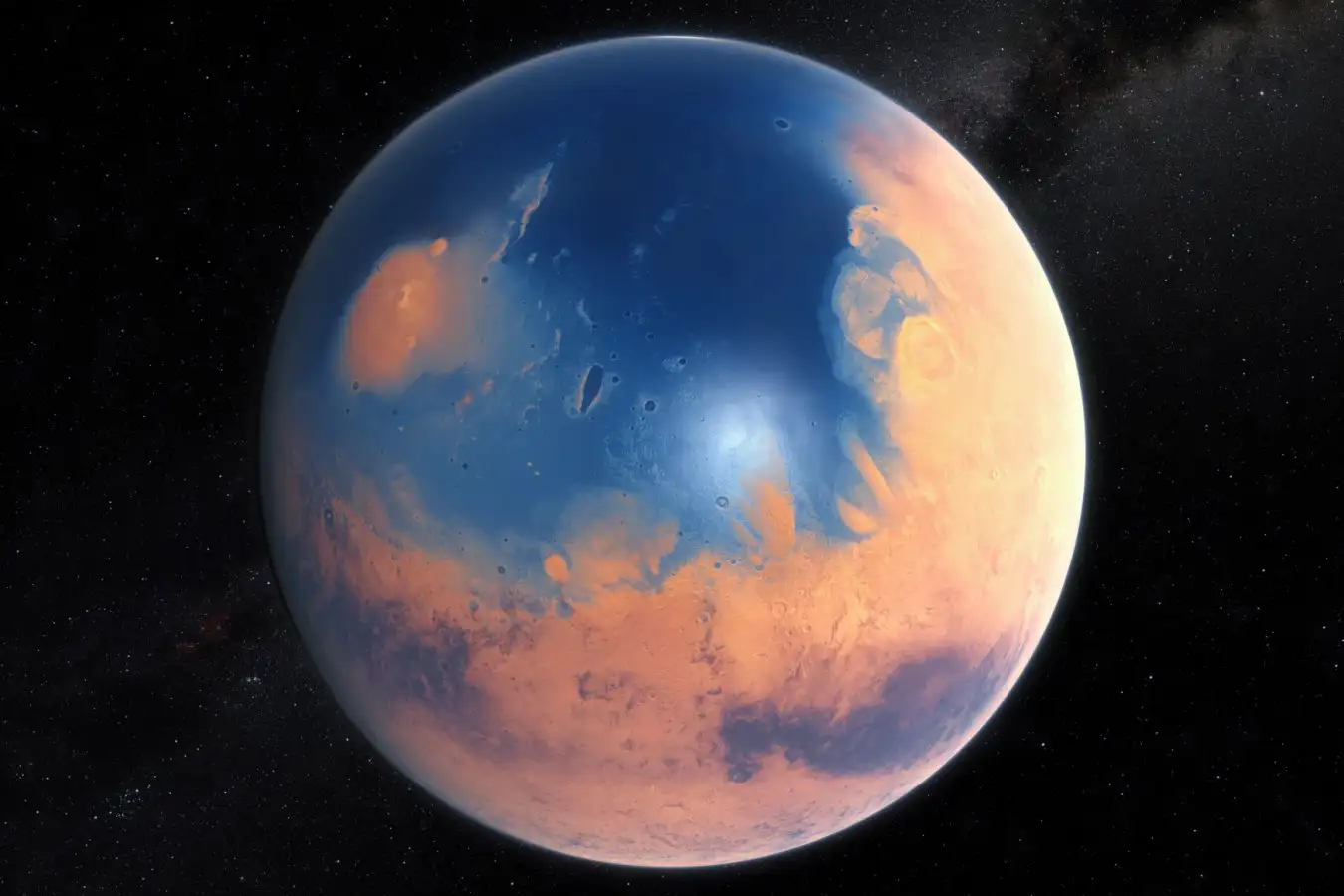
Planetary scientists widely agree that Mars once hosted liquid water on its surface, along with a thriving atmosphere. This era, termed the Noachian Period, spanned from approximately 4.5 billion to 3.7 billion years ago. Based on estimates, it is believed that enough water was present to envelop the planet in an ocean ranging from 150 to 250 meters deep. However, recent findings led by Bruce Jakosky from the University of Colorado Boulder reveal a startling mismatch: the amount of water lost since then appears significantly lower than anticipated.
Jakosky’s team calculated the various mechanisms that could account for water removal from Mars’ surface, concluding that these processes total only a few tens of meters, rather than the expected volume. Presently, Mars contains water equivalent to an ocean just 30 meters deep. Jakosky states, “How do you go from 150 meters, take away a couple of tens, and get to 30 meters? You can’t do that.” This inquiry has unveiled what seems to be a critical gap in the understanding of Martian water history.
Possible explanations for this water loss include: enhanced evaporation into space since the Noachian Period, ice deposits that remain undiscovered, and misinterpretations of how ice caps interact with the atmosphere. Additionally, interactions between various sources of water could lead to an overestimation of water quantity. Jakosky suggests that a combination of these factors likely contributes to the observed discrepancy.
Despite the surprising findings, the notion that the history of water on Mars remains poorly understood is not contentious within the scientific community. At the Lunar and Planetary Science Conference (LPSC), researchers proposed that Mars may have experienced intermittent rain followed by droughts, rather than a continuous presence of water. Eric Hiatt from Washington University noted that this would imply a hydrological cycle distinct from that of Earth, challenging previous assumptions about how groundwater interacts with Martian atmosphere and surface conditions.
Bethany Ehlmann from the University of Colorado Boulder further posited that there could be more water currently on Mars than traditionally estimated. This underlines the complexities of understanding Martian hydrology and its implications for the planet’s potential habitability throughout its history.
Resolving the mysteries surrounding water on Mars will be a considerable endeavor. Jakosky emphasized that addressing these questions requires not merely computational simulations but actual exploratory missions: “If you ask me, I think this really requires boots on the ground.” With organizations like NASA and SpaceX focusing on lunar exploration, human missions to Mars may still be years, if not decades, away, suggesting that ongoing advancements will depend on data gathered from rovers and orbiters.
The content above is a summary. For more details, see the source article.