


Key Takeaways
- The US has imposed a 126% preliminary tariff on Indian solar imports, accusing India of unfair subsidies.
- The World Trade Organization is examining China’s claims that India’s subsidies favor domestic production at the expense of imports.
- India’s production-linked incentive scheme aims to boost manufacturing but faces backlash from global trade partners.
US Tariffs and WTO Scrutiny on India’s Manufacturing Subsidies
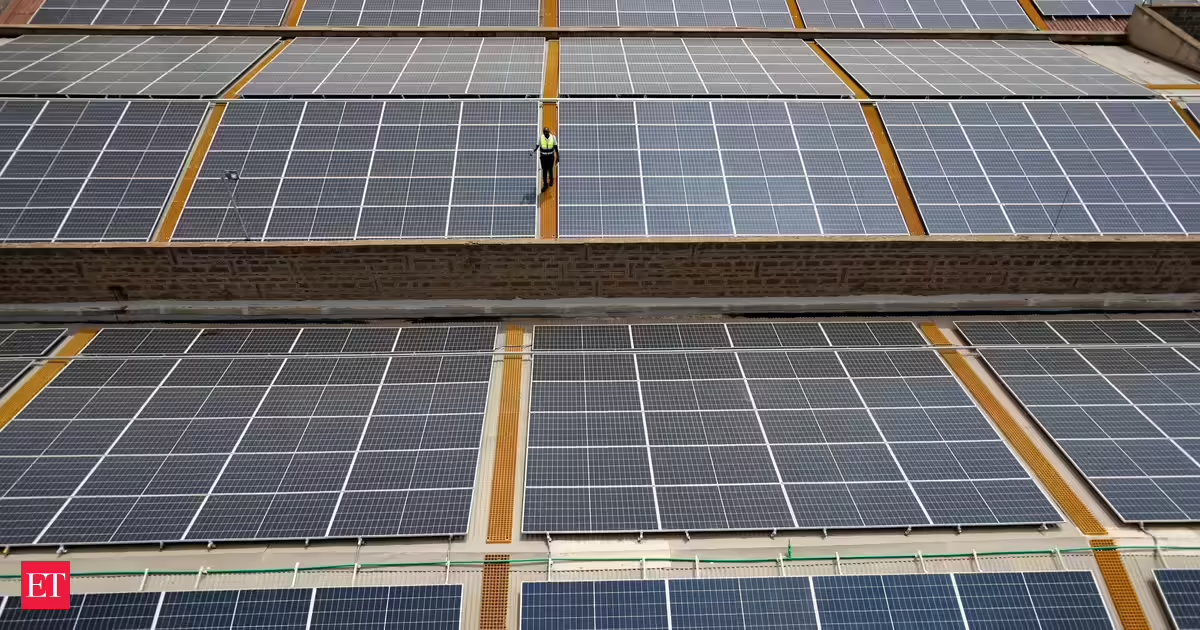
Prime Minister Narendra Modi’s initiative to position India as a global manufacturing powerhouse is facing challenges from major economies, particularly concerning subsidization practices. On Wednesday, the US government announced preliminary tariffs of 126% on solar panel imports from India, which follows a determination of unfair subsidies in Indian manufacturing. Analysts suggest these tariffs could significantly hinder Indian manufacturers’ access to the US market.
This tariff decision coincides with an announcement from the World Trade Organization (WTO). A dispute settlement panel is being formed to investigate China’s claims that India’s incentive programs, specifically in the automotive and renewable energy sectors, are biased towards local goods. This panel was established after failed negotiations between India and China aimed at resolving the latter’s grievances regarding India’s sector-specific subsidies.
The contentious issue stems from India’s production-linked incentive (PLI) scheme, introduced in 2020 to stimulate domestic manufacturing across 14 sectors, including electronics, pharmaceuticals, and solar energy. The initiative has a budget allocation of 1.91 trillion rupees (around $21 billion). Critics argue these subsidies give local producers an unfair advantage. Notable companies in the solar industry, such as Waaree Energies Ltd., Adani Enterprises Ltd., and Reliance Industries Ltd., are reported to have benefited significantly from these government incentives.
Despite the growing tensions, India is attempting to maintain robust relations with both the US and China. Recently, New Delhi and Washington reached an agreement to resolve protracted trade disputes, during which Brazil remained one of the highest sources of US tariffs. Similarly, India is seeking to normalize relations with China, which have been strained since the border clashes in 2020.
While both the US and China are also under scrutiny for their own subsidy frameworks, India remains firm in its defense of its incentive programs. The Ministry of Commerce and Industry has not provided a statement regarding the tariffs; however, unnamed officials in New Delhi assert that India’s incentive schemes are compliant with WTO regulations.
These incentive programs are key to India’s ambition of raising the manufacturing sector’s share of GDP to 25%, from its current level of approximately 17%. Experts suggest that without such schemes, revitalizing India’s manufacturing sector could be a formidable challenge. Biswajit Dhar, an independent trade economist based in New Delhi, emphasizes the need for India to explore additional support avenues, focusing on technological investment and innovation to bolster its industries.
The content above is a summary. For more details, see the source article.









