Key Takeaways
- The James Webb Space Telescope (JWST) has significantly advanced understanding of early galaxies, discovering MoM-z14, which is brighter than anticipated.
- New findings suggest that some celestial objects previously classified as distant galaxies may actually be brown dwarfs within the Milky Way.
- Upcoming projects like the Vera C. Rubin Observatory and the Nancy Grace Roman Space Telescope are expected to revolutionize astronomical research by mapping billions of galaxies.
Expanding Horizons of Galaxy Research
The advent of the James Webb Space Telescope (JWST), affectionately known as the Just Wonderful Space Telescope, is heralding a revolutionary period in galaxy research. Since its launch on Christmas 2021, JWST’s observations have transformed the understanding of galaxies, particularly those that formed shortly after the Big Bang. Contrary to earlier cosmological models, it has been revealed that these early galaxies were unexpectedly bright and filled with stars and hot gas.
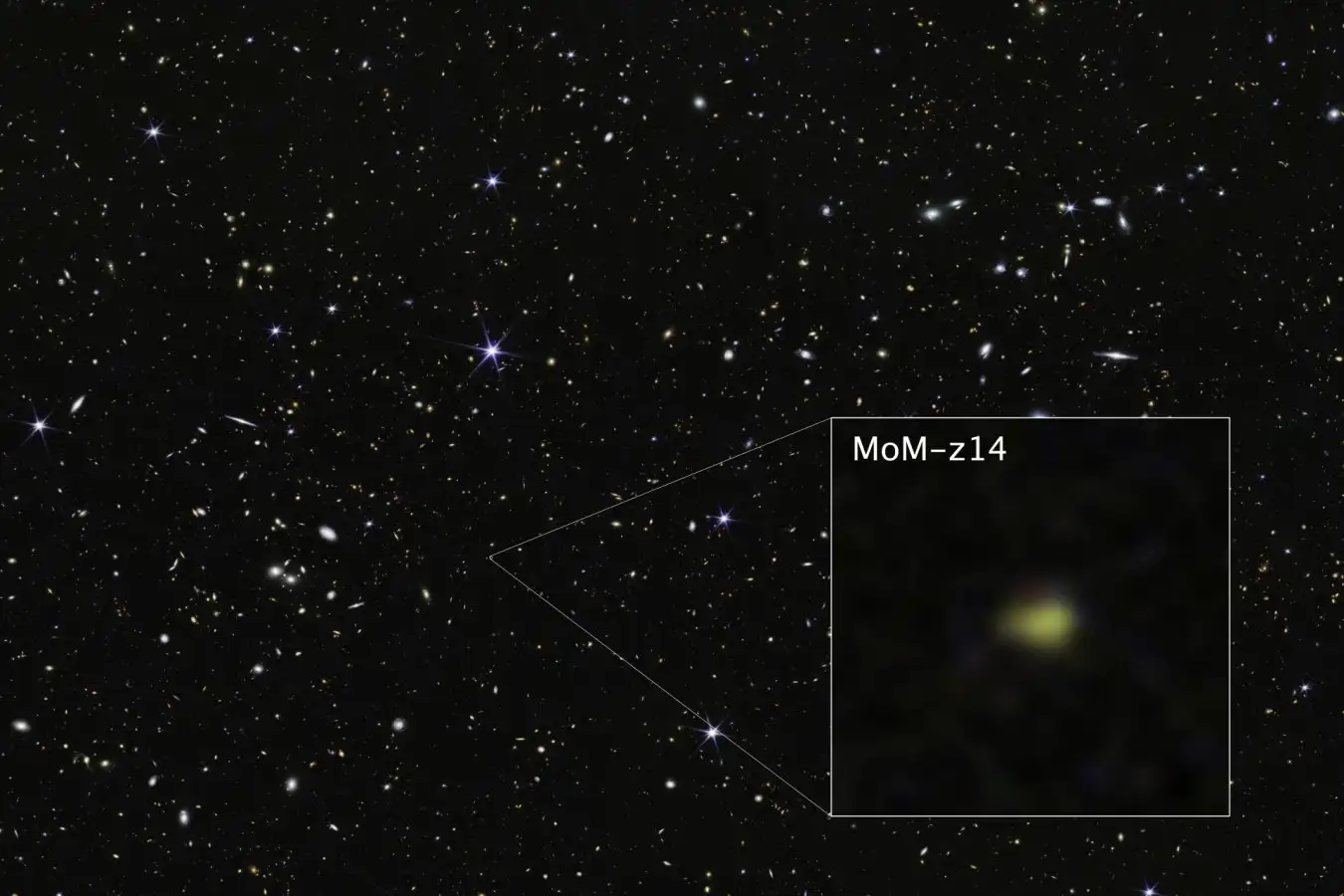
A notable discovery from this advanced research is the galaxy referred to as MoM-z14. Led by Rohan P. Naidu from the Massachusetts Institute of Technology, a global team determined that MoM-z14 is brighter than previously believed possible for such an early cosmic structure. This galaxy formed a mere 300 million years after the Big Bang, a relatively brief time when considering that the universe is around 14 billion years old.
These emerging insights pose both excitement and challenges to astronomers. While the brightness of these galaxies, like MoM-z14, is remarkable, their inherent faintness raises questions about their true nature. For instance, recent research led by Maruša Bradač of the University of California, Davis, found that two bright objects identified by JWST were actually brown dwarfs—star-like objects within our own Milky Way—rather than distant galaxies. This revelation underlines the complexity of distinguishing these faint objects in the vast cosmos.
The possibility of misidentifying celestial bodies presents a profound dilemma in the field of astrophysics. The existence of brown dwarfs, which are too massive to be classified as gas giants yet too small to undergo stellar fusion, contrasts sharply with the expansive characteristics of galaxies teeming with billions of stars. As research continues, the astronomical community remains vigilant for further verification of Bradač’s findings and the true identifications of other young galaxies.
Looking ahead, 2026 promises to be a defining year for astronomy with the launch of the Vera C. Rubin Observatory in Chile. This observatory will undertake a comprehensive ten-year Legacy Survey of Space and Time, mapping the southern sky and capturing images of over five billion galaxies. This ambitious project will run concurrently with JWST and NASA’s next flagship observatory, the Nancy Grace Roman Space Telescope, which will explore hundreds of millions of galaxies. Combined with the European Space Agency’s ongoing Euclid mission, these instruments could fundamentally alter our comprehension of galaxy formation and evolution, including insights into the origins of the Milky Way.
As the capabilities of astronomical observation expand, the potential for groundbreaking discoveries continues to grow, marking a vibrant era for the study of the cosmos.
The content above is a summary. For more details, see the source article.