


Key Takeaways
- AI and machine learning workloads are pushing the envelope in high-performance computing, requiring advanced interconnects like 224G SerDes to handle increasing demands.
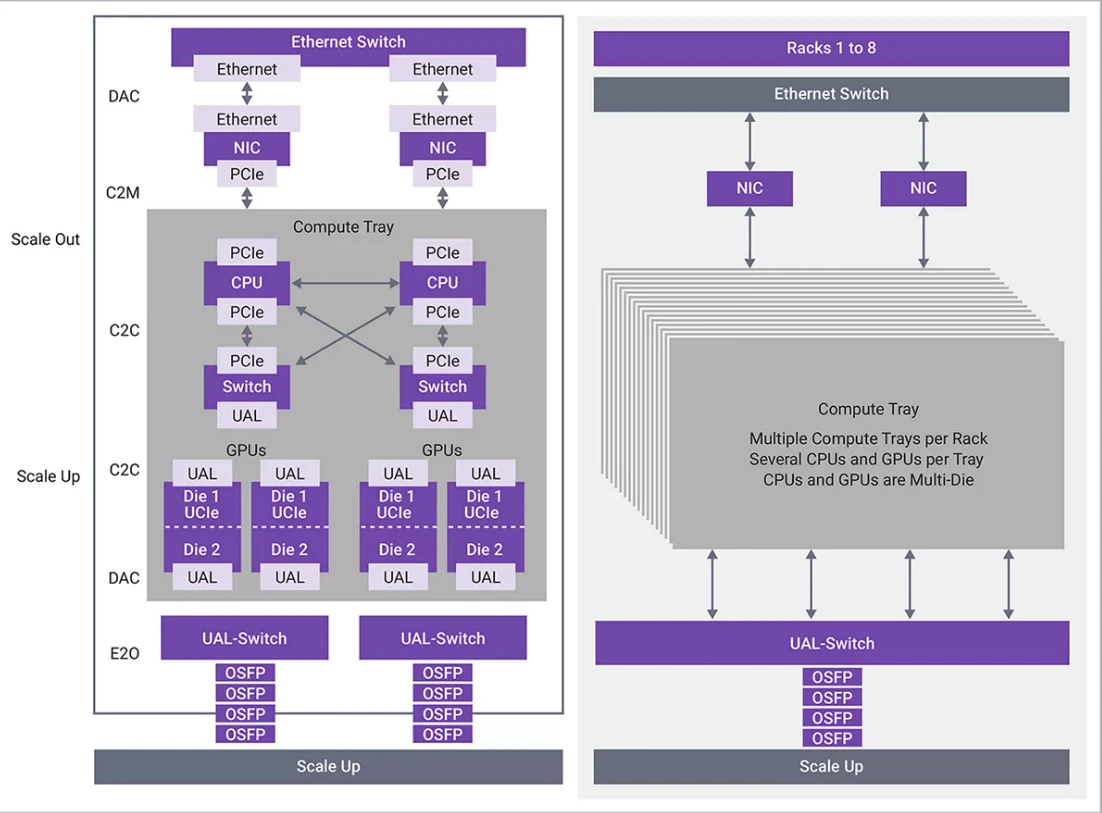
- New protocols, including Ultra Ethernet and Ultra Accelerator Link, are being developed to enhance scalability and performance in data centers.
- The transition to 448G SerDes is on the horizon, necessitating advancements in modulation and channel specifications to maintain signal integrity and performance.
The Interconnect Challenge for High-Performance Computing
The rise of AI and machine learning workloads, particularly driven by large language models, is reshaping data center architectures to accommodate real-time inference and extensive training. The demand for memory can reach up to 700 TB, necessitating clusters of thousands of accelerators, thereby stressing the network fabric. This complex environment requires both low-latency and high-bandwidth solutions.
To meet these demands, two critical protocols have emerged:
- Ultra Ethernet Consortium (UEC): Designed for scalable networks, this protocol supports up to 1 million nodes and emphasizes vendor-agnostic links.
- Ultra Accelerator Link (UAL): This focuses on low-latency connections between accelerators, enabling device-to-device communication.
Both protocols leverage 224G SerDes technology, which is foundational for achieving 1.6 Tbps and 800Gbps port capabilities.
Standards and Signal Integrity in High-Speed Designs
Standards organizations are working on interoperability and reliability specifications for 224G SerDes, with ratifications expected by 2025. Standards such as the Ultra Ethernet version 1 and UALink 200G have already been released, ensuring compatibility among various vendors.
At this speed, signal fidelity becomes critical. The increased Nyquist frequency at 224G heightens channel loss and crosstalk issues. Traditional PCB routing methods fall short under these speeds, leading to the need for advanced materials, improved connectors, and innovative methods such as flyover cables to maintain signal integrity.
Maintaining reliable data transmission requires advanced digital signal processing (DSP) techniques and equalization to compensate for channel degradation. Effective systems at 224G necessitate high-bandwidth analog front ends and specialized equalization methodologies like Maximum Likelihood Sequence Detection (MLSD), which are essential to achieve low bit error rates in challenging environments.
Importance of System-Level Simulation
Simulation environments play a crucial role in the development of these systems before hardware availability. Accurate modeling of the entire signal path—transmitter to receiver—allows designers to evaluate signal integrity and crosstalk, ensuring optimal performance.
The pre-FEC Bit Error Rate (BER) is a primary metric, with specifications set to exceed 1E-4. Comprehensive testing during the silicon phase is critical to validate these simulations against real hardware, confirming the models’ predictive accuracy.
The Path Forward: Advancements Toward 448G
The industry is already preparing for the transition to 448G SerDes, which requires a fundamental rethink about modulation and channel definitions. New copper interconnects are expected to use PAM-6 modulation to handle the increased Nyquist frequency, while optical channels may continue using PAM-4.
This next leap will intensify demands on systems, necessitating innovations in materials, connector technologies, and DSP solutions to ensure that signal integrity and energy efficiency remain intact.
In summary, achieving seamless interoperability for high-performance computing and AI relies on advanced architectures, performance-driven interconnect technologies, and rigorous modeling and validation processes. The successful rollout of 224G SerDes and ongoing developments toward 448G position the industry to meet the growing demands of AI and high-performance computing effectively.
The content above is a summary. For more details, see the source article.









