

Key Takeaways
- The U.S. Army plans to field its long-range hypersonic weapon by the end of fiscal 2025, delayed from an initial target of fall 2023.
- Successful testing of the hypersonic missile in May 2024 and December 2023 has boosted confidence in the program.
- The hypersonic capability is critical for the U.S. to compete with advancements by China and Russia in hypersonic weapon development.
Deployment Timeline for Hypersonic Weapons
The U.S. Army will deploy its long-range hypersonic weapon (LRHW) to its first unit by the end of fiscal 2025 following significant delays. Originally scheduled for fielding in the fall of 2023, this timeline has been extended due to challenges in testing procedures, particularly related to missile launch preparation rather than the weapon itself.
Testing of the LRHW is considered essential for verifying the system’s safety and operational readiness. The U.S. faces competition from China and Russia, both of which are actively developing their own hypersonic technologies. A successful end-to-end flight test conducted at the Pacific Missile Range Facility in Hawaii in May 2024 marked a crucial step in the fielding process, bringing the deployment of the LRHW closer.
Additionally, in December 2023, the Army and Navy achieved another successful test of the Common Hypersonic Glide Body (C-HGB) at Cape Canaveral Space Force Station in Florida. This test, showcasing hypersonic speed capabilities, further solidified the program’s progress and readiness for future operations.
The Army’s LRHW will be launched from mobile ground platforms, while the Navy’s hypersonic system, known as Conventional Prompt Strike, will be deployed from naval vessels. Hypersonic weapons are defined by their ability to travel at speeds exceeding Mach 5—over 3,836 miles per hour—while executing maneuvers that challenge detection systems.
Despite the delays, Army officials emphasize that missile development typically spans a decade, and the LRHW program is currently slightly beyond the five-year mark. Collaboration with private sector partners, such as Leidos’ Dynetics, has been ongoing to establish an industrial base for the C-HGB, which is essential for both military branches.
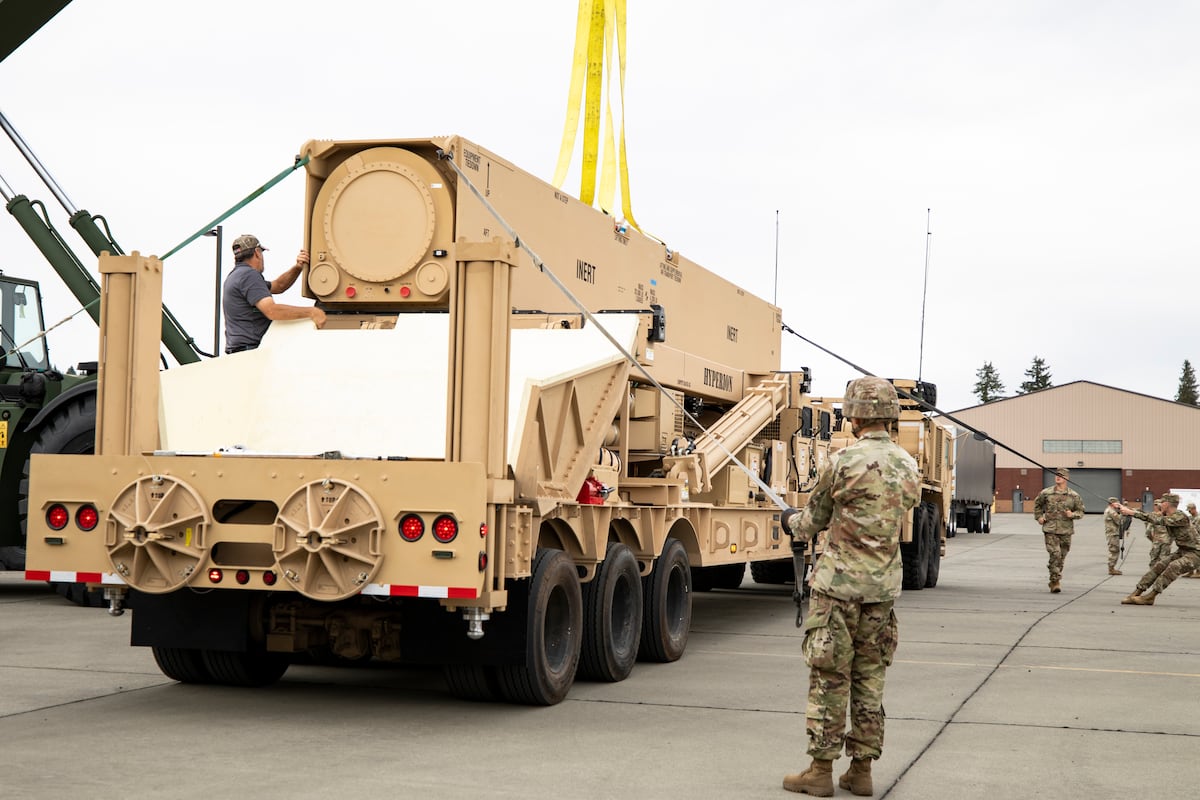
Preparatory measures for the hypersonic capability have seen the Army delivering its first systems, excluding the actual hypersonic rounds, to the Multi-Domain Task Force unit at Joint Base Lewis-McChord (JBLM) ahead of schedule. This unit has been actively training on the system and is preparing for the forthcoming hypersonic rounds. Lockheed Martin is designated as the weapon system integrator for this hypersonic capability.
The ongoing advancements in hypersonic technology underscore the urgency of aligning military capabilities in response to international developments in defense technology. The operational deployment of hypersonic weapons is crucial in maintaining a strategic edge against potential adversaries.
The content above is a summary. For more details, see the source article.