Key Takeaways
- Astronomers have potentially observed a “dirty fireball,” a unique explosion from a dying star.
- This phenomenon, detected using the Einstein Probe, involves X-ray emissions rather than gamma rays, indicating a variation in stellar explosions.
- The discovery could reshape understanding of black holes and gamma-ray bursts, suggesting there may be more diverse explosion types than previously known.
New Insights into Stellar Explosions
Recent observations suggest that astronomers may have identified a new type of stellar explosion called a “dirty fireball.” This finding comes from the work of Xiang-Yu Wang and his team at Nanjing University, who detected an unusual flash of X-rays, designated EP241113a, from a galaxy approximately 9 billion light-years away using the Einstein Probe space telescope.
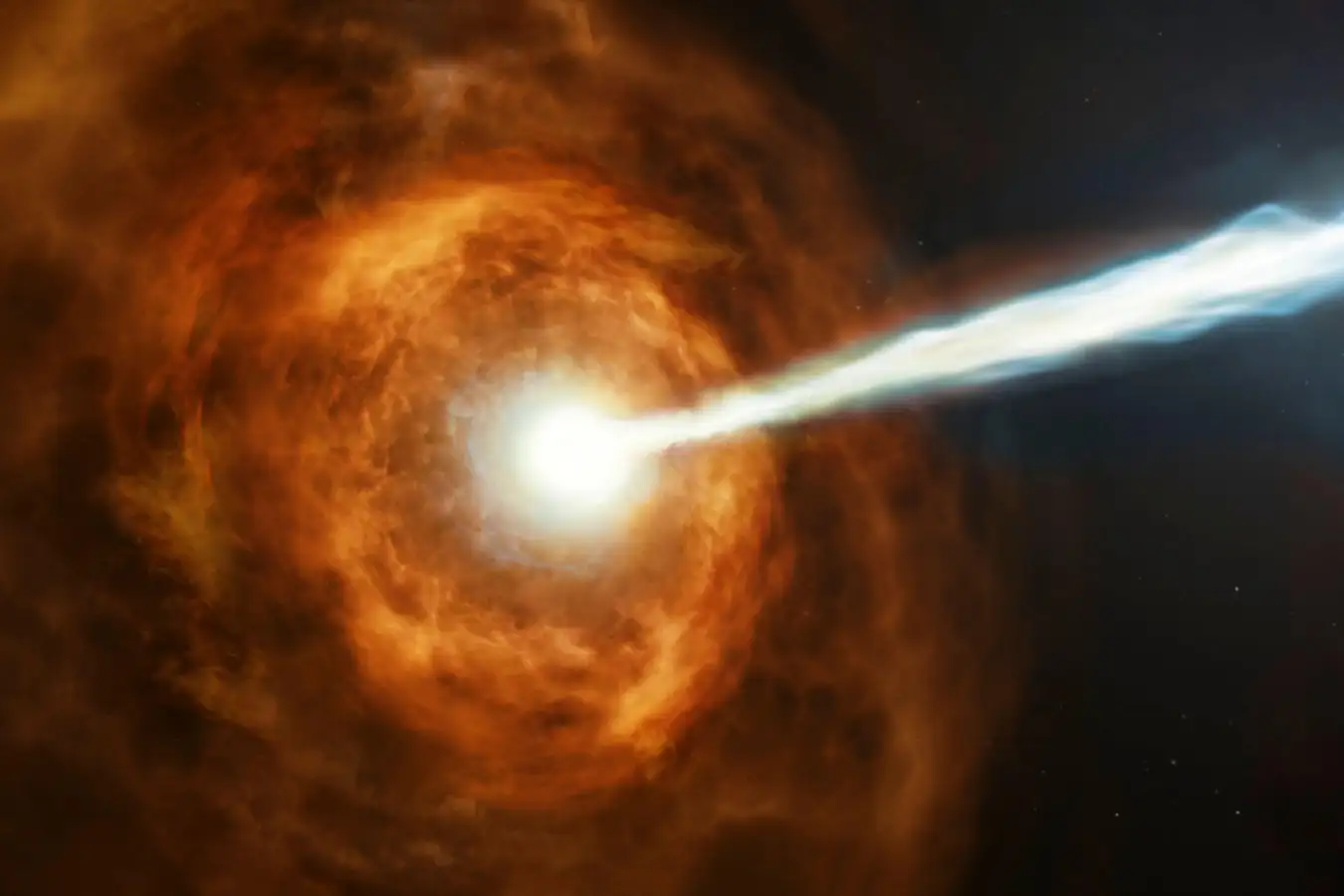
When massive stars exhaust their fuel, they can collapse and explode in various ways. One of these is a gamma-ray burst, an intense release of energy resulting from the formation of a black hole that produces a powerful jet of radiation. These bursts are among the most radiant phenomena observable, often releasing energy on par with what smaller stars, like the sun, emit over their entire lifetimes.
The concept of a “dirty fireball” arises from theoretical proposals suggesting that if the jet incorporates heavier matter from the star itself—such as protons and neutrons—it may emit X-rays instead of gamma rays. Until now, this scenario had been a hypothetical construct without direct observational support.
In their groundbreaking observation, Wang and colleagues recorded an extremely bright flash of X-rays that contained energy comparable to that of a typical gamma-ray burst. This initial burst diminished into a glow lasting several hours before gradually fading away, mirroring the behavior of traditional gamma-ray bursts but differing in light emission type.
Rhaana Starling, an astronomer from the University of Leicester, describes the finding as “very exciting” and notes that despite being theorized since the 1990s, compelling evidence for dirty fireballs has been lacking. Starling speculates that the phenomenon may involve an interaction between the jet and a black hole or neutron star, suggesting new avenues for understanding black hole formation.
This discovery also indicates that the gamma-ray bursts currently cataloged may present an observational bias. Gavin Lamb from Liverpool John Moores University posits that the universe might harbor a continuum of explosion types, suggesting that even less intense jets may exist alongside the powerful gamma-ray events we typically observe.
While there is enthusiasm surrounding this detection, caution remains. Om Sharan Salafia from Brera Astronomical Observatory emphasizes the need for confirmation regarding the galaxy’s distance as claimed by Wang and his team. The validation of this event’s origin is crucial; if proven true, it could lead to further questions about the nature of such explosions and the mechanisms behind them.
In summary, this potential discovery of a dirty fireball could significantly enhance current astrophysical models and provide fresh insights into the death throes of massive stars, dark matter interactions, and the nature of black holes. Further research and verification will be essential to fully understand the implications of this remarkable finding.
The content above is a summary. For more details, see the source article.