Key Takeaways
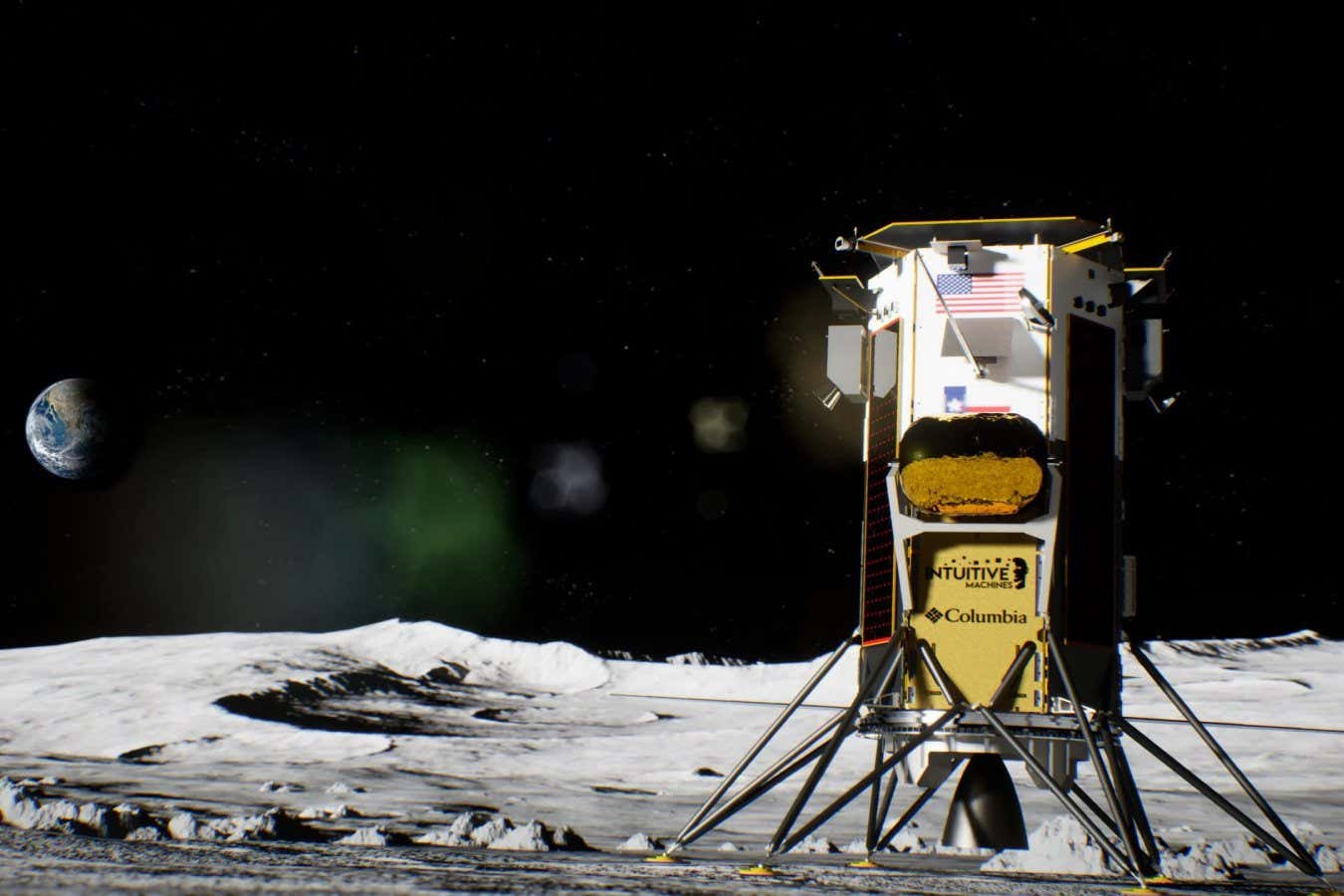
- The Athena spacecraft, developed by Intuitive Machines, is set to launch to the moon’s southern region on February 26th, aiming for a record lunar landing site.
- Athena will carry over 10 scientific instruments, including a NASA drill to search for water deposits, and will be accompanied by other missions on the same rocket.
- The mission sets the stage for future lunar exploration, including NASA’s Artemis program, targeted for crewed moon landings in 2027.
Athena’s Ambitious Lunar Mission
The Athena spacecraft, manufactured by the US company Intuitive Machines, is scheduled to launch aboard a SpaceX Falcon 9 rocket from NASA’s Kennedy Space Center on February 26, 2024. This mission stands out as it aims to reach the most southerly point on the lunar surface ever visited, near the towering Mons Mouton, located approximately 60 kilometers from the moon’s south pole. The launch time is set for 12:17 AM GMT on February 27, 2024.
Intuitive Machines previously made headlines as the first private entity to successfully land on the moon in 2023 with its Odysseus spacecraft. However, Odysseus encountered challenges during landing and tipped over, hindering data collection. With Athena, the company aims to achieve a more stable landing and to conduct meaningful scientific research during its operational period, which will last about two weeks—equivalent to one lunar day—before lunar night begins.
The Athena mission will carry over 10 different instruments sourced from NASA and other private companies. One of the notable instruments includes a NASA drill that will penetrate the lunar soil up to one meter to analyze for potential water and various chemicals. This research is crucial for assessing if these resources can support future astronauts within NASA’s Artemis program, aiming for crewed lunar landings in 2027.
In addition to Athena, the Falcon 9 rocket will be transporting three other spacecraft. This includes AstroForge’s asteroid-prospecting satellite, set to survey a space rock for potential metal resources later in the year, and NASA’s Lunar Trailblazer, which aims to map water reserves on the moon and identify prospective landing sites. Another payload is a satellite from Epic Aerospace, designed to facilitate orbital maneuvers for other satellites.
To enhance exploration capabilities near Athena’s landing site, various small rovers will be deployed. Among these is Dymon’s Yaoki rover, weighing only 0.5 kg, making it the lightest lunar rover ever. The 10 kg Mobile Autonomous Prospecting Platform (MAPP), developed by Lunar Outpost, will create a 3D map of the landing area and test a 4G phone network developed by Nokia. On MAPP, an ant-sized robot from MIT will gather temperature readings.
Another innovative feature of the Athena mission is the deployment of a hopping robot named Grace, which will conduct a series of jumps of up to 100 meters into a deep crater featuring permanently shadowed areas. Evidence suggests that these regions may contain usable ice, but none has been directly explored. Grace will scan the crater’s floor—about 20 meters deep—for roughly 45 minutes before executing its jumps.
As the Athena mission approaches, it promises to expand humanity’s understanding of lunar resources and pave the way for future explorations. With its partner missions and advanced scientific objectives, the upcoming launch signifies a major advancement in private and public space collaboration.
The content above is a summary. For more details, see the source article.