


Key Takeaways
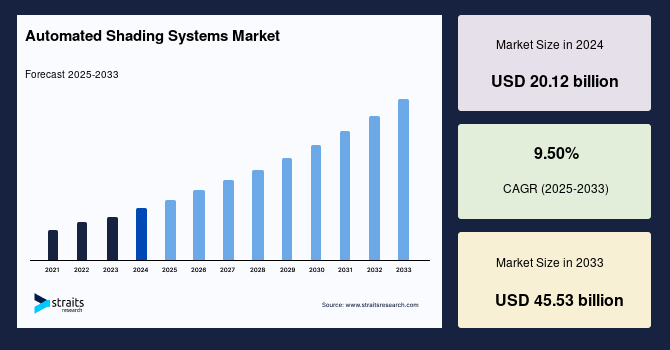
- The global automated shading systems market is projected to grow from USD 22.03 billion in 2025 to USD 45.53 billion by 2033, at a CAGR of 9.50%.
- Technological advancements, especially in IoT and AI, are driving demand for energy-efficient automated shading solutions in residential and commercial sectors.
- High initial costs and installation complexities remain barriers to market growth, though partnerships with smart home tech firms present new opportunities.
Market Overview
The automated shading systems market is on an upward trajectory, with valuation expected to rise from USD 20.12 billion in 2024 to USD 45.53 billion by 2033. This growth is significantly influenced by smart city initiatives, leading to the adoption of energy-efficient technologies in various sectors, particularly in commercial spaces such as offices and educational institutions. Rising consumer demand for convenience and quality of life enhancements is pushing home automation solutions, including automated shading systems, to the forefront of energy management.
A trend towards integrating IoT and AI technologies in shading systems facilitates dynamic adjustments based on environmental conditions, thus improving energy efficiency and occupant comfort. An example of this innovation is Mado Dynamic’s recent introduction of AI-powered dynamic window shades, which promise to revolutionize indoor comfort.
Sustainability awareness is a core factor accelerating market growth. Many consumers are seeking energy-efficient products, aligning with global sustainability goals. According to a PwC survey, a significant portion of consumers is now prioritizing sustainable products, especially millennials and Generation Z.
However, high initial investment costs and complex installation processes present challenges. These systems require skilled labor for installation, deterring potential adopters in more price-sensitive regions. Retrofitting is also complex and can deter users from replacing traditional systems.
Partnerships between automated shading manufacturers and smart home technology companies are emerging as a key opportunity in the market. Notable collaborations, such as Somfy’s alliance with Universal Electronics Inc., aim to create user-friendly automated solutions, reinforcing growth in both residential and commercial segments.
North America leads the market due to robust sustainability initiatives, while Asia-Pacific shows rapid growth potential, fueled by urbanization and tech-savvy consumers. Meanwhile, Europe is progressively embracing energy-efficient automated shading, driven by stringent regulations and a focus on green building practices.
The content above is a summary. For more details, see the source article.









