


Key Takeaways
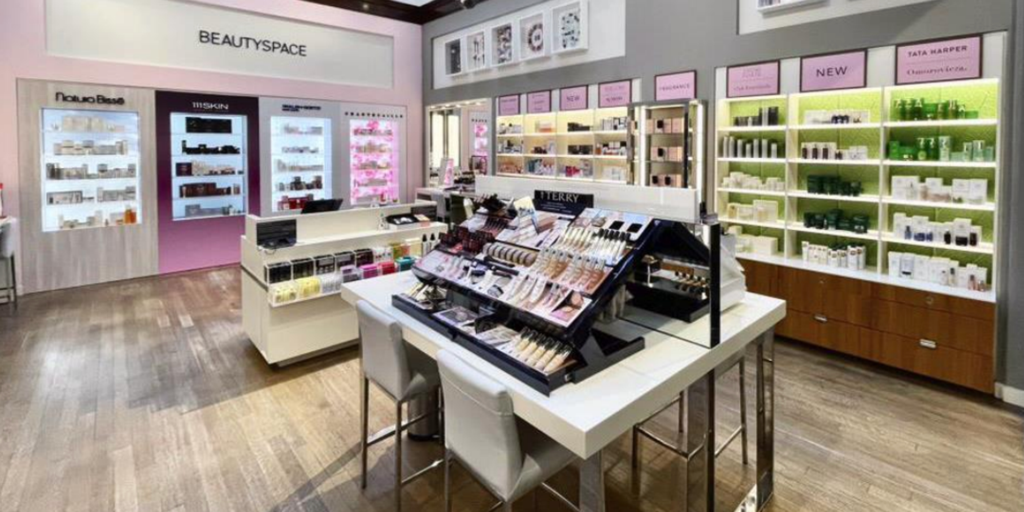
- Beautyspace has launched shop-in-shop installations at five Belk locations, with plans to expand to 100 stores, highlighting the trend of physical retail adapting to e-commerce pressures.
- Shop-in-shop partnerships like Beautyspace’s, along with Violet Grey’s international expansion, showcase evolving strategies in a competitive beauty retail environment.
- The success of such partnerships hinges on alignment between retailer brands, customer bases, and effective execution, as evidenced by contrasting outcomes of Sephora’s and Ulta’s previous collaborations.
Beautyspace Partners with Belk
Beautyspace, an extension of Space NK’s former U.S. operations, has rolled out shop-in-shop installations in five Belk locations across the Southeast, with plans for an additional 100 stores. This partnership also involves an online selection featuring several notable brands, including Briogeo and Verb. Beautyspace’s collaboration with Belk adds to its growing portfolio of shop-in-shop relationships with major retailers such as Walmart and Nordstrom.
In a similar vein, Violet Grey is also expanding internationally through a limited-time pop-up at Harvey Nichols, showcasing 26 brands from its collection. Additionally, the e-tailer has opened a shop-in-shop at Hirshleifers in Long Island, indicating a broader trend of beauty retailers exploring new growth avenues, particularly after the upheaval caused by the pandemic.
Shop-in-Shop Model Evolution
The shop-in-shop concept is not new but has gained traction since the pandemic as retailers seek innovative ways to attract shoppers. Notable partnerships, like Sephora’s with Kohl’s and Ulta’s with Target, were launched around 2020, featuring strategies tailored to each retailer’s objectives. While typically perceived as mutually advantageous, the effectiveness of these partnerships largely depends on the compatibility of their business models and target audiences.
Neil Saunders, a retail analyst, notes that for a shop-in-shop to succeed, both parties must offer value that enhances the partnership. Otherwise, it risks falling short of expectations. The ongoing partnership between Sephora and Kohl’s has successfully revived Kohl’s prestige beauty offerings, while the Ulta and Target collaboration has faced significant challenges.
Industry Challenges
The partnership between Ulta and Target, which is expected to conclude this August, highlights the difficulties inherent in shop-in-shop arrangements. Ulta’s model did not adequately adapt to Target’s mass retail environment, leading to a diluted customer experience. Moreover, financial arrangements can be uneven; estimates suggest Ulta received only a small percentage of sales compared to the Sephora-Kohl’s arrangement, which has proven more lucrative.
Despite these challenges, successful shop-in-shop partnerships can drive traffic and sales growth. However, brands involved must navigate potential risks, including brand dilution and increased inventory costs. As retailers scale quickly, they may also introduce failures due to misaligned shopper expectations, impacting overall performance negatively.
Conclusion on Retail Dynamics
The dynamics of shop-in-shop partnerships reflect a complex interplay of marketing, operations, and customer engagement strategies. While collaborations like Beautyspace’s with Belk and Violet Grey’s international endeavors highlight innovation, they also reveal the precarious balance required for success in the competitive retail landscape. Companies must ensure that their respective missions and operational models align effectively to capitalize on these opportunities.
The content above is a summary. For more details, see the source article.









