


Key Takeaways
- A breakthrough catalyst made from biomass could replace expensive platinum in fuel cells and batteries.
- The cobalt-based catalyst shows high performance and stability, excelling in the oxygen reduction reaction.
- This innovation supports sustainability, utilizing renewable materials for energy applications.
Innovative Cobalt-Based Catalyst from Biomass
A recent study reveals advancements in sustainable energy solutions through the development of a cobalt-based multicomponent catalyst created from biomass. This catalyst, embedded in nitrogen-doped biochar, outperforms traditional platinum alternatives used in fuel cells and metal-air batteries, addressing cost and supply limitations.
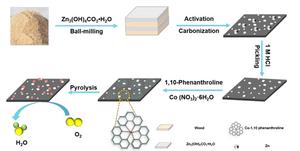
Published in Biochar, the research outlines a scalable production method using wood-derived biomass, cobalt salts, and a nitrogen-rich compound, 1,10-phenanthroline. These ingredients combine during high-temperature processing to form a porous carbon structure containing cobalt and nitrogen functional groups that serve as active catalytic sites.
Researchers highlight the oxygen reduction reaction (ORR) as a key challenge in energy conversion technologies. The newly developed catalyst achieved a half-wave potential of 0.81 volts and a limiting current density of 4.95 milliamps per square centimeter in alkaline conditions, comparable to several leading materials. Its impressive durability is evidenced by over 92 percent retained activity after long-term use, alongside significant resistance to methanol interference.
The catalyst’s unique structure enhances performance: the biochar framework aids mass transport and prevents metal particle aggregation. Nitrogen doping adds active sites to facilitate oxygen adsorption and electron transfer. The embedded cobalt species enhance catalytic efficiency, primarily following a preferred four-electron reaction pathway that converts oxygen into water without producing harmful byproducts.
The study suggests future research will focus on enhancing performance in acidic environments and exploring additional biomass sources to boost scalability and versatility. Beyond fuel cells and batteries, this approach offers potential for broader energy and environmental applications, including hydrogen production and carbon dioxide reduction.
By demonstrating that low-cost, biomass-derived materials can match established catalysts, this research represents a significant step towards sustainable energy innovation. Overall, it aligns with initiatives aimed at developing carbon-neutral technologies and promoting circular resource systems.
The content above is a summary. For more details, see the source article.









