


Key Takeaways
- The study evaluates optimal energy consumption patterns for cost minimization in residential energy hubs with a focus on renewable energy sources (RES) and electric vehicle (EV) battery scheduling.
- Three cases are analyzed: operation without RES, operation with solar panels and EV integration, and incorporating home energy management (HEM) and time-of-use tariffs.
- Results show significant cost savings and efficiency improvements when using RES and smart scheduling strategies, highlighting the potential for reduced grid dependency and enhanced sustainability.
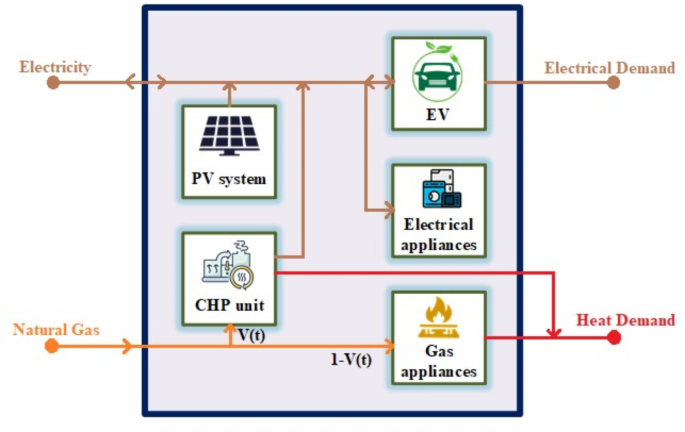
The article discusses a research study aimed at optimizing energy consumption patterns to minimize costs, particularly through the integration of renewable energy sources (RES) and electric vehicles (EVs) in residential energy hubs (REHs). Using simulation software GAMS 38.2 and structural analysis software Abaqus 2022, the study evaluates energy consumption on a typical winter day—January 1st—when heating demands are significant due to low solar output.
The analysis explores three distinct cases:
**Case I** establishes a baseline for a residential energy hub operating without any RES. It uses a 0.75 kW combined heat and power (CHP) unit to balance energy supply. The analysis reveals that the CHP unit alone cannot fully meet both heating and electricity demands, particularly during peak usage hours, resulting in significant reliance on the grid. The findings indicate the operational inefficiencies and cost implications of not incorporating RES.
**Case II** enhances this scenario by integrating a photovoltaic (PV) system and EV battery storage. Here, a rooftop-mounted 2.8 kWp PV system captures solar energy, allowing excess energy to be stored in a 25 kWh EV battery. This configuration demonstrates improved energy efficiency and reduced reliance on grid electricity. The results illustrate how strategic charging and discharging of the EV battery—coordinated with solar power availability—better aligns with household demand, lowering operational costs.
**Case III** introduces home energy management (HEM) and time-of-use (ToU) tariffs into the model. This case helps optimize the scheduling of flexible appliances, further minimizing electricity expenses. The study finds that integrating HEM can lead to a 16.7% reduction in daily electricity costs. This case illustrates how intelligent management of energy consumption enhances cost-effectiveness and complements the benefits brought by renewable energy adoption.
Collectively, the findings highlight that incorporating RES and smart management strategies can significantly enhance economic and operational efficiency. The levelized cost of electricity (LCOE) drops to $0.02/kWh with PV integration, far lower than base grid electricity costs. The research underscores the potential for households to achieve energy independence, lower expenses, and contribute to sustainability goals through strategic energy management and technology adoption.
In conclusion, the study emphasizes the value of integrating RES, EVs, and HEM strategies in residential settings. It offers practical insights for optimizing energy consumption that can reduce reliance on external sources and enhance economic viability while supporting broader sustainability objectives. Such integration has promising implications for the future of smart energy systems in residential contexts.
The content above is a summary. For more details, see the source article.









