


Key Takeaways
- California Governor Gavin Newsom unveiled a $310 billion plan for a zero-emission passenger rail network by 2050.
- The plan aims to divert 200 million daily passenger miles from highways to rail, enhancing climate and traffic outcomes.
- Current projects include electric trains on Caltrain and hydrogen-battery trains in Southern California, with further electrification required across 1,500 miles of track.
California’s Ambitious Rail Vision
Governor Gavin Newsom recently announced a plan to develop a comprehensive zero-emission passenger rail network across California by 2050, with an estimated budget of $310 billion. This extensive proposal aims to create interconnected rail systems, including intercity, regional, and local transit, with high-speed rail serving as the core of this expansive network.
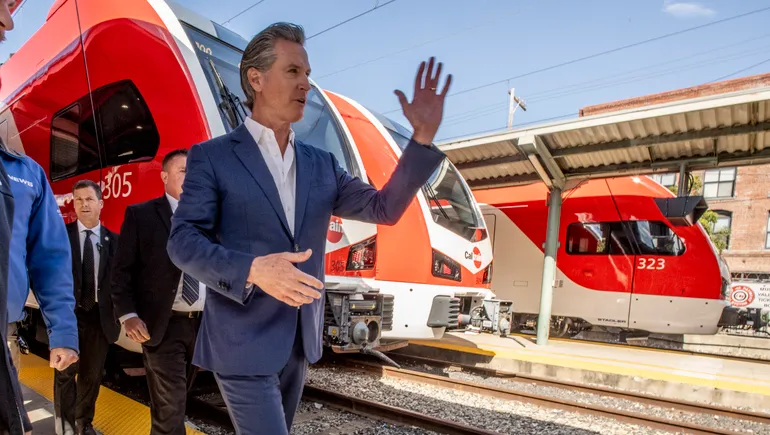
To fund this initiative, a combination of local, state, and federal resources, along with private investments, will be essential. The state’s commitment to transforming its rail infrastructure aligns with the actions of two existing California commuter railroads that have started transitioning to zero-emission trains. Caltrain has replaced diesel trains with electric ones along its 51-mile route since August, while the San Bernardino County Transportation Authority is testing hydrogen-battery trains and plans to introduce them soon.
Newsom’s plan seeks to shift nearly 200 million passenger miles daily from highways to rail, aiming to alleviate traffic congestion and reduce greenhouse gas emissions while enhancing safety for all travelers in California. “Our vision is simple: by 2050, every Californian should be able to choose rail as a way to get to their destination, near or far,” Newsom stated, reflecting the ambitious nature of the initiative.
Urban Planning Professor Michael Manville from UCLA remarks on the enormity of the undertaking, recognizing the challenge of removing so many passenger miles from roads. While he acknowledges it’s a significant goal, he urges caution, as simply replacing vehicles does not guarantee lasting improvement in conditions.
Currently, portions of California’s high-speed rail projects connecting San Francisco to Los Angeles are under construction in the Central Valley. Added to this, the Brightline West project is underway, linking Las Vegas to Southern California, and plans are in place for another high-speed line across the Antelope Valley north of Los Angeles.
The Governor’s office has released a map detailing the proposed rail lines, which includes electrified routes serving major cities like San Diego, Sacramento, and Oakland. Achieving this level of electrification will necessitate constructing electric catenary infrastructure along 1,500 miles of track by 2050. In areas where electrification proves impractical, the plan suggests using hydrogen and battery-electric trains as alternatives for maintaining zero-emission operations.
Despite the ambitious goals, a cautious perspective remains regarding California’s past investments in rail. Manville points out the lack of substantial results from previous spending, underscoring the need for realistic expectations concerning future outcomes.
The content above is a summary. For more details, see the source article.









