


Key Takeaways
- AI Summer 2026 marks the evolution of blockchain as AI agents begin executing tasks autonomously, shifting from human-driven interactions.
- Key projects like Fetch.ai and Bittensor are shaping the AI crypto ecosystem, focusing on decentralized compute, AI modeling, and data sharing.
- Potential risks include regulatory challenges, “AI washing,” and the imbalance of developer focus between blockchain and AI technologies.
The Emergence of AI Summer 2026
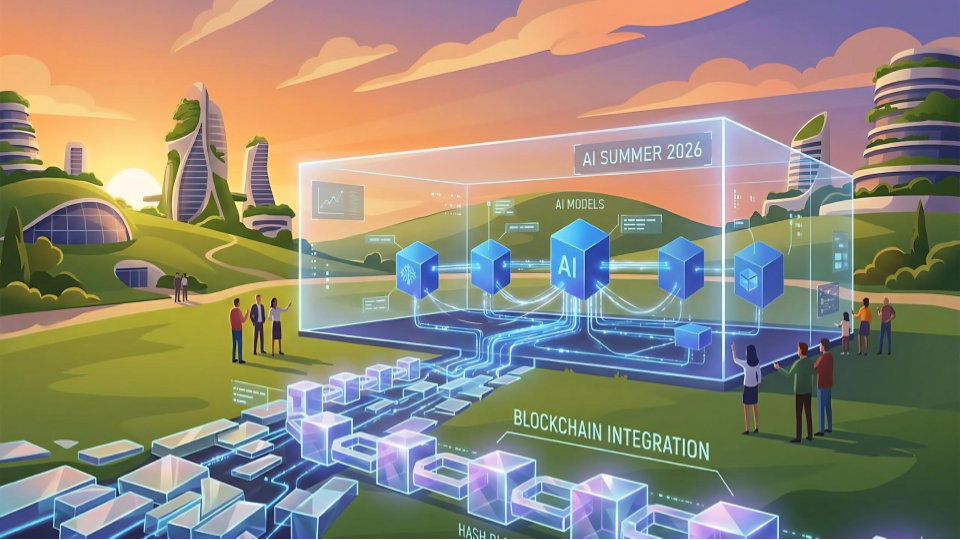
AI Summer 2026 represents a significant shift in the blockchain landscape, transitioning from the human-centric financial activities of DeFi Summer 2020 to systems where artificial intelligence (AI) operates autonomously. This convergence allows AI agents to perform tasks such as trading and portfolio management, moving beyond mere automation to fully autonomous participation.
In 2020, decentralized finance (DeFi) gained traction through protocols like Compound, which incentivized users to engage with blockchain financial systems. Etherum’s smart contracts enabled decentralized applications to flourish, leading to rapid user adoption and capital inflow. The emergence of yield farming and the introduction of governance tokens encouraged a surge in liquidity, propelling DeFi to mainstream recognition.
Fast forward to 2026, the integration of AI into the blockchain has progressed from speculative interest to robust applications with real utility. Decentralized compute networks and AI trading systems are now commonplace, allowing extensive participation while maintaining decentralization and user ownership. Platforms such as Fetch.ai and Bittensor are enabling developers to utilize AI models effectively without relying on centralized systems.
The current landscape signals a fundamental change in how value is created within crypto markets. The focus is shifting toward real revenue models driven by genuine usage—a departure from merely valuing token emissions. Institutions and venture capital are investing in projects with clear economic frameworks, making capital allocation more selective and longer-term.
AI agents are the cornerstone of this new economy. Unlike their human predecessors, these agents can execute transactions based on predefined objectives without constant oversight. They monitor market dynamics and adjust operations in real-time, effectively managing financial strategies across various DeFi platforms.
However, challenges and risks are emerging as the AI crypto space evolves. The phenomenon of “AI washing” raises concerns about projects exaggerating their AI capabilities without delivering substantial value. Regulatory scrutiny is increasing as governments explore accountability frameworks for AI systems. Additionally, the migration of developer talent towards AI, potentially at the expense of core blockchain development, could disrupt the foundational structure supporting these innovations.
The landscape continues to thrive as ongoing developments in AI, including improved language models and machine learning capabilities, further connect with blockchain technology. As the foundations of AI and DeFi strengthen, they are set to redefine the future of decentralized economies.
Investors and developers are advised to focus on genuine value, emphasizing sustainable growth and innovative applications, rather than getting swept up in the latest hype cycles. Understanding this interplay between infrastructure and artificial intelligence will be key to navigating the evolving crypto landscape.
The content above is a summary. For more details, see the source article.









