Key Takeaways
- ESA successfully received its first navigation signal from the Celeste mission, a major milestone for European satellite navigation.
- The Celeste mission focuses on Low Earth Orbit Positioning, Navigation and Timing (LEO-PNT) and is currently in its in-orbit demonstration phase.
- The event took place at ESA’s Navigation Lab at ESTEC, a significant location in ESA’s navigation history.
Historic Signal Reception
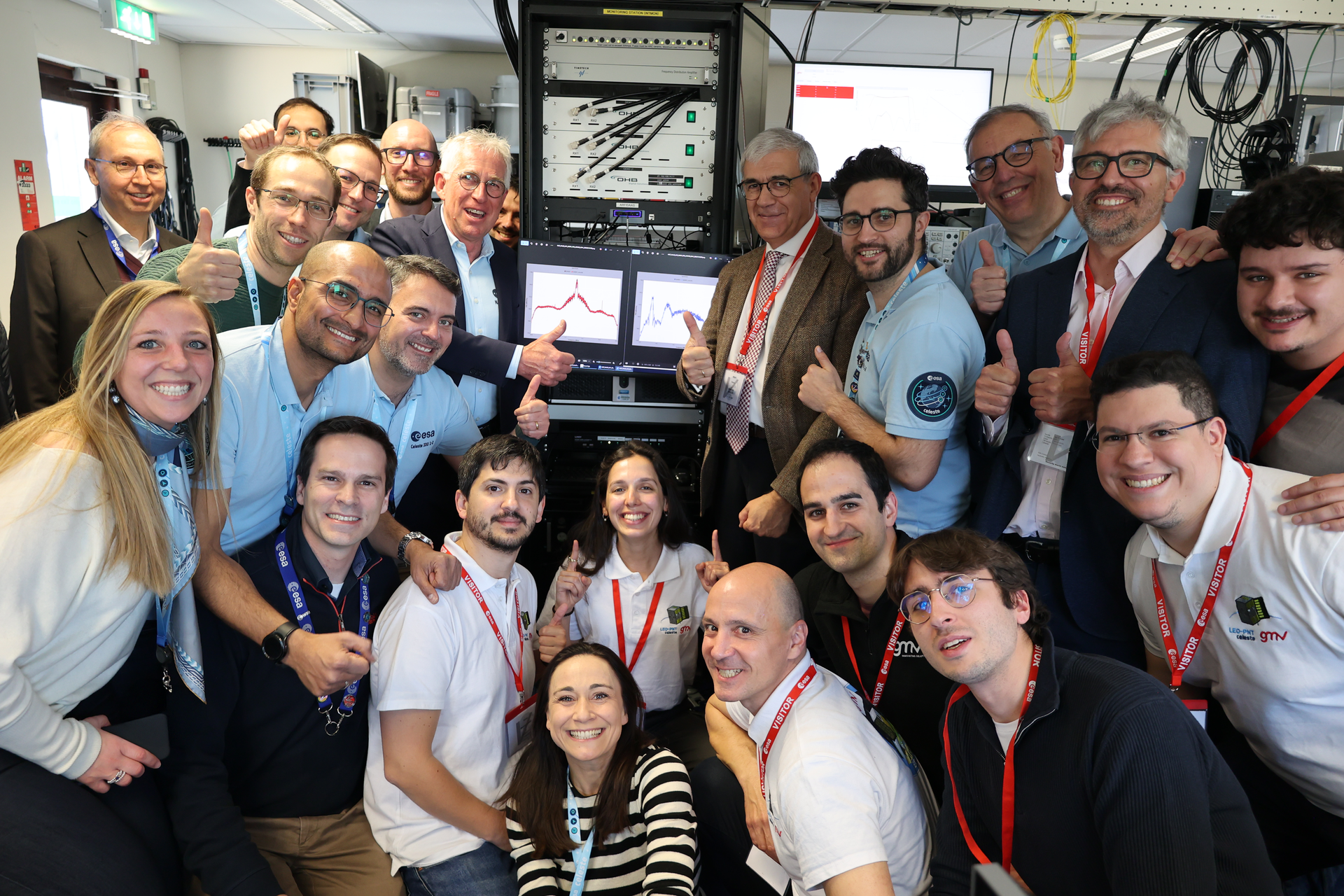
On April 8, teams from the European Space Agency (ESA) collaborated with industry partners at ESA’s Navigation Lab in ESTEC, Netherlands, to celebrate a significant achievement: the successful reception of the first navigation signal from the Celeste mission. This event represents a groundbreaking moment for European satellite navigation, particularly in Low Earth Orbit Positioning, Navigation, and Timing (LEO-PNT).
The Celeste mission is currently in its in-orbit demonstration phase, aimed at exploring new navigation capabilities. The Navigation Lab at ESTEC has been pivotal in ESA’s navigation testing activities and was chosen to receive this first signal due to its historical significance. More than ten years ago, this very lab facilitated another key milestone—the initial determination of a ground location using satellites within the Galileo constellation.
Receiving the navigation signal indicates substantial progress toward enhancing Europe’s satellite navigation capabilities and demonstrates ESA’s commitment to advancing space technologies. The ongoing development of the Celeste mission will play a crucial role in improving the accuracy and reliability of navigation systems in low Earth orbit, beneficial for various applications, including commercial and scientific use.
The successful transmission and reception of this signal highlight both technological advancements and the collaborative efforts within the European space industry. ESA’s Navigation Lab continues to serve as a central hub for innovation in this critical field, reinforcing its reputation as a leader in aerospace technology and navigation systems.
As the Celeste mission progresses, further developments are anticipated, paving the way for more robust navigation solutions that aim to impact commercial and scientific sectors significantly. The successful signal receipt exemplifies not only the potential of technological advancements but also the dedication of ESA and its partners to push the boundaries of space exploration and satellite navigation.
The content above is a summary. For more details, see the source article.