


Key Takeaways
- China has successfully mass-produced high-purity silicon-28, achieving isotopic abundance over 99.99%.
- This breakthrough enhances China’s self-sufficiency in quantum technology, previously reliant on foreign suppliers.
- Silicon-28’s stability improves qubit performance in quantum computers, enabling more complex calculations.
Advancements in Silicon Production
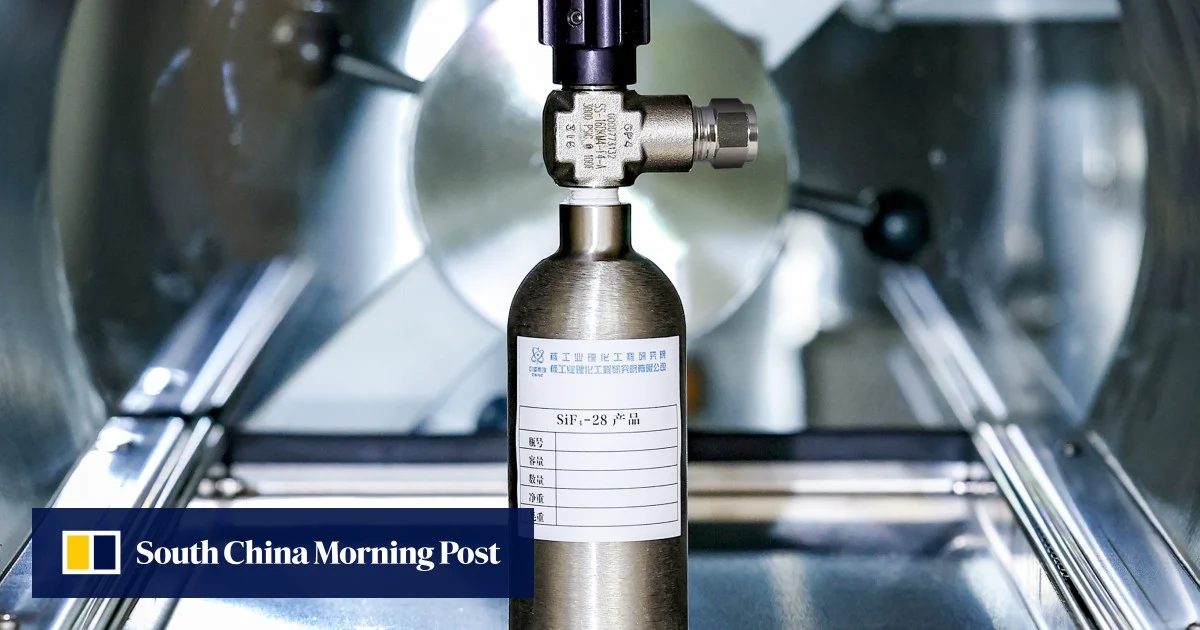
China has recently achieved a significant milestone with the mass production of an ultra-pure form of silicon, specifically the silicon-28 isotope. The China National Nuclear Corporation (CNNC) announced that its research institute has successfully produced this isotope with an isotopic purity level exceeding 99.99%. This accomplishment represents the first instance of a large-scale independent production of silicon-28 in the country.
The development is set to strengthen China’s position in the quantum technology sector, addressing a critical gap in its supply chain for materials necessary for building silicon-based quantum computers. Prior to this achievement, the production of silicon-28 was mainly controlled by a limited number of international sources, primarily located in Russia, Europe, and US-associated supply chains.
Standard silicon remains essential for everyday technologies, such as smartphones and computer chips. However, the complexities of quantum computing necessitate a highly purified form of silicon. Traditional computers operate using bits, which denote information as either a zero or one. In contrast, quantum computers employ qubits, which can represent multiple states simultaneously, offering unprecedented computational capabilities that surpass those of supercomputers.
Nonetheless, qubits are delicate and can easily lose their quantum state due to external disturbances, often referred to as “noise.” Regular, natural silicon allows such interference, leading to data loss. Silicon-28, on the other hand, is characterized as a stable isotope. The production of this ultra-pure variant enhances the possibility of creating a more stable environment for qubits, ultimately enabling longer retention of their quantum state—essential for the effective function of quantum computers.
This breakthrough not only showcases China’s advancement in a vital technology domain but also highlights its efforts to reduce dependency on foreign technology in strategic fields. By achieving self-sufficiency in the production of high-purity silicon, China is poised to make significant strides in the development of quantum computing technologies, potentially influencing global competitive dynamics in this emerging field.
The content above is a summary. For more details, see the source article.









