


Key Takeaways
- Twisted WSe2/WS2/WSe2 hetero-trilayers successfully create charge-layer-locked (CLL) trions through precise stacking and charge distribution.
- Low-temperature photoluminescence (PL) measurements reveal distinct CLL trion emissions, demonstrating their stability and strong Coulomb interactions compared to inter-layer excitons.
- Both optical and electric fields induce a transition from CLL trions to inter-layer excitons, showcasing the potential for manipulating many-body correlated states within the trilayer system.
Creating Charge-Layer-Locked Trions
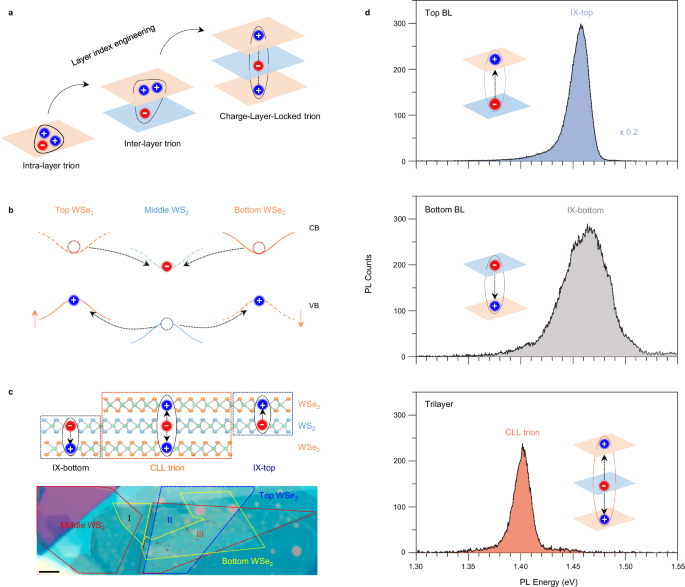
Twisted WSe2/WS2/WSe2 hetero-trilayer structures have been selected to investigate charge-layer-locked (CLL) trions. The symmetric trilayer enables a type-II band alignment, where electrons predominantly reside in the WS2 layer and holes in the outer WSe2 layers. This arrangement allows for the formation of CLL trions through inter-layer Coulomb interactions while preventing tunneling between the outer layers due to spin restrictions.
The intentional AB stacking of the outer WSe2 layers further ensures the holes maintain opposite spin states, which inhibits tunneling and thus facilitates CLL trion formation. This approach distinguishes these trions from quadrupolar excitons, which form in configurations that require inter-layer tunneling.
Verification through Photoluminescence Measurements
Low-temperature PL measurements were conducted on the hetero-trilayer to confirm the presence of CLL trions. The photoluminescence at approximately 1.40 eV, alongside substantial energy differences from known inter-layer excitons, indicates a stable CLL trion state. The observed stability at room temperature suggests a large binding energy due to enhanced Coulomb attraction, affirming the trilayer’s effectiveness as a platform for studying CLL trions.
Optical and Electric Field-Induced Transitions
The application of external electric fields enabled the investigation of transitions between CLL trions and inter-layer excitons. As the electric field increased, the PL emission showed characteristic shifts indicative of the trionic state. A nonlinear energy blueshift was observed for both CLL trions and inter-layer excitons, suggesting correlations among excitonic states.
The transition dynamics revealed a consistent intensity ratio of approximately 60:40 between CLL trions and inter-layer excitons under varying powers, indicating a robust interaction between the two species.
Correlated States and Their Dynamic Evolution
The interplay between CLL trions and inter-layer excitons can lead to the formation of correlated states. By tuning excitation power and electric fields, sharp jumps in PL intensity were identified, signaling the transition from fermionic to bosonic characteristics within the trilayer. The findings highlight the trilayer system’s potential for exploring complex many-body correlations, as the CLL trions act as a reservoir for exciton and charge fillings, establishing dynamic interactions among quasiparticles.
This research opens new avenues for understanding correlated states and their evolution in layered materials, demonstrating the promise of using such structures to delve deeper into many-body physics.
The content above is a summary. For more details, see the source article.









