


Key Takeaways
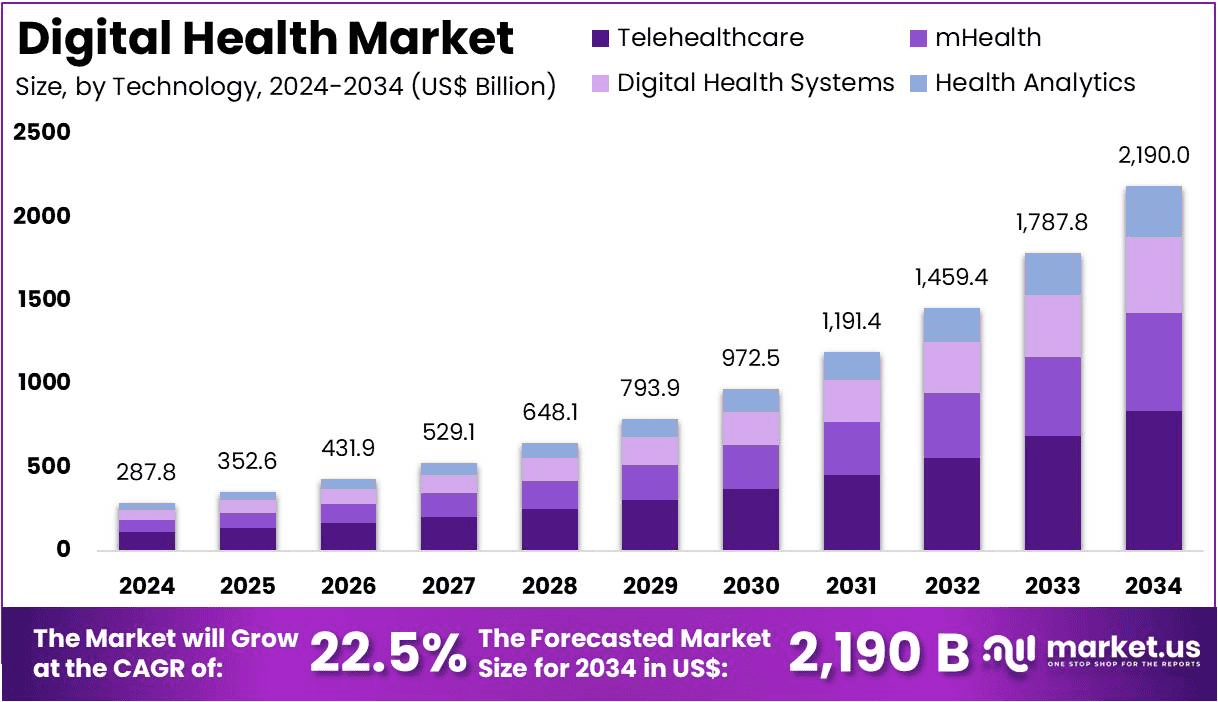
- The global digital health market is projected to grow from US$ 287.8 billion in 2024 to US$ 2,190.0 billion by 2034, at a CAGR of 22.5%.
- North America held the largest market share of 38.4% in 2024, driven by advanced healthcare IT and strong investments.
- Key segments include telehealthcare, mHealth, and digital health systems, with increasing adoption of AI and wearable technologies enhancing patient care.
The global digital health market is set for significant growth, expected to reach US$ 2,190.0 billion by 2034, escalating from US$ 287.8 billion in 2024, driven by a compound annual growth rate (CAGR) of 22.5% from 2025 to 2034. Digital health encompasses various high-tech approaches such as telemedicine, mobile health applications, wearable devices, electronic health records, artificial intelligence, and remote patient monitoring, all designed to deliver improved healthcare services and outcomes.
North America leads the digital health market, commanding over 38.4% of the share in 2024, reflecting strong healthcare infrastructure, extensive adoption of telehealth, and substantial government backing. The benefits of digital health technologies include personalized patient engagement, improved operational efficiency, and diminished healthcare costs, as healthcare organizations increasingly embrace these digital solutions.
Key sectors within the market highlight that the services segment was the largest revenue earner, accounting for 48.9% of total revenues in 2024. Moreover, telehealthcare was identified as the dominant technology segment, holding 38.4% of market share, bolstered by the rise of chronic disease management and the necessity for timely medical interventions in remote areas.
Digital health has especially transformed access to healthcare for underserved regions. The proliferation of smartphones and internet connectivity has made remote healthcare services more viable. Statistics reveal that telehealth services surged by 154% in the U.S. during 2020, emphasizing heightened consumer acceptance. Remote patient monitoring and mobile health applications are expanding rapidly, with the latter projected to generate USD 150.7 billion by 2032.
In the context of application-specific growth, diabetes remains a leading focus, contributing to 32.9% of market revenue in 2024. Patients are the largest end-user segment, comprising 47.2% of overall revenue. As digital health evolves, it is anticipated that advancements in AI will further optimize disease diagnosis, treatment planning, and healthcare workflows, enhancing overall patient safety.
Looking ahead, emerging trends in the market will likely include enhanced integration of AI and machine learning, growth in telehealth and remote patient monitoring, and a strong emphasis on cybersecurity to protect sensitive patient information. Healthcare payment models are shifting towards value-based care, fostering a greater reliance on digital technologies and comprehensive patient engagement approaches.
As international investments in digital health surge, the future outlook remains optimistic. North America will continue to lead, while the Asia-Pacific region is poised for rapid growth, driven by improvements in digital infrastructure and increased healthcare expenditures. Overall, digital health is positioning itself as a critical component for more effective, efficient, and accessible healthcare delivery worldwide.
The content above is a summary. For more details, see the source article.









