


Key Takeaways
- EduWriter.ai offers AI-driven support for academic writing, including essay creation, paraphrasing, summarizing, and citation generation.
- Sample essays produced by the platform exhibit structured writing but lack depth and effective source integration.
- Enhancements are needed in argumentation, source inclusion, user customization, and expanding free access features.
AI-Enabled Academic Support
EduWriter.ai is an innovative platform designed to assist students and professionals, including educators, with academic content creation. Equipped with features such as essay generation, paraphrasing, summarization, and citation formatting, EduWriter.ai aims to streamline the writing process and enhance academic productivity.
The platform’s AI Essay Writer enables users to draft essays on a variety of topics by selecting specific parameters, including essay type, length, and subject matter. This feature provides students and researchers a quick and efficient way to structure their academic papers and organize their thoughts.
The Paraphrasing Tool enhances existing written material by clarifying language while retaining the original voice, thereby reducing the risk of plagiarism. This functionality is particularly beneficial for students and researchers looking to refine their work without altering its core message.
Another valuable feature, the Text Summarizer, condenses lengthy documents into brief summaries, allowing users to quickly access essential details from extensive texts. Additionally, the APA Citation Generator automates the creation of references formatted according to academic standards, facilitating compliance with citation requirements.
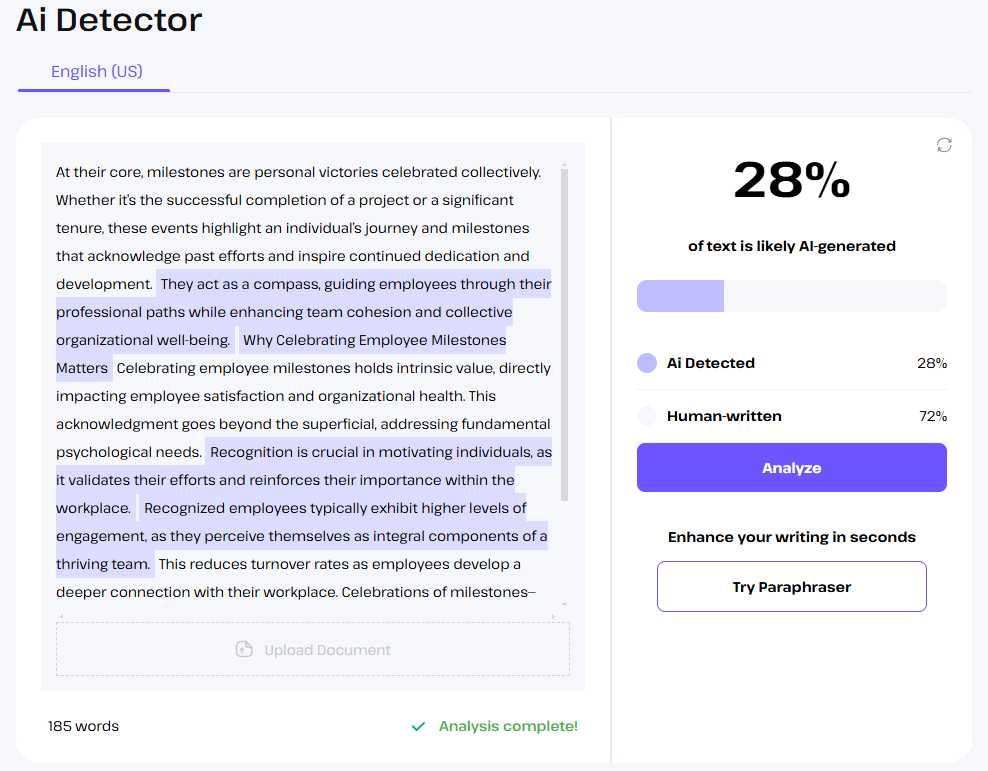
To ensure academic integrity, EduWriter.ai includes an AI Detector that scans text for originality, identifying potential plagiarism issues and helping users maintain the standards expected in scholarly writing.
Evaluation of Sample Essays
An assessment was conducted on two essays produced by EduWriter.ai: “The Ambitious Marc Antony in Julius Caesar” and “The Story of My Life Essay.” Both essays exhibited coherent structures, clearly defined sections including introductions, body paragraphs, and conclusions. The grammar and syntax were sound, demonstrating the language capabilities of the AI.
However, the evaluation identified significant weaknesses. Despite the good structural integrity, the essays lacked in-depth critical analysis and presented weak arguments. The writing style often became repetitive and too generic, leading to unengaging content. Furthermore, the absence of external citations hindered the credibility of the essays, which is crucial in academic writing.
Areas for Improvement
EduWriter.ai, while valuable, has several areas for enhancement to increase its effectiveness. Enhancing the depth of argumentation is essential, promoting more complex analytical thinking and robust argumentative structures. Additionally, enabling users to input their references for automatic integration into AI-generated essays would address the issue of source integration.
User customization could also be improved, offering a variety of writing tones, styles, and citation methods beyond just APA formatting. Finally, there is a need to broaden access to free features, allowing users to thoroughly test the platform’s capabilities without restrictions.
User Feedback
Feedback from users has been mixed; while many appreciate the efficiency and functionality of EduWriter.ai, others express concerns about its limitations in depth and originality.
In summary, EduWriter.ai is an advanced AI academic writing tool that offers useful resources to students and professionals. Despite its current shortcomings—such as the use of generic phrases and a lack of source integration—the platform significantly aids users in structuring their academic writing during the drafting phase.
The content above is a summary. For more details, see the source article.









