

Key Takeaways
- Interfacial delamination significantly impacts the reliability of power devices, especially in electric vehicles.
- A new method using an adhesion promoter layer enhances material bonding, preventing delamination without the downsides of traditional roughening techniques.
- Tests show power devices using the adhesion promoter remain free from delamination after rigorous reliability conditions, demonstrating improved performance and longevity.
Power Device Reliability Enhancements Through Adhesion Promotion
The automotive industry increasingly demands highly reliable power devices, particularly due to the rise of electric vehicles (EVs). Interfacial delamination poses a significant challenge to performance reliability, referring to the separation of layered materials within a device, which compromises electrical performance and mechanical stability. This issue is especially pertinent in power devices, where various components such as dies, die attachments, and lead frames are bonded together.
To address interfacial delamination, the electronic packaging industry has traditionally employed lead frame roughening technology, which enhances the bonding through a mechanical interlocking mechanism by increasing surface roughness. However, this method involves complicated processes and hazardous chemicals, often resulting in bleed-out issues that negatively impact reliability.
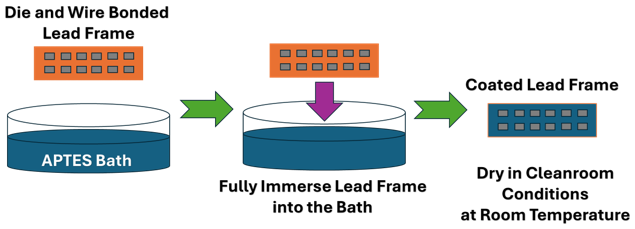
A recent study proposes a more efficient and cost-effective approach to achieve similar benefits without the drawbacks associated with roughening techniques. By applying a layer of adhesion promoter (AP) on the die and wire-bonded lead frames, the new method aims to enhance interfacial adhesion across all material interfaces, reducing the risk of delamination. The adhesion promoter, synthesized from silane coupling agents, forms strong covalent bonds with both inorganic and organic materials, thus improving the overall adhesion of the epoxy mold compounds to various device components.
The study utilized the D2PAK package for testing, applying the AP after the wire bonding process to strengthen adhesion. This approach involves a simple dipping method to apply the (3-Aminopropyl) triethoxysilane (APTES) layer. The findings presented suggest that devices coated with the AP are free from interfacial delamination even after being subjected to aggressive moisture sensitivity levels and thermal cycling conditions.
Elemental analysis conducted through techniques such as X-ray photoelectron spectroscopy (XPS) indicates successful coating of the AP on the lead frames, with notable changes in atomic composition. Additionally, the wettability studies reveal enhanced surface energies and reduced contact angles for the coated units, contributing to improved adhesion performance.
Inspection following the application of Sn plating confirm that coated devices meet quality standards while retaining adequate solderability, indicating that the coating does not interfere with subsequent manufacturing processes.
Upon subjecting the devices to reliability assessments, non-coated units exhibited considerable delamination under various conditioning stress tests. In contrast, all AP-coated devices showed no signs of delamination, demonstrating the effectiveness of the adhesion promoter application.
This innovative method of enhancing interfacial adhesion through a self-assembled monolayer of APTES not only simplifies the manufacturing process but significantly boosts the performance reliability of power devices, providing a promising solution for use in electric vehicles and beyond. The study emphasizes that through careful attention to material interfaces, long-term reliability can be substantially improved in power device configurations.
The content above is a summary. For more details, see the source article.