Key Takeaways
- The ESA has launched its Biomass satellite, providing detailed maps of forest carbon stock over nearly two decades.
- This advanced dataset supports global climate efforts and national greenhouse-gas reporting under the Paris Agreement.
- The forthcoming Biomass mission will improve accuracy in measuring dense forest carbon, especially in tropical regions.
Significance of the Biomass Satellite
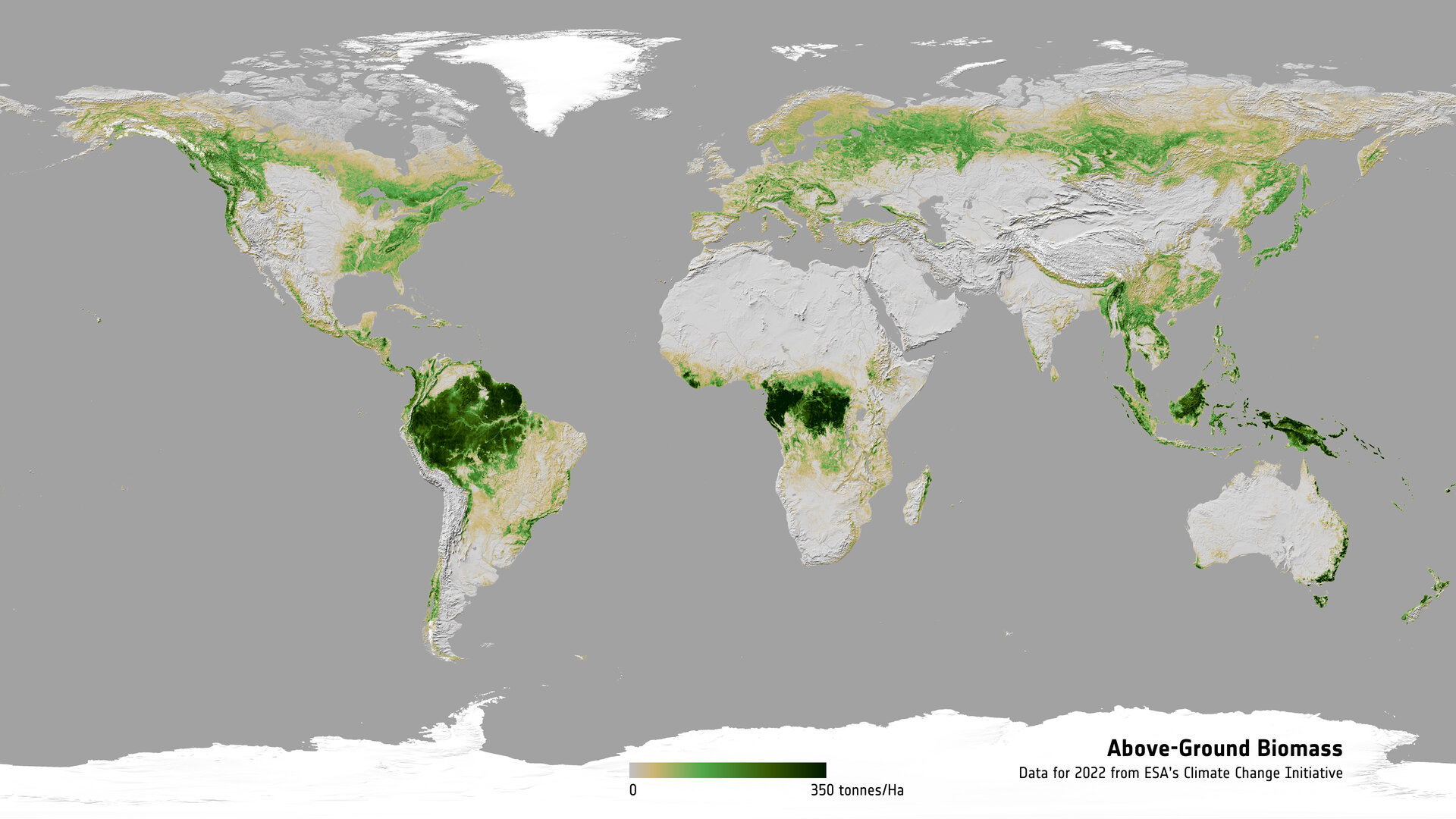
The European Space Agency (ESA) has introduced its Biomass satellite, which successfully launched on April 29, 2025. This satellite marks a significant advancement in understanding global forest carbon stocks, offering extensive datasets that span nearly two decades. The newly released data, developed through ESA’s Climate Change Initiative, integrates information from multiple satellite missions, delivering the most precise picture to date of how forest carbon has evolved globally.
Overview of the Dataset
The dataset, featuring measurements from 2007 to 2022, focuses on the carbon-rich components of trees, primarily trunks and branches, at resolutions varying from 100 meters to 50 kilometers. This information is crucial for climate modeling, forest management, and supporting national submissions for greenhouse-gas inventories under the United Nations Framework Convention on Climate Change.
Frank Martin Seifert from ESA emphasized the dataset’s importance, stating that it provides unprecedented consistency and timeliness in global biomass estimates. It enables researchers and policymakers to track carbon dynamics with the precision needed for effective climate action.
The Role of Forests in Climate Regulation
Forests are vital in the carbon cycle, acting as significant carbon sinks. They accumulate carbon as they grow, but they can quickly release it back into the atmosphere through events like deforestation and wildfires, intensifying carbon dioxide emissions and contributing to climate change. The dataset compiles information from various Earth-observing satellites, including ESA’s Envisat, Copernicus Sentinel-1, Japan’s ALOS PALSAR, and NASA’s ICESat and GEDI lidar missions.
Improved Accuracy Through Collaboration
Enhanced international cooperation, particularly with the Japan Aerospace Exploration Agency, has led to more accurate biomass estimates, especially in high-biomass regions previously underestimated. Refinements in the biomass retrieval algorithms have resulted in a dataset characterized by greater reliability across diverse forest biomes, although its accuracy remains highest for areas with up to 400 tonnes of biomass per hectare.
Richard Lucas from Aberystwyth University noted that the dataset significantly improves the representation of forest biomass, particularly in regions where previous estimates fell short. However, challenges persist in measuring carbon density in the most carbon-rich ecosystems, especially in dense tropical forests where current radar technology faces limitations.
Future Developments with the Biomass Mission
The ESA’s Biomass mission promises to revolutionize assessments of forest carbon storage, equipped with a pioneering spaceborne P-band radar with a wavelength of about 70 cm. This capability will allow it to penetrate thick forest canopies, measuring carbon locked in even the densest vegetation, thus lowering uncertainties associated with forest carbon estimates, particularly in tropical areas like the Amazon and Central Africa.
Maurizio Santoro from Gamma Remote Sensing highlighted the improved quality of the new maps when matched against independent reference data. He acknowledged the need for better characterization of carbon stored in vegetation, a task that will benefit from integrating additional satellite data from past and upcoming missions.
Overall, the Biomass mission is expected to enhance understanding of the global carbon cycle and its implications for climate change. The ESA Climate Change Initiative Biomass Dataset Version 6 is freely accessible, paving the way for open data utilization in climate research.
The content above is a summary. For more details, see the source article.