


Key Takeaways
- Strategic roadmap proposed to address rising energy costs from West Asian geopolitical tensions.
- Gradual pass-through of oil and gas prices needed while incentivizing solar energy and reforms.
- Urging for urgent reforms in electricity distribution to handle increased demand and renewable energy integration.
Addressing Rising Energy Costs Amid Geopolitical Tensions
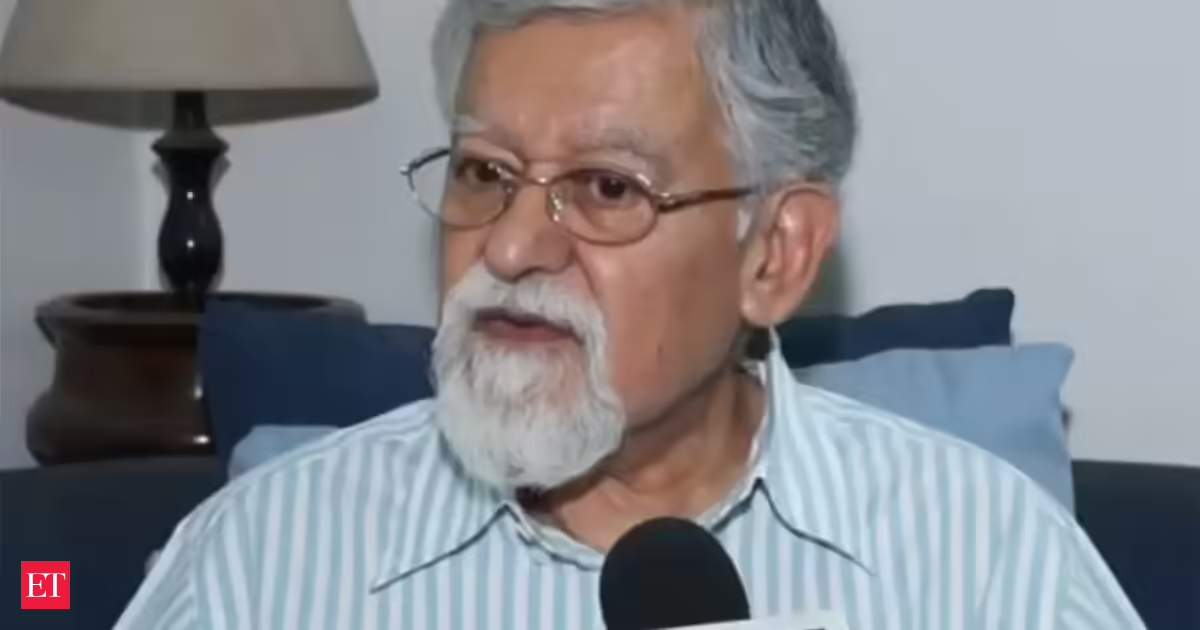
Former NITI Aayog member Arvind Virmani highlighted the urgent need for a strategic roadmap to mitigate the impact of escalating geopolitical tensions in West Asia on global supply chains and energy prices. In an interview with ANI, he observed that the current situation has already significantly affected the Indian economy, with the country’s dependence on imports for 70 to 80 percent of its oil and gas creating immediate inflationary pressures.
Virmani pointed out that the conflict has disrupted logistics in the Gulf, elevating India’s import bill and posing a challenge for policymakers in determining how to allocate these increased costs throughout the economy. He identified three key factors influencing cost distribution: the extent to which oil companies can absorb price hikes, the government’s capacity to reduce these costs through means like excise duty cuts, and the portion passed on to consumers and industries.
He emphasized the importance of gradual adjustments in domestic oil and gas prices to provide the right signals for industries to adapt and explore alternative energy sources. The logistical disruptions have already led to surging prices for critical inputs like sulphur and fertilisers, which could have fiscal repercussions due to increased subsidy requirements.
In the medium to long term, Virmani urged India to focus on alternative energy, particularly solar power. While recent government policies and incentives, such as productivity-linked incentive schemes and electric vehicle initiatives, have made progress, he stressed that more needs to be done. He suggested that implementing time-of-day pricing for solar energy would encourage industries to shift production to off-peak hours, thus maximizing solar usage.
Virmani also called for enhanced investment in energy storage solutions, essential for using solar power generated during the day in the evening. According to recent data, India ranks third globally in renewable energy capacity, having reached a cumulative solar capacity of over 150 GW by March 2026. A significant portion of this capacity comes from distributed solar energy, highlighting its growing importance in India’s energy landscape.
Reforming the electricity distribution system is crucial for managing the increased demand from both renewable sources and newer technologies like electric vehicles and induction cookers. Virmani pointed out international examples where sudden spikes in demand led to distribution network failures, underscoring the need for coordinated reforms rather than isolated incentives.
He cited Andhra Pradesh as a model, where reforms have liberated the distribution system to allow data centers and other entities to generate their own electricity. This change could lead to significant efficiency improvements in energy management.
The Andhra Pradesh government’s initiative providing free electricity to handloom and power loom weavers further exemplifies effective energy distribution reform. With a budget of nearly Rs 150 crore annually, this program is expected to benefit nearly 104,500 weavers, illustrating a cooperative approach towards economic support and energy management.
In summary, a comprehensive and cohesive strategy involving gradual energy price adjustments, accelerated solar energy adoption, and urgent reforms in electricity distribution is crucial for India to navigate the current energy crisis while positioning itself for a sustainable energy future.
The content above is a summary. For more details, see the source article.









