


Key Takeaways
- Accurate simulations are crucial for predicting warpage and stress in semiconductor packaging, especially with advanced materials like metal thermal interface materials (TIMs).
- Mechanically characterizing metal TIMs as thin films rather than bulk specimens is essential for reliable simulation results.
- Utilizing rheometer-derived material properties significantly improves the accuracy of simulations, leading to better design reliability and reduced costs in package development.
Analyzing mechanical behavior in semiconductor packaging has taken a critical turn as companies strive to enhance design reliability while minimizing production costs. Traditionally, simulations have played a pivotal role in predicting warpage and stress levels before fabrication. With the surge in demand for high-performance semiconductor packages, particularly for applications in artificial intelligence (AI), high-performance computing (HPC), and automotive sectors, there has been an escalating challenge in ensuring accurate predictions, particularly when adapting to diverse materials.
The introduction of advanced metal thermal interface materials (TIMs), known for their superior thermal conductivity compared to conventional polymer materials, has marked a significant shift in thermal management within these packages. Accurate thermal dissipation is vital, as the heat generated during operation critically impacts the package’s performance.
Despite extensive data existing for polymer TIMs, the characterization of metal TIMs remains relatively limited due to their novelty. Most simulations rely on material properties derived from suppliers, typically based on bulk specimens. This approach poses inherent inaccuracies since metal TIMs, used in practical applications, behave like thin films. Hence, precise characterization of these materials under actual usage conditions is essential for improving simulation accuracy.
In a recent study, researchers evaluated several metal TIM packages using the shadow moiré technique to examine how these materials behave under varying temperatures. The material properties were adjusted based on empirical data to align with observed behavior, and various techniques, including dynamic mechanical analysis (DMA) and tensile testing, were utilized for validation.
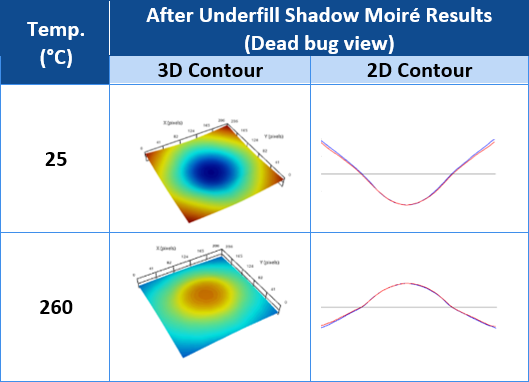
A focus of this research was the fabrication of a lidded flip chip ball grid array (FCBGA) incorporating a metal TIM, which underwent warpage testing. When comparing it to a polymer TIM vehicle under comparable conditions, both types revealed similar warpage behaviors. Interestingly, after subjecting the packages to an underfill process, characteristics changed, displaying distinct “crying” and “smile” modes at varying temperatures.
Mechanical simulations were conducted based on supplier data, showcasing significant discrepancies when comparing results of metal TIM packages with those of polymer TIM packages, especially under end-of-line (EOL) conditions. This inconsistency underscored the importance of material properties in determining simulation reliability.
Further tests on the film-type metal TIM suggested that the rheometer method, which replicates application conditions more accurately than standard tensile tests, yielded crucial data. This testing method presented lower modulus values than those from bulk specimens, indicating that simulations must utilize data reflective of the actual material and assembly processes.
By integrating the rheometer-based material properties into simulations, researchers observed a marked improvement, with simulation results aligning well with shadow moiré measurements. This indicated a successful reproduction of the warpage behavior and transition characteristics observed in real-world scenarios.
The findings advocate for the necessity of precise material characterization in semiconductor packaging, especially for innovative metal TIMs, establishing a foundation for improved reliability and reduced costs in high-performance package development. Future research will expand to include various metal TIM compositions, aiming for broader optimization in packaging design.
This study illustrates the limitations of using generic material properties in simulations and emphasizes the imperative of using application-specific material data to achieve valid results in predictive modeling.
The content above is a summary. For more details, see the source article.









