


Key Takeaways
- Fraunhofer IIS successfully demonstrated broadband 5G NTN connections via the Heinrich Hertz satellite using the Ka-band frequency.
- The transmission achieved data rates of up to 137 Mbit/s, with handover capabilities between satellite beams.
- This technology lays the groundwork for integrating satellites into existing 5G infrastructure for seamless global connectivity.
5G NTN Connection Achieved via Heinrich Hertz Satellite
In April 2026, the Fraunhofer Institute for Integrated Circuits IIS showcased a groundbreaking demonstration of broadband 5G Non-Terrestrial Network (NTN) connections utilizing the Ka-Band frequency through the geostationary Heinrich Hertz satellite. This achievement was marked by successful handovers between two satellite beams, illustrating the potential for seamless connectivity in future applications.
The trials were part of the Heinrich Hertz mission, conducted by the German Space Agency at the German Aerospace Center (DLR). GEO satellites, such as Heinrich Hertz, are known for their ability to transmit large volumes of data while covering extensive areas on the ground, making them reliable for applications that are less sensitive to latency—like streaming services and software updates. In upcoming 3D networks, these satellites can function as a stable, high-capacity layer, bridging any gaps during outages or capacity challenges in lower-altitude components.
During the recent communication experiment, researchers achieved end-to-end transmission using frequency band n512 (Ka-band) based on the 3GPP Release 18 5G standard. They utilized bandwidths between 50 to 100 MHz, resulting in impressive data rates of up to 137 Mbit/s.
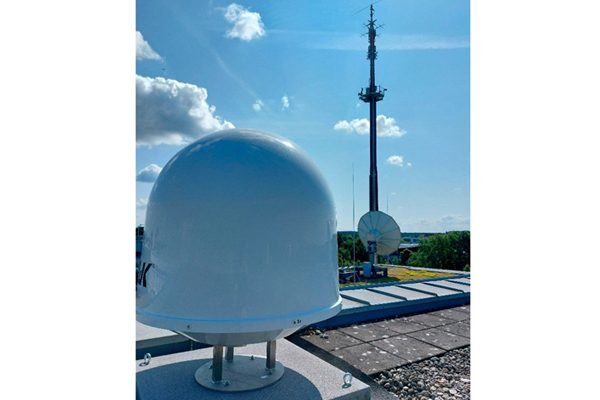
To enable broadband 5G operations in the Ka-band, the Fraunhofer IIS team developed specialized transmission and reception equipment, as conventional satellite communications have not extensively tested 5G signal transmission at higher gigahertz frequencies. Currently, gateways that incorporate 5G base stations and NTN receiver terminals are not commercially available.
Rainer Wansch, head of RF and SatCom Systems Department at Fraunhofer IIS, remarked, “With the successful demonstration of an end-to-end 5G transmission in the Ka-band, we have shown how broadband 5G connections via satellite can be realized. This provides the basis for satellites to work seamlessly with existing 5G infrastructure in future 3D networks.”
A vital aspect of seamless connectivity in this scenario is the ability to perform precise handovers. Modern GEO satellites deploy multiple transmission beams to deliver signals on Earth. As users transition from one coverage area to another, reliable handover capabilities become critical, especially for mobile applications like in-flight and maritime connectivity.
Fraunhofer IIS successfully executed a handover between the north and south beams of the Heinrich Hertz satellite during these tests, marking a significant milestone. The handover process utilized fully software-defined solutions for both the base station (gNodeB, gNB) and the 5G user equipment (UE), based on OpenAirInterface—the open-source implementation of the 5G protocol stack—optimized for high bandwidth channels and inter-beam transitions.
These advancements make a compelling case for the future integration of satellite technology within existing 5G networks, promising uninterrupted connectivity in a variety of scenarios.
The content above is a summary. For more details, see the source article.









