


Key Takeaways
- Fraunhofer IZM has created a compact 500-kW inverter with peak efficiency over 99% for Mitsubishi Heavy Industries.
- The design incorporates advanced techniques, including embedded silicon carbide MOSFETs and innovative cooling solutions.
- The inverter boasts five times the power density of typical alternatives, showcasing significant advancements in power electronics.
Innovative Power Inverter Development
Fraunhofer IZM has unveiled a groundbreaking 500-kW inverter designed in collaboration with Mitsubishi Heavy Industries. The unit is extraordinarily compact, fitting into a volume of just one liter while achieving a peak efficiency exceeding 99%. It operates on 800 V DC drives and delivers 500 A RMS per phase with an effective inductance of approximately 1 nanohenry and switching speeds reaching 65 V/ns.
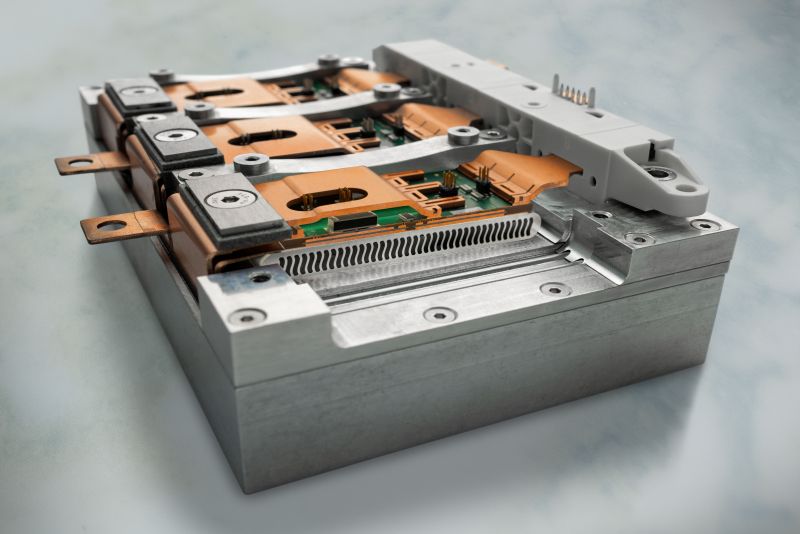
The exceptional performance of this inverter stems from four integrated design approaches. Firstly, the power modules utilize a two-level half-bridge topology, with one module per phase featuring twelve silicon carbide (SiC) MOSFETs directly embedded onto the printed circuit board (PCB). This innovative embedding approach minimizes component height and drastically reduces parasitic inductance. Furthermore, an RC snubber is placed between each module and the DC-link capacitor to mitigate oscillations, enabling the MOSFETs to switch at their physical limits. Achieving faster switching translates to reduced losses, which in turn lessens the cooling requirements.
The second innovation lies in the cooling system. A flat, extruded aluminum heat sink positioned beneath the three modules features over 40 slightly corrugated channels, maximizing the surface area available for heat exchange. The entire heat sink can be produced in a single extrusion process, providing both cost-effectiveness and a compact form factor.
The third aspect of the design enhances the busbar connection. Wiljan Vermeer from Fraunhofer IZM’s Power Electronic Systems group explained that the busbar contacts were laser-welded directly onto the circuit board, eliminating the need for screws that could consume valuable space and increase inductance. Additionally, the vertical arrangement of the two input busbars is designed to partially cancel each other’s magnetic fields, further contributing to the reduction of inductance.
Lastly, the incorporation of NanoLam capacitors in collaboration with PolyCharge addresses the DC-link inductors. These capacitors are specifically tailored for this application and are strategically placed alongside the busbars, resulting in a total DC-link inductance of 2 nH with 300 microfarads of capacitance. Although NanoLam capacitors generate higher thermal losses compared to traditional types, copper contacts have been adopted to enhance heat dissipation. The entire capacitor unit is integrated into the casing below the aluminum cooler, effectively limiting the operating temperature to 130 °C against a maximum of 150 °C.
The significance of this newly developed inverter is highlighted by its impressive performance metrics, claiming to outperform standard inverter alternatives by five times in terms of power density, while surpassing current leading systems by a factor of 2.5 times. Wiljan Vermeer is set to present this innovative inverter at the upcoming PCIM Europe exhibition in Nuremberg, scheduled for June 9-11.
The content above is a summary. For more details, see the source article.









