


Key Takeaways
- German and Spanish companies urge their governments to continue funding for sixth-generation fighter jet expertise after the Future Combat Air System (FCAS) program’s collapse.
- Intra-European disputes between Airbus and Dassault Aviation over leadership and intellectual property contributed to the program’s termination.
- Germany’s Defense Minister Boris Pistorius is exploring options for next-gen fighters, including the purchase of F-35 jets or joining the British-Italian-Japanese Global Combat Air Programme.
Industry Groups Seek Funding Amid FCAS Collapse
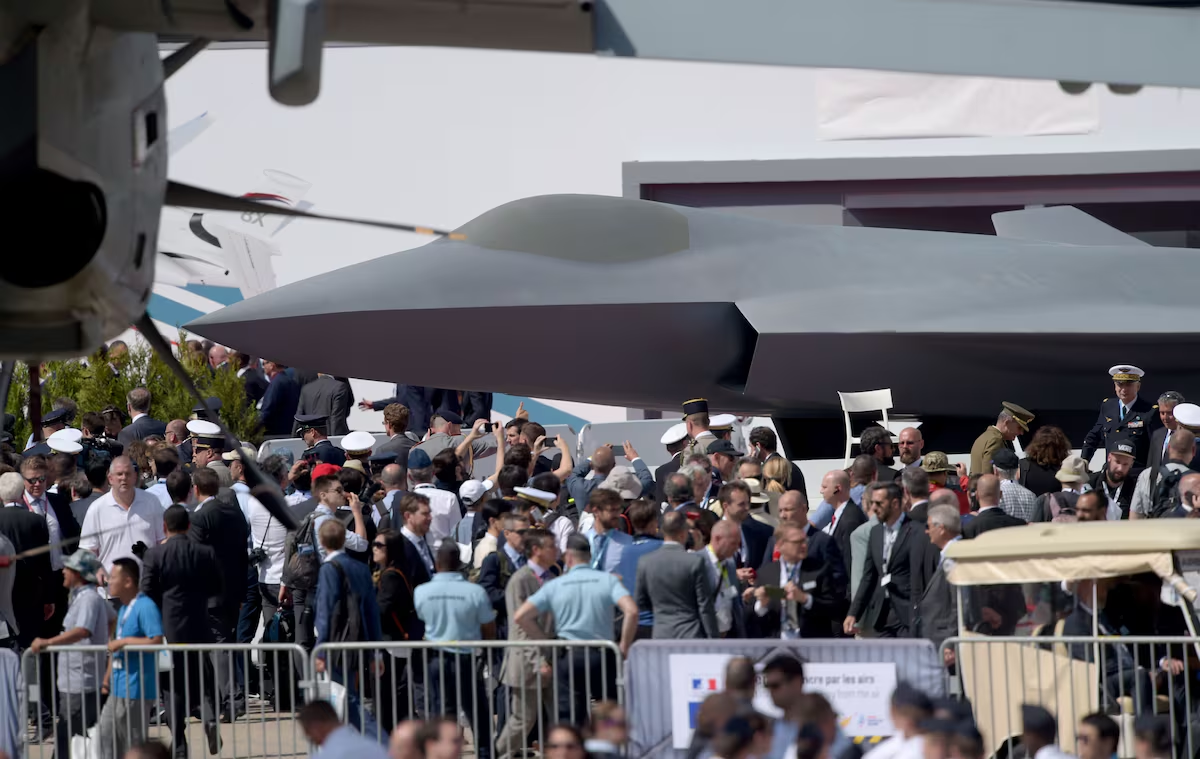
German and Spanish companies involved in the Future Combat Air System (FCAS) program are advocating for their governments to maintain financial support for the expertise developed in sixth-generation fighter jet technology. This appeal comes after German Chancellor Friedrich Merz and French President Emmanuel Macron decided to abandon the sixth-generation fighter segment of the FCAS initiative.
The sixth-generation jet was intended to serve as a cornerstone of the FCAS, alongside complementary drones, sensors, and communication systems designed for integrated warfare. Prolonged disagreements between the primary German contractor Airbus and the French counterpart Dassault Aviation over leadership roles and intellectual property issues ultimately overshadowed political goodwill, leading to the program’s cessation.
In Germany, a consortium called “Team Gen 6” includes major players such as Airbus Defence and Space, Autoflug, Diehl Defence, Hensoldt, Liebherr, MBDA Deutschland, MTU Aero Engines, and Rohde & Schwarz. In a joint statement made at the ILA Berlin Airshow, these companies emphasized the necessity of continuing the development of a sixth-generation fighter plane, stating that “an effective new setup is now indispensable for achieving our common objective: a superior European air combat system for our collective security.”
They highlighted the urgency of securing funding before existing FCAS contracts expire at the end of this year, warning that any delay would lead to an “irreversible” loss of expertise. Spanish companies involved include Indra, the Spanish arm of Airbus Defence and Space, Grupo Oesia, GMV, ITP, and Sener, all expressing a willingness to collaborate in a multinational framework for future jet development. They are open to potential partnerships with ongoing initiatives like the Global Combat Air Programme (GCAP) involving the UK, Italy, and Japan.
German Defense Minister Boris Pistorius outlined potential paths for Germany to address its future fighter jet needs. One option involves procuring F-35 jets from the United States. An alternative could see Germany join forces with the GCAP. A third option entails leading a new Airbus-driven project in collaboration with other industry players, which aligns closely with the focus of the joint statement issued by the German companies.
As discussions continue, the emphasis on international collaboration and a unified European air defense strategy underscores the importance of maintaining technological capabilities in the face of shifting geopolitical challenges. The evolving situation calls for strategic planning to ensure that Europe can secure its air combat advantages in an increasingly competitive global landscape. The future of sixth-generation fighter projects now hangs in the balance, contingent on the decisions made by German and Spanish authorities and their industrial partners.
The content above is a summary. For more details, see the source article.









