


Key Takeaways
- The government supports the ethanol-blended petrol program, citing benefits for the sugar economy and foreign exchange savings.
- Maize is now the primary source for ethanol production, with India’s capacity increasing significantly.
- The program aims to reduce reliance on crude oil and CO2 emissions while improving farmers’ incomes through ethanol production.
Government Defends Ethanol-Blended Petrol Program
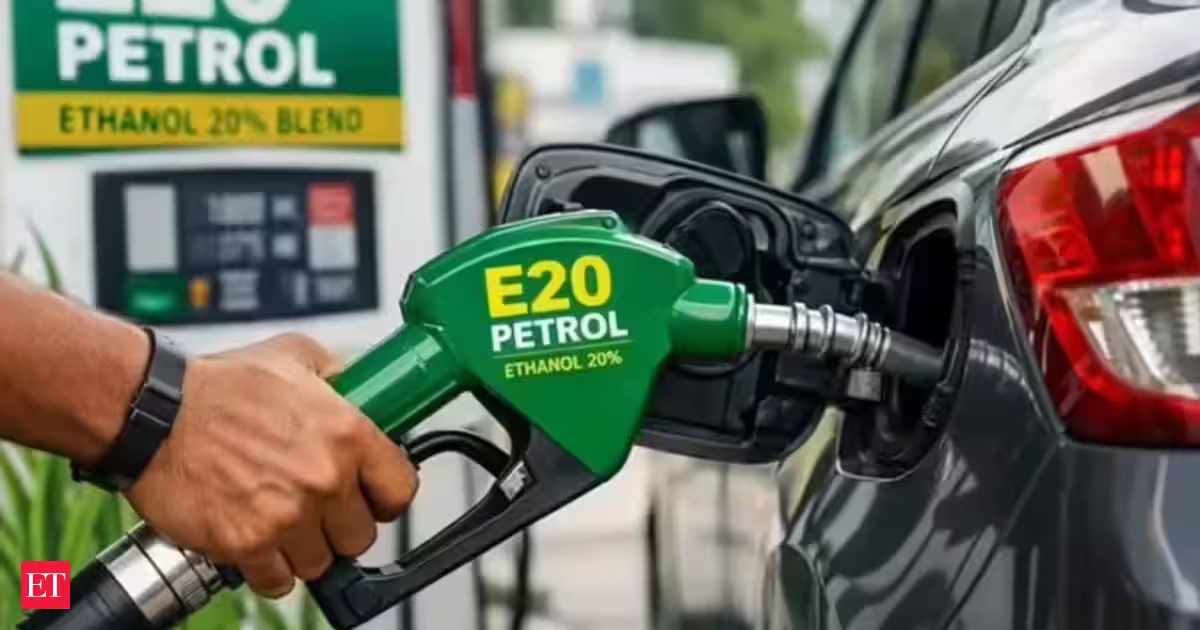
The Indian government has reaffirmed its commitment to the ethanol-blended petrol (EBP) initiative during a recent conclave hosted by the Grain Ethanol Manufacturers Association (GEMA). Concerns have been raised regarding potential engine damage and reduced mileage from using ethanol-blended fuel. However, Joint Secretary in the food ministry, Ashwani Srivastava, emphasized that the program has generated significant benefits for the agricultural sector and the national economy.
Since its introduction in 2014-15, the EBP program has contributed to over Rs 1.90 lakh crore in foreign exchange savings by substituting more than 310 lakh tonnes of crude oil with ethanol, alongside a reduction of approximately 930 lakh tonnes in net CO2 emissions. The initiative has proven beneficial for sugarcane farmers, ensuring timely payments and decreasing arrears to the lowest levels in history.
The government has provided substantial subsidies—approximately Rs 14,600 crore between 2014-15 and 2020-21—to sugar mills. Notably, no export subsidies were needed starting from 2021-22, as mills have shifted surplus sugar production toward ethanol manufacturing.
Maize has emerged as the leading input for ethanol production, making up 47 percent of supplies to oil marketing companies for 2024-25 and 36 percent in the current supply year. This shift has allowed maize farmers to experience better financial returns.
India’s ethanol production capacity has skyrocketed from about 21 crore litres in 2013-14 to nearly 2,000 crore litres today. The EBP program’s success has been particularly valuable during times of rising crude oil prices driven by regional instability, as it has allowed for significant foreign exchange conservation.
Srivastava also highlighted recent government initiatives, including a reduction in permissible broken grain content in rice supplied under the Pradhan Mantri Garib Kalyan Anna Yojana. This adjustment will provide higher-quality rice for over 50 crore beneficiaries while allowing excess broken rice to be channeled for industrial uses, such as ethanol production.
The government is promoting flex-fuel vehicles (FFVs) that can operate on a range of ethanol blends, enhancing consumer choice and supporting the broader ethanol blending strategy. GEMA’s President, C K Jain, stated that the EBP program underwent extensive research before approval, with rigorous testing conducted over four years to assess the impact of E20 on engine performance.
Jain pointed out that the primary challenge facing the ethanol sector is not production volume, but rather public perception. He called for a clear roadmap for future developments beyond E20, which may enhance farmer productivity and bolster the sector further. He noted India’s robust investment in ethanol production, highlighting it as a significant effort compared to investments made by other countries, such as the US.
Overall, the government’s backing of the ethanol-blended petrol program reflects its commitment to bolstering rural incomes, enhancing energy security, and promoting environmental sustainability.
The content above is a summary. For more details, see the source article.









