


Key Takeaways
- AI is enhancing production workflows by automating tasks and analyzing data, helping print service providers meet modern demands.
- Current AI implementations focus on optimizing processes rather than achieving full automation, with an emphasis on workflow management.
- As interest in AI grows, businesses are increasingly exploring strategic applications to harness data and improve operational efficiency.
AI’s Impact on Production Printing
Artificial intelligence (AI) has transformed from a futuristic concept to a practical tool within the production printing industry. While previously limited to demonstrations and trials, AI has become integral to the operations of many larger, tech-savvy print service providers (PSPs). Contrary to expectations of a complete overhaul of production processes, AI is facilitating smaller, incremental improvements that enhance efficiency and adaptability.
Print service providers are facing growing pressures—clients seek shorter print runs, faster turnaround times, and greater customization, which traditional systems struggle to manage. AI offers solutions by analyzing vast amounts of production data to make informed predictions, automate decisions, and optimize workflows. Key areas for AI applications include scheduling, estimating, and production planning, allowing organizations to integrate AI without extensive technical expertise.
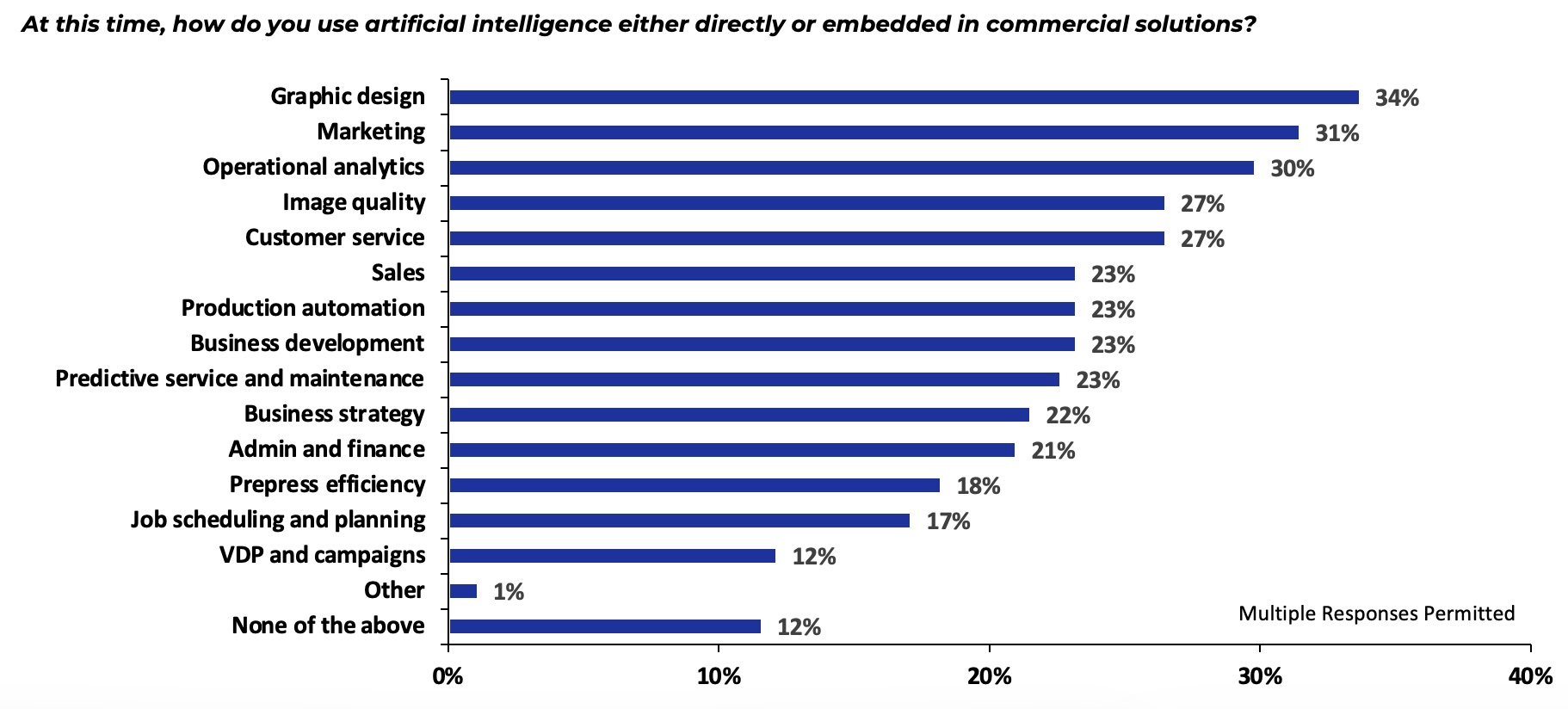
Ongoing research indicates that businesses primarily utilize AI for efficiency-related tasks, focusing on automation and data analysis rather than autonomous operations. The integration of AI into existing workflows helps to improve processes without completely replacing established systems. Looking ahead, companies plan to adopt AI more strategically, particularly in areas such as predictive maintenance and production automation.
AI’s ability to transform raw data into actionable insights is invaluable. Many printing environments generate substantial data, much of which often goes unrealized. By employing AI, organizations can identify trends, recommend improvements, and mitigate potential issues. An example of effective AI usage is predictive maintenance, where potential equipment failures are flagged early, minimizing downtime and enhancing overall productivity.
In robotics, there is an emerging interest in automation for tasks like material handling. Robotics are increasingly deployed for repetitive tasks, such as moving materials or loading/unloading operations, which are labor-intensive and ripe for automation. AI enhances these robotic systems, making them more adaptable and responsive, potentially leading to collaborative environments with humans and robots working alongside each other.
Despite the growing interest, AI adoption varies significantly among firms. Larger companies with more resources are ahead of the curve, while smaller PSPs exhibit caution due to challenges in integrating AI with legacy systems and concerns over ROI. Moreover, many organizations struggle with the need for high-quality data to train AI systems effectively.
Currently, AI in production printing is seen as foundational rather than revolutionary. The emphasis remains on smaller, practical improvements such as better scheduling and enhanced analytics. The successful adoption of AI will depend on aligning initiatives with business objectives and improving data utilization. Vendors play a crucial role in easing access to AI by integrating it into familiar platforms, fostering a smoother transition for businesses exploring these technologies.
The content above is a summary. For more details, see the source article.









