


Key Takeaways
- Reset domain crossing (RDC) verification is vital for identifying potential functional failures in complex system-on-chips (SoCs).
- Conventional structural analysis often reports false violations, complicating design verification efforts and increasing debugging time.
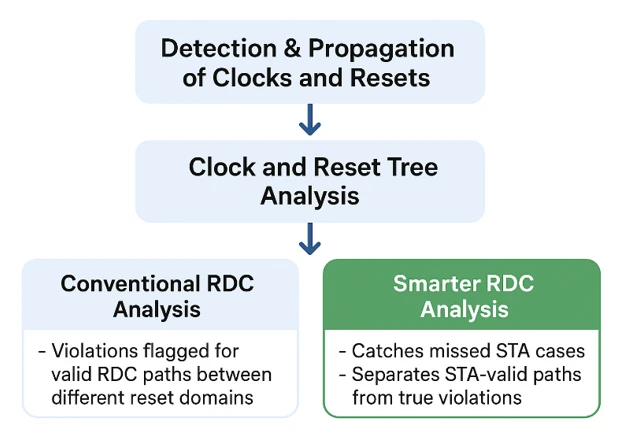
- A new context-aware methodology can distinguish safe implementations from genuine risks, improving verification efficiency and accuracy.
The Evolution of RDC Verification
Modern system-on-chips (SoCs) have evolved to integrate a multitude of intellectual property (IP) blocks and control mechanisms, which drives significant advancements in functionality and performance. However, this complexity has led to increased verification challenges, notably reset domain crossing (RDC) verification—a critical process for ensuring different reset domains interact correctly to avoid metastability and functional failures.
As SoCs grow in complexity, the challenge of verification noise arises. Engineering teams frequently find themselves investigating numerous RDC violations that turn out to be safe rather than addressing actual design errors. This shift in focus raises a vital question: Can engineers differentiate between actual design risks and safe implementation choices?
Limitations of Conventional RDC Verification
Traditional RDC verification predominantly bases its findings on structural analysis. Any interaction between sequential elements across different reset domains is flagged as a possible violation, a conservative approach aimed at minimizing undetected bugs. However, this perspective fails to consider the designer’s intent and the advanced architectures often present in modern SoCs.
Many systems utilize sophisticated reset mechanisms, including reset controllers and synchronized generation, to ensure correct behavior across multiple reset domains. As a result, many reported violations do not pose a real risk, leading to overwhelming numbers—sometimes thousands or tens of thousands—of flagged violations, complicating the debugging process.
Understanding Reset Behavior vs. Risks
A common misconception is that simply having different reset domains signifies a metastability risk. The reality is that safety hinges on how resets interact with the clock, not merely their categorization across domains. For instance, in scenarios where transmitter and receiver registers share a clock yet belong to different reset domains, the synchronization can render the crossing functionally safe, even if conventional analysis suggests otherwise.
For example, if a transmitter reset is generated synchronously, its effects will align with the clock, mitigating asynchronous risks. As such, a detailed approach is necessary for accurately assessing these crossings.
A Context-Aware RDC Verification Methodology
The paramount shift in RDC verification involves evaluating the specific context of each crossing. Instead of merely confirming structural differences, context-aware verification considers crucial factors, such as the method of reset generation, clock synchronization, and whether static timing analysis (STA) can confirm the crossing’s safety.
When crossings are deemed safe by these criteria, they are categorized as timing-safe rather than functional violations. This enhanced classification allows engineers to concentrate on real functional problems while still addressing timing through appropriate validation strategies.
Improving Verification Efficiency
This new methodology does not aim to reduce the number of checks but to enhance classification. True RDC risks remain recorded while timing-safe crossings are reclassified as cautions, facilitating prioritized debugging efforts.
Quantitative benefits have been observed in real-world applications. For instance, a comprehensive verification on a large industrial design initially reported around 50,000 violations. By implementing STA-aware classification, roughly 10,000 crossings were confirmed as timing-safe, resulting in a nearly 20% reduction in reported violations without compromising the integrity of genuine hazard detection.
Future Directions
As verification technologies advance, the need for tools that comprehend design context becomes increasingly important. A combination of traditional analysis with timing awareness will lead to significant reductions in false positives and more meaningful insights, allowing engineering teams to hone in on actual design challenges rather than safe resets.
The content above is a summary. For more details, see the source article.









