


Key Takeaways
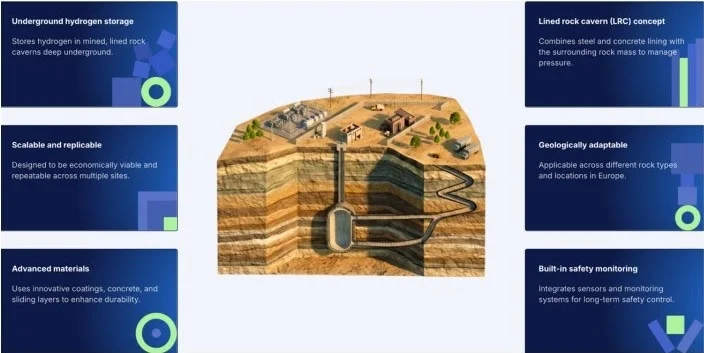
- The HyCavern project, a European initiative, aims to develop underground hydrogen storage solutions using lined rock caverns.
- Focusing on scalability and adaptability, the project seeks to enhance hydrogen storage across diverse geological conditions.
- Supported by a consortium of 15 partners, HyCavern will explore advanced materials, monitoring technologies, and cost-effective designs over three years.
Innovative Underground Hydrogen Storage Solutions
The HyCavern project has launched with the goal of developing next-generation underground hydrogen storage solutions specifically designed for mined, lined rock caverns. Coordinated by SINTEF Industry and led by experts Dr. Pierre-Rolf Cerasi and Dr. Mohammad Masoudi, the initiative unites 15 partners from across Europe, tackling a critical challenge for the region’s hydrogen economy: the need for large-scale, safe, and adaptable hydrogen storage systems.
With the increasing integration of renewable energy sources, hydrogen’s role is becoming crucial in balancing energy supply and demand, facilitating industrial decarbonization, and enhancing energy security. However, current underground storage technologies are often limited by geological prerequisites. The HyCavern project aims to overcome these constraints by developing lined rock cavern (LRC) systems that allow hydrogen storage in areas where traditional methods are not feasible.
The project’s approach will fuse advanced materials and technologies to create cost-effective and standardized solutions for hydrogen storage. Over a three-year period, HyCavern will focus on several key development areas:
- Advanced Steel Liner Solutions: Using laser welding and protective coatings to minimize risks of hydrogen embrittlement and leakage.
- Testing of Low-Carbon Materials: Evaluating new concrete and rock-interface systems to enhance structural integrity and environmental performance.
- Simulation and Optimization Tools: Creating digital tools to support cavern design across various geological contexts.
- Integration of Monitoring Technologies: Employing fiber-optic sensing, 3D-printed sensors, and digital twins for real-time monitoring.
- Validation of Storage Concepts: Testing lined rock cavern systems under realistic conditions to confirm their viability.
- Site Selection Toolkit Development: Producing a GIS-based tool to assist with selecting suitable storage locations across Europe.
- Economic Assessment: Evaluating the techno-economic feasibility, market potential, and business models to support future storage initiatives.
A primary goal of the HyCavern project is to enhance the scalability and replicability of underground hydrogen storage solutions by accommodating a variety of geological conditions. This flexibility is expected to unlock storage capabilities in locations not suited for conventional solutions, ultimately aiding Europe in its clean energy transition.
The initiative is backed by the Clean Hydrogen Partnership and involves a diverse consortium that includes prominent research organizations, universities, technology firms, and industrial partners from multiple countries, such as SINTEF (Norway), Fundación Hidrógeno Aragón (Spain), and the University of Edinburgh (UK). The consortium aims to engage effectively with stakeholders, sharing valuable findings with industry, policymakers, and researchers involved in the future of hydrogen storage.
By combining cutting-edge engineering and research, HyCavern is poised to contribute significantly to the development of sustainable hydrogen storage solutions that will play a pivotal role in Europe’s energy landscape.
The content above is a summary. For more details, see the source article.









