


Key Takeaways
- Hyundai Mobis will launch a new research base in Silicon Valley to enhance semiconductor technology development.
- The company is set to mass-produce key semiconductors, including power integrated chips for electric vehicles.
- Hyundai Mobis aims to strengthen its capabilities in both power and system semiconductors for future mobility solutions.
Hyundai Mobis Establishes Silicon Valley Research Base
Hyundai Mobis has announced plans to establish a specialized research base in Silicon Valley this year to enhance its research and development of vehicle semiconductors. This new facility will run alongside domestic research institutes, focusing on semiconductor design technologies tailored for both Korean and international markets.
The company has also completed the research and reliability testing of semiconductors essential for various automotive components including electrical systems and lighting, and it has commenced mass production. Key semiconductors being produced this year include power integrated chips and lamp-driven semiconductors that integrate electric vehicle power control functions. This follows the existing battery management integrated circuits, which help monitor electric vehicle charging status and enhance overall stability.
Over the past few years, Hyundai Mobis has prioritized R&D, positioning automotive semiconductors as pivotal for future mobility. The acquisition of Hyundai Autron, an affiliate within the Hyundai Motor Group, in 2020 has advanced this trajectory by enabling the establishment of a dedicated semiconductor business unit, which has grown to employ over 300 professionals.
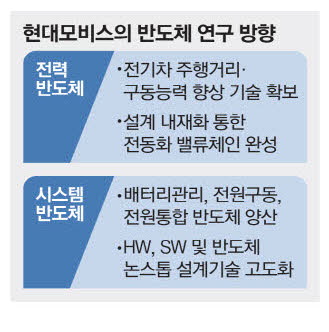
Hyundai Mobis’s R&D efforts are primarily focused on two categories: power semiconductors and system semiconductors. The company aims to develop an ‘Electricization Value Chain’ by internalizing power semiconductor design, which is crucial for improving the driving range and capabilities of electric vehicles. Currently, Hyundai Mobis is mass-producing ‘Power Modules,’ which consolidate multiple power semiconductors into a single unit equipped with cooling functionality. This initiative is part of a broader strategy to create a complete electric vehicle driving system, integrating power semiconductors, power modules, inverters, and motor-PE systems.
In addition to power semiconductors, Hyundai Mobis also intends to advance its system semiconductor capabilities. These semiconductors perform crucial functions encompassing power management, driving dynamics, communication, sensing, and networking. The company plans to enhance its design capacities in this area and establish a comprehensive ecosystem for other types of semiconductors, thereby improving its supply and demand responsiveness in the market.
The content above is a summary. For more details, see the source article.









