


Key Takeaways
- The U.S. Army’s budget request includes a 12.9% increase in research and development funding, totaling $18.7 billion for 2027.
- Congressional leaders express concern over reduced financial management and audit readiness amidst increasing R&D expenditures.
- Key investments include advancements in communication technology, military aircraft, and modernization of existing systems.
R&D Budget Increase Sparks Accountability Concerns
The U.S. Army’s proposal for a budget of $253 billion includes a notable 12.9% increase in research and development (R&D) funding, amounting to $18.7 billion in 2027, up from $16.6 billion in 2026. This funding aims to maintain a technological edge, according to Army officials. However, concerns have arisen among congressional leaders regarding accountability in light of decreasing funds dedicated to financial oversight and auditing.
During a recent House Appropriations Subcommittee hearing, Rep. Betty McCollum of Minnesota highlighted these issues. She noted that while investments in applications, infrastructure, and data are expanding, the budget now features significantly fewer lines dedicated to auditing—dropping from 41 to just four. This compression raises alarms about the Army’s ability to manage funds transparently. McCollum articulated the risk, stating, “We might have a discussion about what you’re going to do, but without the lines, we don’t have the accountability.”
The focus of the increased R&D funding extends beyond mere budget numbers; it raises the question of where this money will be allocated. Highlights from the Army’s budget reveal a commitment of $2.9 billion to a science and technology fund aimed at developing next-generation systems for the Army by 2040. Investments will include various procurement items such as loitering munitions and advanced night vision goggles.
Significant allocations within the budget include:
- $904 million for the Next Generation Command and Control (NGC2), designed to update the Army’s communications technologies. A prototype was developed by Anduril Industries for $99.6 million last year, integrating technologies from companies like Palantir and Microsoft for improved decision-making.
- $2.1 billion for the MV-75 Cheyenne II tiltrotor aircraft, touted as a revolutionary platform intended to eventually replace the long-serving UH-60 Black Hawk.
- $474 million for Abrams M1E3 modernization, part of a multi-year initiative to enhance the Army’s main battle tank, with plans to include a hybrid-electric drive and advanced AI capabilities. This upgrade comes as the Army shifts from the older M1A2 upgrade to the more sophisticated M1E3 by 2030.
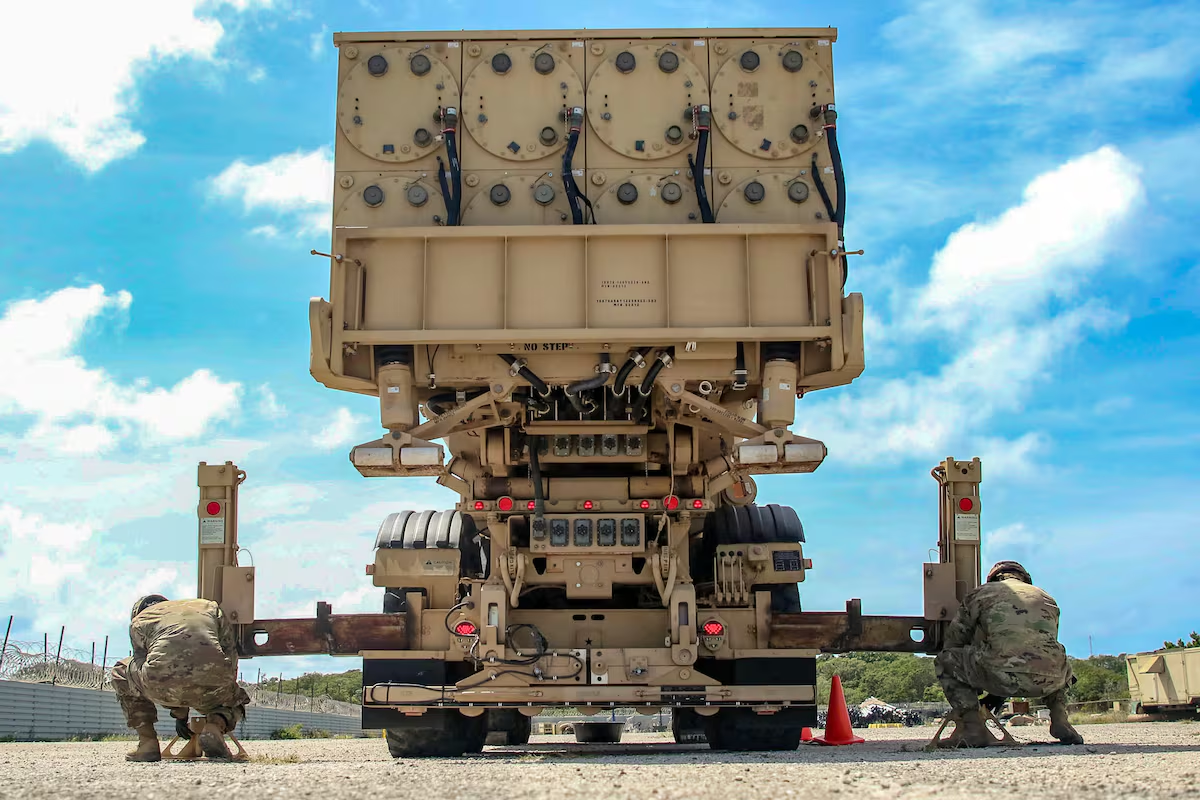
- $1.1 billion to transfer the Terminal High Altitude Area Defense (THAAD) system to Army control, a move aimed at simplifying oversight and integration of ballistic missile defense.
In response to concerns raised by Rep. McCollum, Army Secretary Dan Driscoll acknowledged past management issues regarding taxpayer funds. He emphasized the necessity of increased flexibility in the budget to keep pace with the rapid evolution of technology, asserting that innovation requires adaptive resource allocation.
Driscoll proposed leveraging technology for enhanced visibility over financial management, mentioning the Army’s Vantage dashboard developed by Palantir, which offers comprehensive reporting capabilities. However, McCollum reiterated the need for robust auditing processes, underscoring that budget discussions should be a collaborative process between the Army and Congress.
The evolving budget landscape presents a balancing act between fostering innovation and ensuring accountability, with stakeholders keenly watching how funds will be managed to optimize both technological advancements and responsibility to taxpayers.
The content above is a summary. For more details, see the source article.









