


Key Takeaways
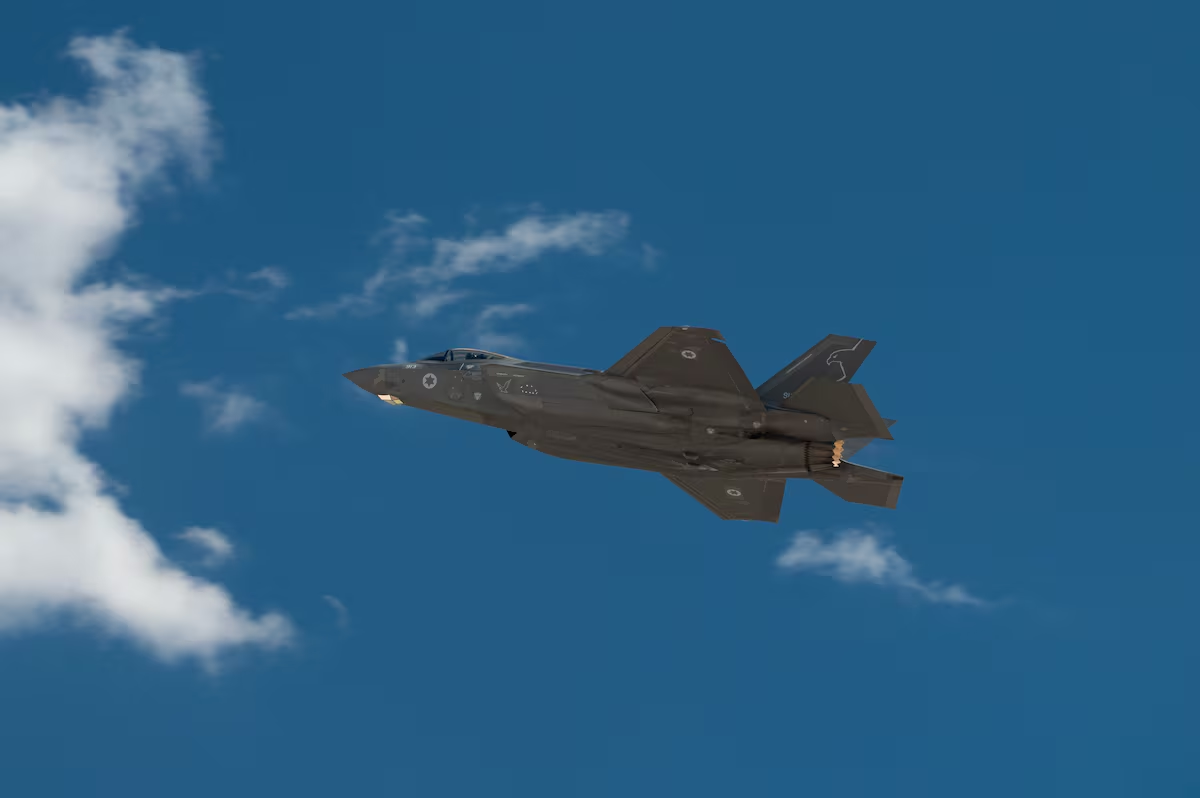
- Israel plans to enhance the range of its F-35I ‘Adir’ fighter jets, with a contract awarded to Elbit Systems worth approximately $34 million.
- The upgraded range will be supported by external fuel tanks based on the F-16I “Sufa” design.
- This initiative follows recent military activities, including an air-to-air combat success involving the F-35I against Iranian targets.
Range Upgrade for F-35I Fighter Jets
Israel’s defense ministry announced on May 14 its plans to extend the operational range of its F-35I ‘Adir’ fighter jets. While specific range targets were not disclosed, the existing F-35A model, which the Israeli variant is based upon, has a reported range of 1,200 miles.
The ministry noted that the project will focus on developing external fuel tanks, utilizing a design from the F-16I “Sufa,” which has a range of about 1,300 miles. Elbit Systems has been contracted for this development, with the contract amounting to approximately $34 million (100 million NIS).
This announcement takes place during a delicate ceasefire between the U.S. and Iran, following Israel’s recent military operation dubbed “Lion’s Roar.” During this operation, an F-35I achieved a significant milestone by securing the first air-to-air kill attributed to an F-35 in combat, successfully taking down an Iranian Yak-130, a Russian-built trainer aircraft used in a light-attack capacity.
Currently, Israel operates a fleet of 50 F-35I aircraft across two squadrons. In 2023, the country is expected to receive an additional 25 jets, and negotiations for another 25 have recently begun. If successful, this would increase Israel’s F-35I fleet to a total of 100 aircraft, thereby establishing four squadrons.
The F-35I “Adir” is distinguished as a fifth-generation multi-mission stealth fighter aircraft, specifically designed and manufactured by Lockheed Martin according to Israel’s unique operational requirements. The aircraft integrates advanced stealth technologies, sophisticated data fusion, and the capability to carry internal weaponry. Moreover, it incorporates Israeli-made electronic warfare systems, communications, and computing capabilities within the framework of American infrastructure.
The developments surrounding the F-35I highlight Israel’s ongoing commitment to enhancing its aerial combat capabilities amid a complex geopolitical landscape.
The content above is a summary. For more details, see the source article.









