Key Takeaways
- Astronomers have identified GLIMPSE-17775 as likely being a black hole star, potentially resolving the mystery of “little red dots” detected by the James Webb Space Telescope.
- These red dots, appearing shortly after the Big Bang, may disappear due to intense growth phases and the clearing effects of supermassive black holes.
- The discovery provides new insights into the evolution of the universe and is supported by multiple lines of observational evidence.
Discovery of GLIMPSE-17775
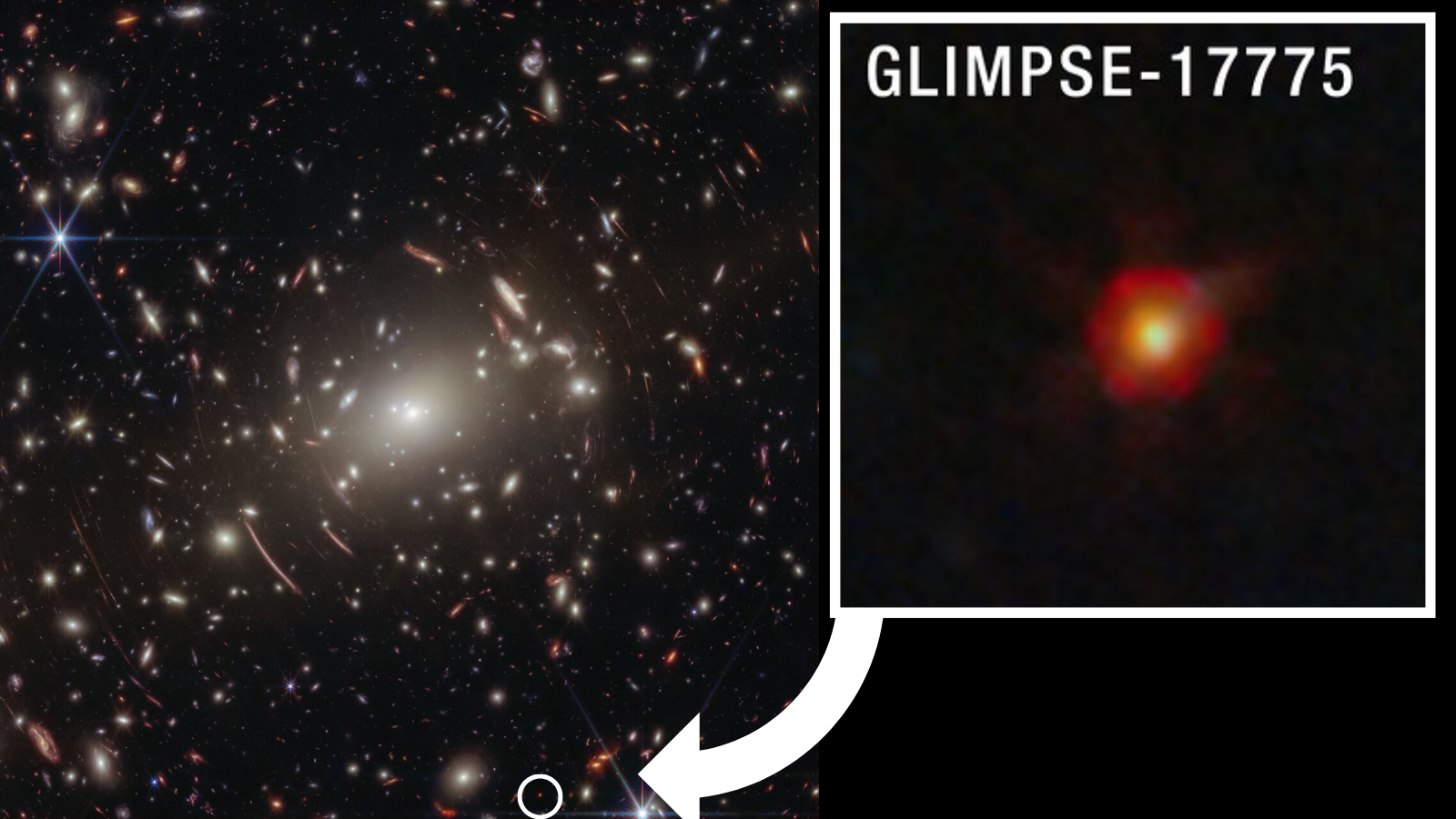
Astronomers utilizing the James Webb Space Telescope (JWST) are edging closer to understanding the enigmatic “little red dots” observed in the early universe. Among these objects, one named GLIMPSE-17775 has been identified as a likely black hole star—a supermassive black hole shrouded in a dense cloud of partially ionized gas. These little red dots became prominent in data from the JWST beginning in June 2022, with their appearance noted around 600 million years after the Big Bang. They vanish before the universe reaches 2 billion years, leading some scientists to speculate about their potential to “break cosmology.”
One of the leading theories regarding these mysterious objects is that they are black hole stars. This hypothesis suggests that their disappearance results from rapid growth phases causing them to burn out or from supermassive black holes at their centers dispersing the dense gas and dust that obscures them. Until recently, observational evidence supporting this theory was lacking. However, JWST’s observations of GLIMPSE-17775, occurring just 1.8 billion years post-Big Bang, may offer significant insights.
The Role of Gravitational Lensing
The JWST observed GLIMPSE-17775 while analyzing the galaxy cluster Abell S1063, which serves as a gravitational lens. This phenomenon, first predicted by Albert Einstein, bends light due to its immense gravitational pull, allowing scientists to see objects that would otherwise be hidden. The JWST transformed about 30 hours of observation into a more comprehensive understanding of GLIMPSE-17775.
Upon analyzing the spectrum of GLIMPSE-17775, researchers likened the process to assembling a puzzle. They identified key signals such as the scattering of electrons and emissions indicating a dense gas cocoon surrounding the object. Additionally, observations of fluorescence and helium absorption were also noted. An unexpected “iron forest” appeared in the spectra, linked to the rapid energy output of a supermassive black hole, which aligns with the black hole star hypothesis.
Emerging Insights and Future Directions
GLIMPSE-17775 lacks a strong “Balmer Break,” a typical spectral feature found in similar objects, which researchers suggest may be due to its encirclement by a large host galaxy. This observation complements existing models of cosmic evolution and enhances the understanding of little red dots.
The researchers express excitement over the potential to uncover more about the mechanisms powering these objects. While the leading theory points to black holes, alternative explanations are still being considered. More observations over the next couple of years could provide a clearer picture of these fascinating cosmic phenomena. This recent research was published on June 10 in The Astrophysical Journal, marking a significant step in mastering the mysteries of early cosmic history.
The content above is a summary. For more details, see the source article.