

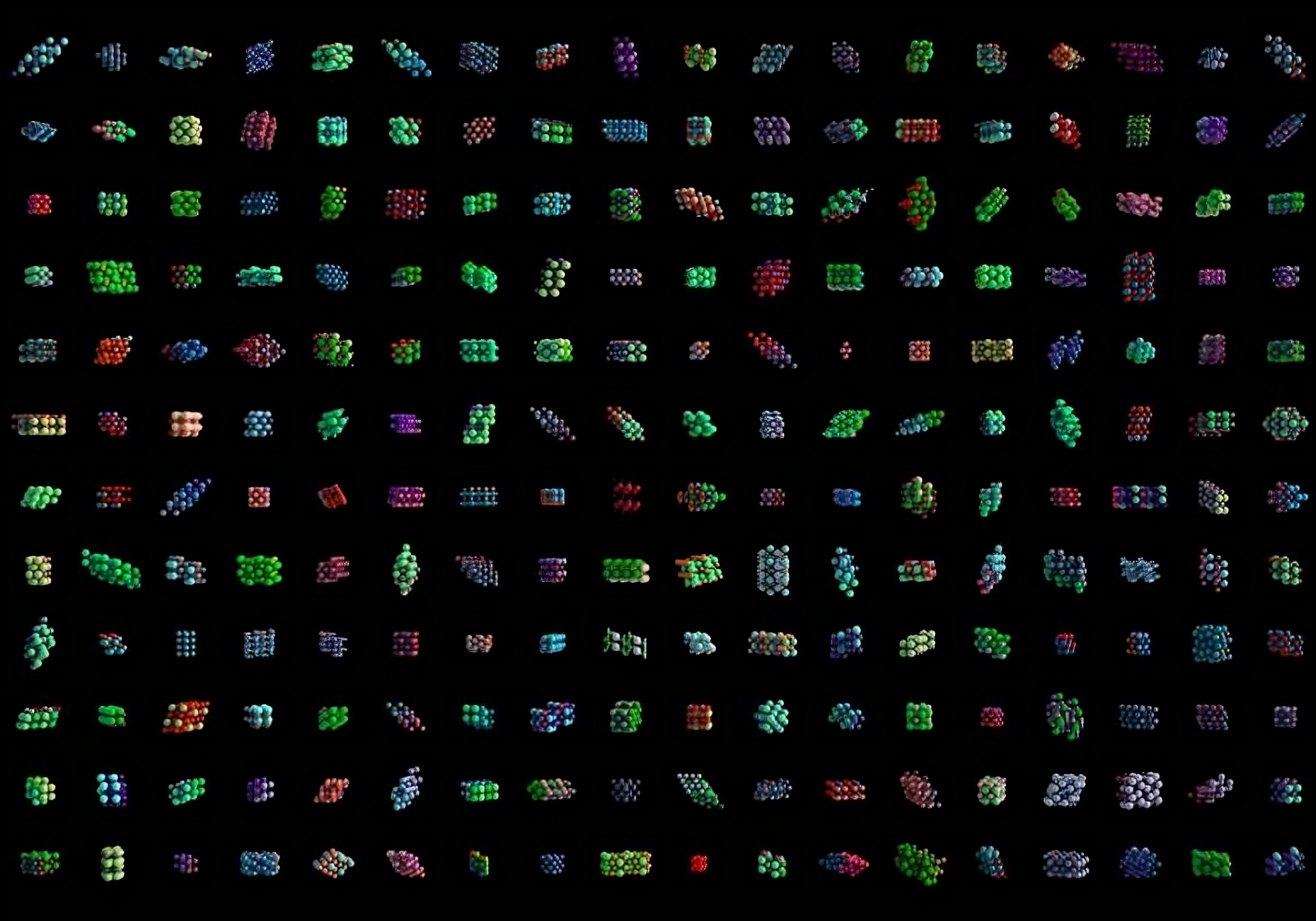
Key Takeaways
- Microsoft’s new AI tool, MatterGen, revolutionizes materials discovery by generating novel materials based on specific design criteria rather than traditional screening methods.
- The model significantly outperformed conventional techniques in producing materials with desired properties, notably achieving a bulk modulus greater than 400 GPa.
- MatterGen’s potential has been validated through collaboration with researchers, leading to the experimental synthesis of a new material, TaCr₂O₆, with promising results despite slight deviations from targets.
Transforming Materials Discovery with MatterGen
The discovery of new materials is essential to addressing major global challenges, yet traditional methods like trial-and-error are inefficient. Microsoft aims to change this with MatterGen, a new generative AI tool designed to streamline the materials discovery process.
Historically, the search for new materials has involved time-consuming and expensive trial-and-error experiments. While computational screening has sped up the process by sifting through vast databases of materials, it remains labor-intensive and limited in scope. MatterGen offers a groundbreaking alternative that not only accelerates this process but also enhances the ability to explore previously unknown materials.
Described in a recent paper published in Nature, MatterGen is a diffusion model that works within the 3D geometry of materials. Instead of altering pixel values to generate images, this AI tool modifies materials’ structures by adjusting elements, positions, and periodic lattices. This unique approach is finely tuned to meet the specific challenges of materials science, such as 3D arrangement and periodicity.
MatterGen presents a significant departure from conventional computational screening methods, which typically require researchers to comb through extensive databases to find suitable candidates. Rather than searching for existing materials, MatterGen generates original materials based on specific prompts that outline desired properties, such as chemical composition, mechanical strength, and electronic functionality. This AI model was developed using more than 608,000 stable materials from the Materials Project and Alexandria databases.
In empirical comparisons, MatterGen proved superior to traditional screening methods, particularly in generating novel materials with properties such as a bulk modulus exceeding 400 GPa, indicative of materials that resist compression. As traditional screening methods faced diminishing returns in finding new candidates, MatterGen continued to create innovative results.
Compositional disorder—where atoms within a crystal lattice randomly swap places—poses a common challenge in materials synthesis. Traditional algorithms often struggle to differentiate between similar structures in assessing material novelty. Microsoft addressed this by creating a new structure-matching algorithm that accounts for compositional disorder, enabling precise evaluations of material uniqueness.
To validate MatterGen’s efficacy, Microsoft collaborated with researchers at the Shenzhen Institutes of Advanced Technology to synthesize a material designed by the AI—TaCr₂O₆. While the synthesized material achieved a bulk modulus of 169 GPa, slightly below the target of 200 GPa, the relative error of 20% indicates that MatterGen’s predictions are close to reality. Notably, compositional disorder was present, yet the structure conformed closely to model predictions.
Microsoft sees MatterGen as a complementary tool alongside its earlier AI initiative, MatterSim, which enhances simulations of material properties. Both tools together create a feedback loop that accelerates the exploration and simulation of new materials’ properties, reflecting what Microsoft calls the “fifth paradigm of scientific discovery.” AI is evolving from mere pattern recognition into a more dynamic role of guiding scientific experiments.
MatterGen’s source code and datasets have been released under the MIT license to encourage further research and broader adoption. Microsoft believes the implications of generative AI extend beyond materials science, with potential parallels drawn to drug discovery, suggesting that MatterGen could transform various fields such as renewable energy, electronics, and aerospace.
The content above is a summary. For more details, see the source article.