


Key Takeaways
- A 20-by-20-foot scaled “smart” city at Cornell’s Information and Decision Science Laboratory enables researchers to enhance transportation safety and efficiency.
- The lab uses a mix of automated and human-driven vehicles to provide valuable data on traffic interactions in a controlled environment.
- Recent funding and partnerships aim to make the testbed accessible to other institutions and advance smart transportation technologies.
Innovative Mini-City for Transportation Research
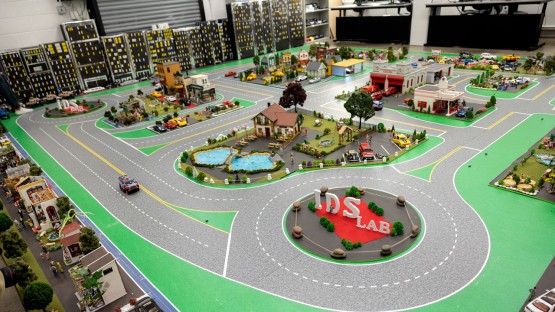
The Information and Decision Science Laboratory at Cornell features a 20-by-20-foot scaled city designed to improve transportation systems. This intricate layout includes residential and commercial spaces as well as a variety of vehicles, all operated in a controlled environment. The aim is to enhance the functionality of connected and automated vehicles, allowing them to interact effectively with their surroundings and each other.
Director Andreas Malikopoulos emphasizes the importance of a physical testbed compared to simulations, highlighting that real-world variables such as miscommunication and unexpected events yield richer data for improving vehicle performance. The project began over a decade ago while Malikopoulos was working at Oak Ridge National Laboratory, and it became a reality after transitioning to Cornell, where he upgraded to more sophisticated technology.
The laboratory’s motorized fleet, now at 75 cars and 15 mini drones, has been crafted from remote-control vehicles modified with custom electronics and sensors. These vehicles are tracked by eight cameras and GPS systems. Drones supplement the configuration by broadcasting positioning data, which is particularly useful for traffic safety and military convoy protection.
Students working in the lab are actively involved in both hardware development and experimental driving. They can test their driving skills through six emulators and a virtual reality (VR) system that simulates different traffic situations, contributing to the overall research effort. The VR environment is noted for its cost and time efficiency, allowing for safe testing of various scenarios without the logistical challenges of real-world environments.
The research fosters understanding of a cyber-physical system where human-driven and automated vehicles coexist. The results can inform the creation of algorithms that predict vehicle behavior in real time.
Researchers are also exploring the social implications of transportation technology. Collaborations with the Federal Highway Administration aim to make the testbed available as an educational tool for other institutions. A recent $800,000 grant from the National Science Foundation supports advancements in smart, autonomous systems.
As the project expands, plans for a second testbed are underway, and there’s potential to scale the city further, making it even more impactful. This initiative not only pioneers advancements in transportation technology but also acts as a recruitment magnet for aspiring engineers looking to tackle real-world problems through innovative solutions.
The content above is a summary. For more details, see the source article.









