


Key Takeaways
- A new humidity sensor developed by Chinese researchers enhances human activity tracking while ensuring privacy.
- This innovative sensor enables real-time monitoring of subtle changes in respiration, aiding in healthcare and smart home automation.
- The technology classifies up to nine distinct human behaviors with 96.2% accuracy without relying on visual data.
The advent of more practical human activity tracking systems promises significant advancements in healthcare and smart home technology. These systems are designed to monitor and analyze daily activities, facilitating personalized care and treatment for chronic conditions like diabetes. Additionally, they can streamline smart home operations by adjusting elements like lighting and temperature based on user habits.
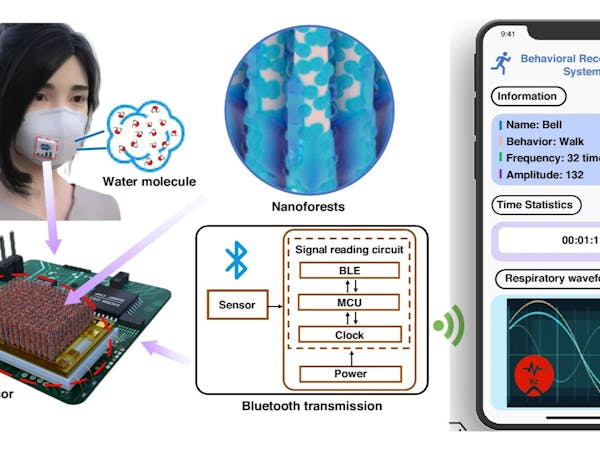
However, traditional activity tracking tools often face acceptance issues due to privacy concerns—many rely on intrusive cameras or awkward wearables. Researchers from the Institute of Microelectronics at the Chinese Academy of Sciences have pioneered a solution with a novel humidity sensor that is both accurate and unobtrusive, protecting user privacy. This sensor detects minimal humidity variations in exhaled air linked to specific physical activities.
Utilizing advanced porous nanoforest material, the sensor significantly improves upon the stability and sensitivity of conventional devices. A built-in micro-heater boosts its functionality, amplifying sensitivity by 5.8 times and allowing for the timely detection of even the slightest changes in breathing within a 2.2-second response time.
To make sense of the data gathered, the system employs a convolutional neural network (CNN) to interpret readings, converting single-dimensional measurements into comprehensive three-dimensional maps. This technology can distinguish between nine different human behaviors with an impressive 96.2% accuracy, enabling real-time activity classification.
Unlike existing tracking methods that use visual data, this lightweight, mask-like device offers a discreet way to monitor activities, transmitting data wirelessly to smartphones or computers for instant analysis. This technology holds promise for various applications, especially in healthcare, where monitoring breathing patterns can provide vital information for patients with respiratory issues such as asthma. Future improvements could lead to even more efficient sensors and expanded capabilities in tracking behavior.
The content above is a summary. For more details, see the source article.









