


Key Takeaways
- Oxford researchers have developed a new technique to identify materials suitable for fault-tolerant quantum computing.
- The scanning tunneling microscope method confirmed that uranium ditelluride (UTe2) is an intrinsic topological superconductor.
- This breakthrough could simplify the search for quantum materials, potentially replacing complex synthetic circuits for topological qubits.
Revolutionizing Quantum Material Discovery
A team from Oxford University has introduced a groundbreaking method aimed at discovering materials essential for the advancement of fault-tolerant quantum computers. This new technique is particularly focused on identifying topological superconductors, which are critical for the next generation of quantum computing.
Quantum computers offer enormous computational advantages over traditional supercomputers. Despite their promise, their performance is hampered by quantum decoherence, where environmental interactions degrade quantum states. For decades, researchers have struggled to find materials that can resist these decoherence effects.
The new study, published in the journal Science, demonstrates the effectiveness of a novel technique that allows researchers to pinpoint materials capable of hosting exotic quantum particles known as Majorana fermions. Unlike standard particles, Majorana fermions can store information with greater stability due to their topological properties, thereby reducing the risks associated with decoherence and improving data retention.
Historically, confirming whether a superconducting material is a viable candidate for intrinsic topological superconductivity has been a challenge. Recent advancements revealed that uranium ditelluride (UTe2), identified in 2019 as a strong contender, is indeed an intrinsic topological superconductor. This identification marks a significant milestone. Researchers initially believed that UTe2 exhibited unusual electron pairing necessary for topological superconductivity, but conclusive evidence was lacking until this study.
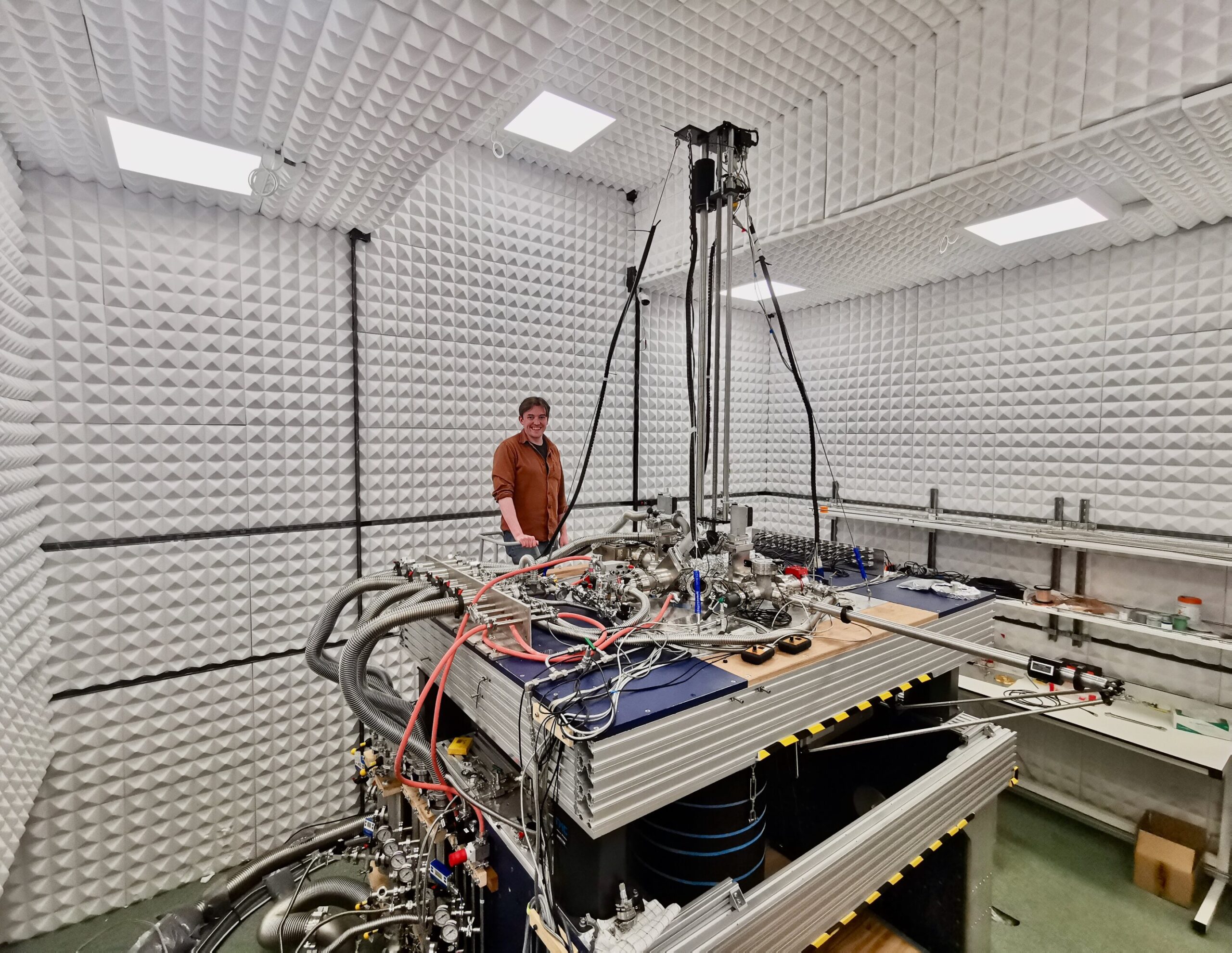
Using an innovative approach involving a scanning tunneling microscope (STM), the team captured ultra-high-resolution images at the atomic level without the need for light or electron beams. The Andreev STM technique, developed by Professor Séamus Davis, allowed researchers to focus specifically on electrons in topological surface states, confirming the predicted behaviors of UTe2 and illuminating its properties.
The findings suggest that while Majorana particles exist in pairs within UTe2, they cannot be isolated—an important factor for practical applications in quantum computing. Nonetheless, the Andreev STM technique represents a significant advancement, enabling precise identification of materials that may host intrinsic topological superconductivity, thereby paving the path for the development of topological quantum computers.
The quest for intrinsic topological superconductors has been fraught with difficulty, primarily remaining a theoretical pursuit. However, researchers globally are mobilized to explore potential candidates further. Earlier this year, Microsoft revealed the Majorana 1, claiming it as the world’s first Quantum Processing Unit with a Topological Core, built from synthetic topological superconductors. The breakthrough stemming from the Davis Group indicates a potential shift toward using simpler crystalline materials, potentially reducing costs and complexity in quantum computing.
Professor Séamus Davis articulated the significance of these findings, emphasizing that the Andreev STM technique and the validation of intrinsic topological superconductivity could drastically enhance efforts to discover optimal materials for quantum computing. Lead author Dr. Shuqiu Wang echoed this sentiment, expressing enthusiasm about the new spectroscopic technique’s potential to unravel more about the intricate physics behind intrinsic topological superconductors.
The collaboration extended to various prestigious institutions, including the University of California—Berkeley, Cornell University, and more, highlighting the collective pursuit of unlocking the mysteries of quantum material science for practical applications.
The content above is a summary. For more details, see the source article.









