


Key Takeaways
- The world’s first Pixel-Based Local Sound OLED technology allows each pixel to emit different sounds simultaneously.
- Developed by POSTECH, this technology eliminates sound crosstalk, enabling precise localization of audio from displays.
- Applications include smartphones, laptops, automotive displays, and virtual reality, enhancing user experience through immersive sound.
Innovative Pixel-Based Sound Technology
A research team led by Professor Su Seok Choi from POSTECH has unveiled the world’s first Pixel-Based Local Sound OLED technology. This groundbreaking innovation enables each pixel in an OLED panel to emit distinct sounds, resembling a multichannel speaker system. The technology was successfully tested on a 13-inch OLED display, paralleling those typically used in laptops and tablets.
The advancement signifies a shift toward multisensory displays. While recent innovations in display technology have elevated picture quality—featuring better resolution, high dynamic range, and color accuracy—there’s a growing need to enhance the immersive user experience through sound. Most current displays rely on external sound systems, creating design obstacles, particularly in compact spaces like vehicles.
Embedding Sound in OLED Displays
Researchers have targeted the challenge of integrating sound directly into OLED displays, renowned for their sleek and flexible designs. Prior attempts have involved attaching external exciters or bending displays around speakers, but these methods often lead to challenges with sound quality, particularly in accurately localizing audio.
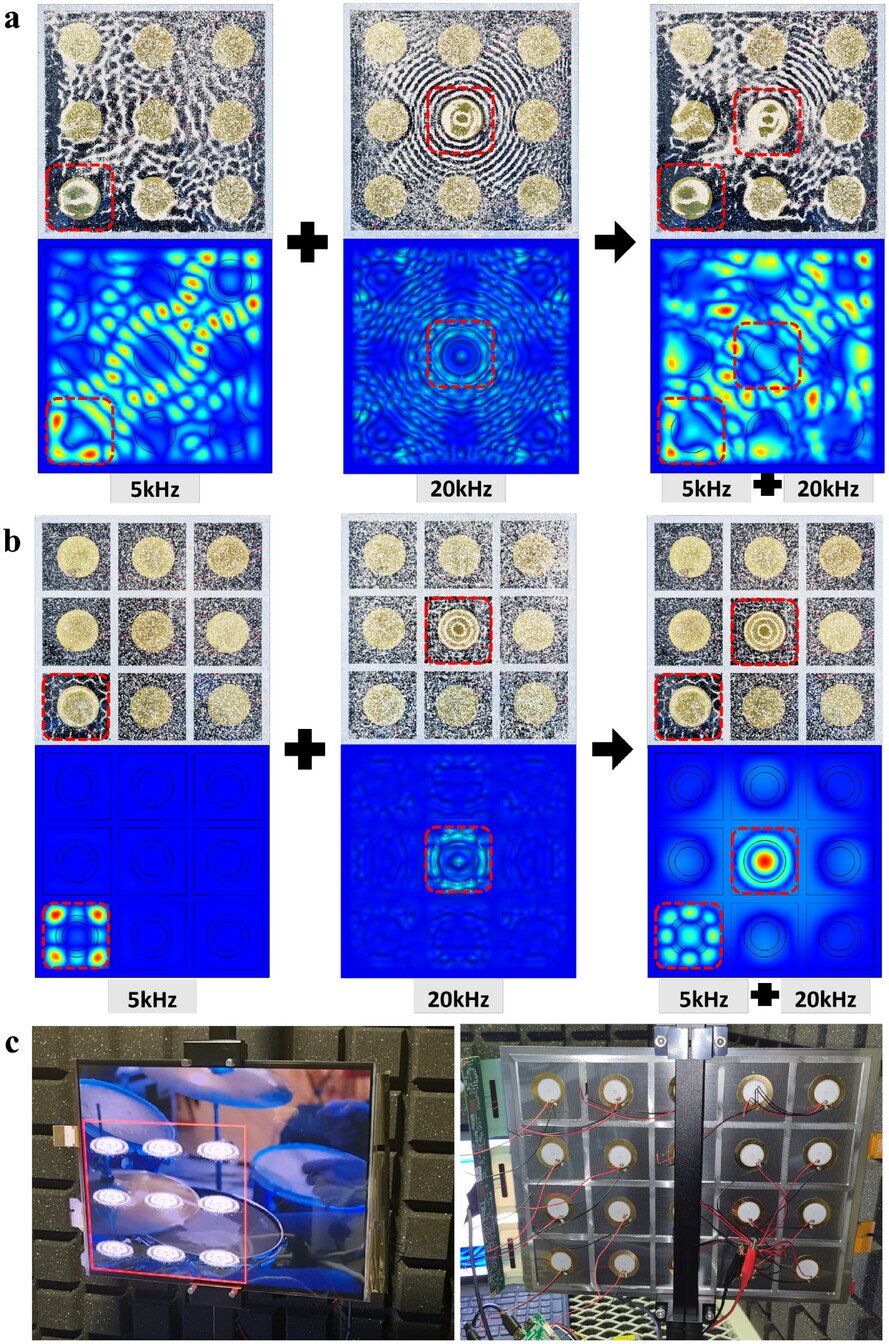
The POSTECH team tackled these issues by embedding ultra-thin piezoelectric exciters within the OLED display frame. These exciters act as independent sound sources alongside the pixels. Unlike traditional exciters, which are bulky, the new design maintains the thin profile of OLED panels and avoids sound crosstalk, allowing for clear and distinct audio from various screen sections—something not feasible in current multichannel setups.
Practical Applications and Future Prospects
This innovative technology paves the way for localized audio experiences. For example, in an automotive setting, a driver could hear navigation prompts while a passenger enjoys music from the same screen. In virtual reality and mobile devices, audio can dynamically adapt to head or hand movements, significantly enhancing the realism of the experience.
The feasibility of this technology has been validated through its implementation on a 13-inch OLED panel, confirming its scalability and potential for commercial production. The display promises high-quality audio directly from the screen without necessitating external speakers, sustaining the lightweight nature of OLED.
Professor Choi emphasizes, “Displays are evolving beyond visual output devices into comprehensive interfaces that engage both sight and sound.” This technology could become a defining aspect of next-generation devices, promoting sleek designs in smartphones, laptops, and automotive displays, while delivering an immersive audio experience.
For further details, this groundbreaking work has been documented in the journal Advanced Science, showing the potential impact of Pixel-Based Local Sound technology on future electronic devices.
The content above is a summary. For more details, see the source article.









