


Key Takeaways
- The Marine Corps plans to test its Aerial Logistics Connector (ALC) prototype in 2024, aiming for operational demonstrations by 2027.
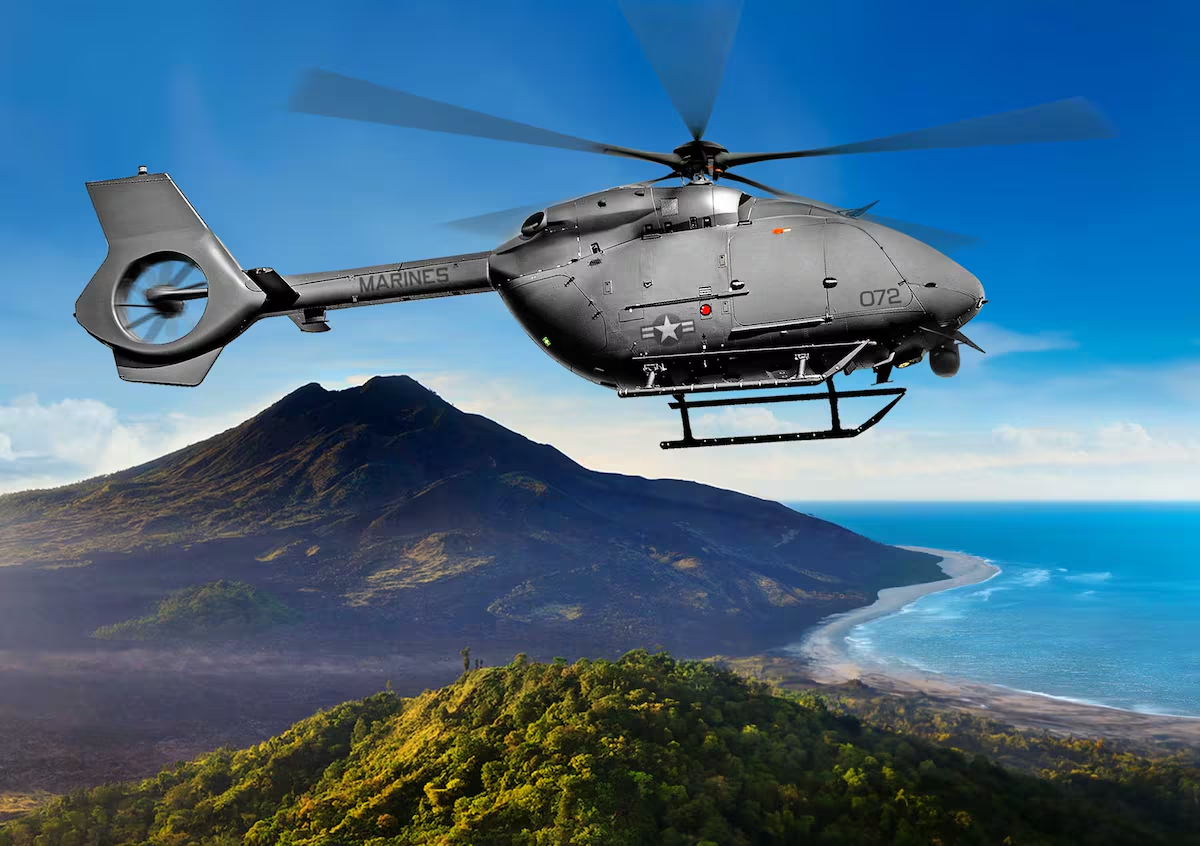
- Airbus and Parry Labs are developing a drone version of the UH-72 Lakota helicopter for the ALC, which has successfully completed several autonomous flight tests.
- ALC and Medium Aerial Resupply Vehicle – Expeditionary Logistics (MARV-EL) are distinct projects designed to enhance logistics capabilities for Marine forces.
Details on Aerial Logistics Connector Development
The Marine Corps is preparing for the testing of its Aerial Logistics Connector (ALC), an advanced unmanned logistics aircraft, in the Pacific next year. Lt. Col. Ben Link, who oversees vertical takeoff and landing concepts for the Marine Corps, emphasized that an operational demonstration is targeted for 2027. He stated, “We will fight with prototypes and rapidly learn and refine our requirements,” highlighting ALC’s essential role in supporting the Marine Air-Ground Task Force by providing autonomous logistic support.
In collaboration with Airbus and Parry Labs, the Marines are working on a drone variant of the UH-72 Lakota helicopter, with recent tests demonstrating the aircraft’s ability to perform autonomous flights, navigate obstacles, and land safely under simulated real-world conditions. This initiative also involves Near Earth Autonomy, which conducted a successful test flight using a Leonardo AW139 helicopter.
Though both ALC and the Medium Aerial Resupply Vehicle – Expeditionary Logistics (MARV-EL) share a focus on logistics, the Marine Corps distinguishes their purposes. MARV-EL is intended to operate under the supervision of ground forces, while ALC serves as a general support vehicle managed by aviation units. Lt. Col. Link noted that the two systems have complimentary designs but are still undergoing refinements to meet evolving operational needs.
Additionally, the Marines have expressed an interest in utilizing their Littoral Regiments for future testing and experimentation. This follows a successful trial with an autonomous low-profile vessel (ALPV) that the Okinawa-based 12th Marine Littoral Regiment recently evaluated. Moving forward, Marine Corps Commandant Gen. Eric Smith revealed plans to transition the ALPV into a formal program after its effective testing in the Pacific.
Looking ahead, the Marines aim to have prototypes from both leading vendors for the ALC ready for a full mission autonomy experiment. Lt. Col. Link mentioned that these aircraft would likely start with optional piloting capabilities rather than being fully autonomous. This acquisition program spans five years, with the goal of incorporating valuable insights from end-users, particularly the Marine forces.
At the Modern Day Marine exposition, the Marines introduced a visual representation illustrating the development of ALC alongside several other autonomous aircraft projects. These include MUX-TACAIR, a collaborative aircraft designed to operate alongside manned fighters, and Future Attack Strike (FASt), which may also feature optional piloting capabilities. These initiatives aim to create a sophisticated mix of aircraft that can meet the various logistical and combat demands of ongoing operations.
As new capabilities emerge, the integration of these systems is expected to become increasingly complex. Maj. Michael Zbonack, a planner with Future Concepts UAS, expressed that the evolving landscape will require a balanced approach with a family of systems designed to deliver diverse support to Marine forces. The ongoing developments reflect a significant commitment by the Marine Corps to enhance their operational capabilities through innovative technology in the coming years.
The content above is a summary. For more details, see the source article.









