


Key Takeaways
- U.S. Defense Secretary Pete Hegseth advocates for increased military spending among Asian allies to counter China’s military expansion.
- Hegseth emphasizes the need for a self-reliant network of allies, highlighting the importance of stability over escalation.
- The U.S. is ready to resume strikes on Iran while maintaining focus on the Asia-Pacific region, indicating no changes in arms sales policy towards Taiwan.
U.S. Defense Secretary Calls for Increased Military Spending
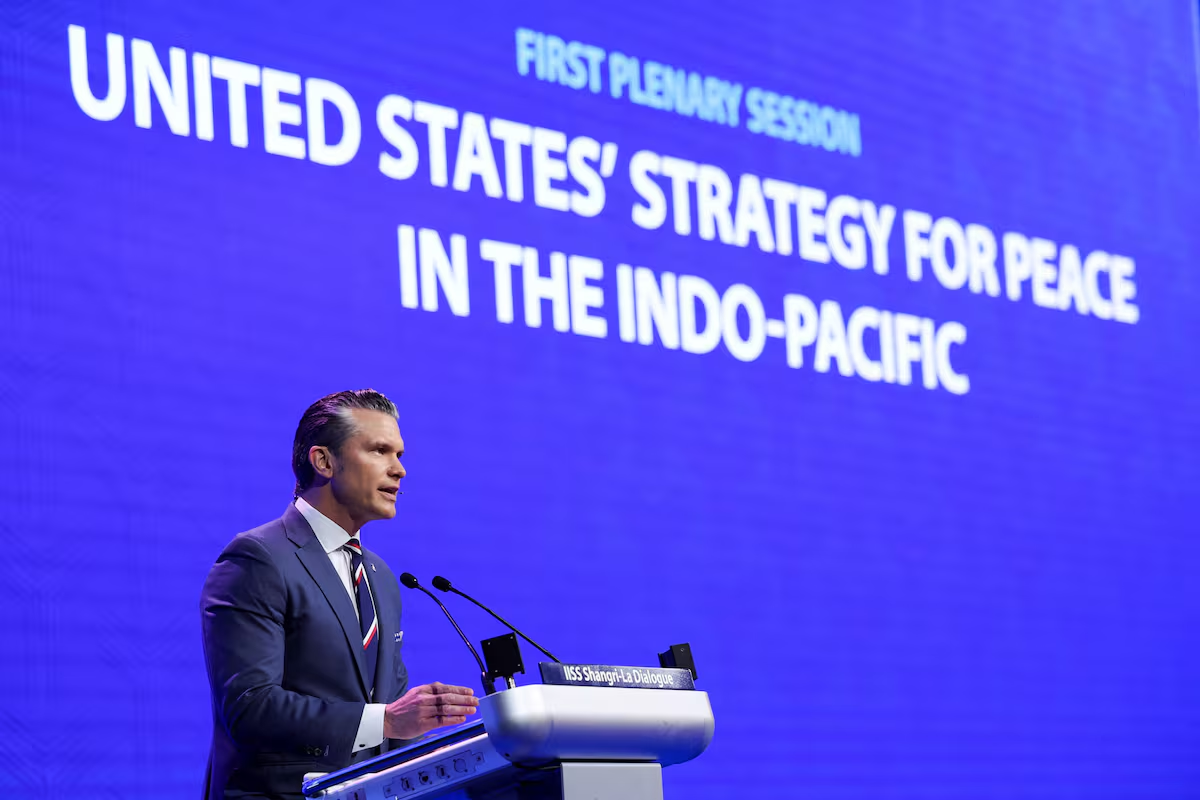
In a recent address at the Shangri-La Dialogue in Singapore, U.S. Defense Secretary Pete Hegseth urged Asian allies to boost military expenditures to counteract China’s rapid military growth. He expressed “rightful alarm” regarding China’s military buildup, warning that a Pacific dominated by a single hegemon would destabilize regional power dynamics.
Hegseth highlighted the importance of an allied network capable of deterring aggression and maintaining a balance of power. He emphasized that no nation, including China, should be permitted to jeopardize the security and prosperity of regional allies. The United States anticipates that its Asian partners will increase their defense budgets to 3.5% of GDP, aligning with the Pentagon’s own $1.5 trillion military investment.
“Less Shangri-La, more ships, more subs,” Hegseth remarked, underscoring the necessity for tangible military capabilities over diplomatic gatherings. His statement resonated with allies who seek stability rather than escalatory measures. He acknowledged that the strength offered by the U.S. is characterized by a disciplined approach and steady resolve.
On U.S.-China relations, Hegseth noted that military communication has improved, contributing to a more stable interaction between the two powers. However, a senior Chinese delegation member, Zhou Bo, described relations as “complicated,” although he recognized a better tone in discussions this year compared to the last.
Hegseth reiterated President Trump’s call for allied nations to contribute more significantly to their defense, stating that the era of the U.S. subsidizing the defense of wealthy nations is coming to an end. “We need partners, not protectorates. There’s no strong alliance unless everyone has skin in the game,” he asserted, praising allies such as South Korea, Australia, and Japan for their growing defense commitments.
Turning to Middle East conflicts, Hegseth indicated that the U.S. is prepared to resume military strikes against Iran if diplomatic efforts falter. He assured that the military remains capable and that Trump seeks a comprehensive deal to prevent Iran from acquiring nuclear weapons.
While addressing concerns regarding the ongoing conflict’s impact on Asia-Pacific priorities, Hegseth stated that the U.S. could manage both fronts concurrently. He also fielded questions about arms sales to Taiwan, emphasizing that decisions would ultimately rest with President Trump. Hegseth reassured that current military stockpiles are robust despite potential impacts from international tensions.
In summary, Hegseth’s address highlights the U.S. commitment to fortifying alliances in Asia while managing complex relations with China and the Middle East. The call for increased defense spending reflects a strategic shift towards a more self-reliant regional security arrangement, with an unwavering focus on U.S. military readiness.
The content above is a summary. For more details, see the source article.









