


Key Takeaways
- Raytheon has secured a contract to provide SeaRAM systems and support for Australia’s new Sea3000 frigates, with deliveries starting in late 2028.
- The program is set to replace the aging Anzac-class frigates with 11 upgraded Mogami-class frigates.
- SeaRAM enhances naval defenses against emerging threats, including advanced missiles and drones, significantly extending engagement ranges.
Contract Details
Raytheon has announced a new contract with Mitsubishi Heavy Industries to supply SeaRAM ship self-defense systems for Australia’s Sea3000 General Purpose Frigate program. This contract includes providing SeaRAM launchers, Blast Test Vehicles, and the necessary technical services to support the installation and testing for the first three ships being built in Japan. Deliveries are expected to commence in late 2028, and the work will be executed at Raytheon’s facility in Louisville, Kentucky.
The Sea3000 program is a strategic move to replace the Royal Australian Navy’s aging Anzac-class frigates with eleven upgraded Mogami-class frigates. This acquisition is regarded as one of the most significant naval procurements in Australia in decades.
SeaRAM System Overview
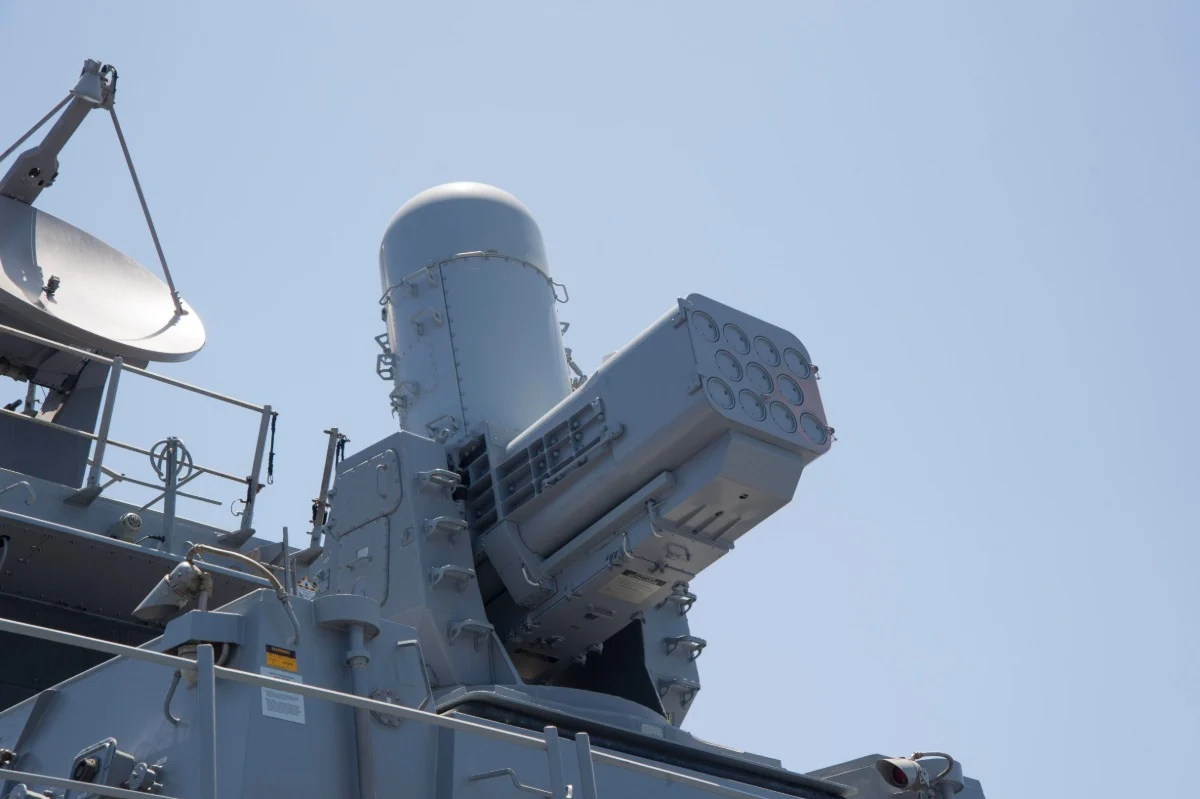
The SeaRAM system integrates two established naval defense technologies into a cohesive terminal defense solution. At its foundation is the Phalanx Close-In Weapon System, a radar-guided Gatling gun designed for close-range defense against incoming threats since the 1980s. The SeaRAM system enhances this by replacing the Phalanx gun mount with an eleven-round Rolling Airframe Missile (RAM) launcher, maintaining the existing Phalanx sensor suite for tracking and engagement.
The key advantage of SeaRAM is its ability to engage threats at a significantly greater range—approximately nine kilometers compared to the two-kilometer range of the Phalanx gun—while preserving the autonomous engagement features essential for immediate threat responses.
Strategic Defense Enhancement
Barbara Borganovi, president of Naval Power at Raytheon, emphasized the significance of SeaRAM in addressing emerging naval threats. “SeaRAM extends the defensive reach of a ship beyond traditional close in weapon system ranges,” she stated. By integrating SeaRAM into Australia’s new frigates, the navy will enhance its air and missile defense layers, crucial for countering the rising capabilities of adversarial anti-ship cruise missiles and drone technologies.
The Rolling Airframe Missile is a compact weapon designed with dual-mode guidance, allowing it to engage threats without requiring the launching ship to use its radar, thereby reducing electromagnetic emissions during combat. The small size and compact design of SeaRAM make it suitable for different types of vessels, particularly those with limited deck space.
Australia’s Sea3000 program represents a vital response to an increasingly contested strategic environment in the Indo-Pacific, characterized by the expansion of Chinese naval power, missile development from North Korea, and the proliferation of advanced anti-ship technologies. Equipping the new Mogami-class frigates with SeaRAM provides an essential layer of defense against various modern threats, enhancing Australia’s naval capabilities substantially.
The content above is a summary. For more details, see the source article.









