


Key Takeaways
- Researchers at Chemnitz University of Technology are developing organic solar cells made via printing processes.
- Transport resistance, caused by disordered organic materials, limits the efficiency of these solar cells.
- Recent findings shed light on improving organic solar cell performance without major obstacles in production.
Innovations in Organic Solar Cells
At Chemnitz University of Technology, a research team led by Prof. Dr. Carsten Deibel is exploring the production of organic solar cells that utilize novel semiconductors and established printing techniques. These organic solar cells offer the advantage of cost-effective manufacturing; however, they face significant challenges in current flow efficiency compared to traditional crystalline silicon solar modules.
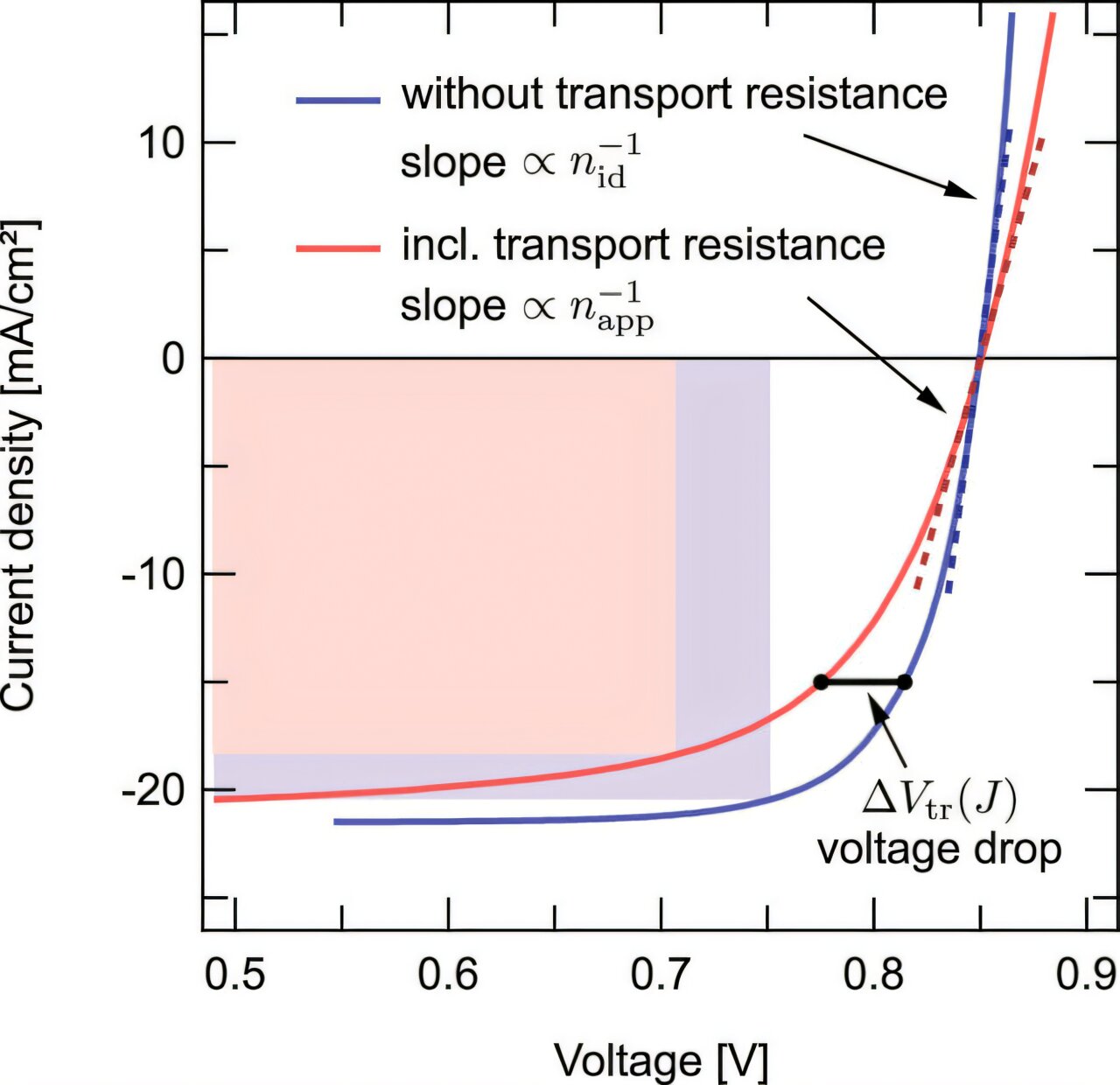
The primary challenge stems from transport resistance, which significantly hinders the flow of electricity within these organic solar cells. Because their light-absorbing layers are created from a type of ink, the resulting material structure is disordered. This disorganization slows down the movement of charge carriers, such as electrons and holes, resulting in reduced power output.
To investigate this issue, Deibel and his research associate Maria Saladina conducted extensive studies on various organic solar cell designs. They measured current-voltage characteristics under illumination, revealing how the interaction between charge generation, recombination, and transport affects the solar cells’ power efficiency.
Their research also included a comparison with the suns-Voc method, an approach that provides an alternative current-voltage profile that is uninfluenced by transport resistance. According to Saladina, “Transport resistance arises from the sluggish charge carriers in disordered solar cells, leading to reduced fill factors and power output.”
These significant findings were recently published in Reports on Progress in Physics, highlighting the potential for organic solar cells’ optimization despite transport resistance challenges. Furthermore, insights were provided in a perspective article published in Advanced Energy Materials, authored by Deibel, Saladina, and colleagues from several German universities. This piece explains in detail the physical origins and implications of transport resistance within solar cells.
“The ongoing improvements in charge transport had previously progressed without a clear understanding of the connection between fill factor losses and transport resistance,” remarked Deibel. Saladina added that factors like the density of states’ structure in organic solar cells also contribute to transport resistance, indicating growing clarity on the fundamental aspects of these innovative photovoltaic devices.
This research is part of the DFG Research Unit POPULAR, which is dedicated to advancing the understanding and performance of printed organic solar cells. The findings point to a promising future for organic solar technology, suggesting that with increased comprehension and refinement, efficient solar cells can be produced using printing methods without encountering significant production barriers.
The content above is a summary. For more details, see the source article.









