

Key Takeaways
- Yokohama National University researchers developed a new untethered levitation device enabling frictionless, omnidirectional movement.
- The device operates at speeds exceeding three meters per second and can carry loads up to 150 grams while maintaining levitation.
- Future developments aim to enhance stability and efficiency for applications in machine assembly and biomedical transport.
Advancements in Frictionless Movement Technology
Recent advancements in technology have necessitated innovative solutions for transporting small mechanical and electronic components. Traditional conveyor systems face limitations due to friction, slowing movement and reducing precision, especially for miniaturized products. To address this, researchers at Yokohama National University have created an untethered levitation device capable of frictionless, high-speed movement in multiple directions.
The study, published in Advanced Intelligent Systems, reports that the device achieved speeds exceeding three meters per second on inclined surfaces. When tested at a 10-degree incline, the device operated effectively under levitation. Without levitation, however, it was unable to overcome gravity, demonstrating the necessity of the levitation mechanism.
Further testing confirmed the device’s functionality while carrying weights. It maintained its levitation and movement with a total load of up to 150 grams, showing promise for practical applications where weight is a consideration. However, it failed to levitate with any weight exceeding this limit.
While alternative levitation methods such as diamagnetic and pneumatic levitation were considered, these options posed challenges including reliance on external magnets or pressurized gas systems. The researchers opted for acoustic levitation, which employs sound waves to lift objects. A significant hurdle with acoustic levitation is the need for cables, which can disrupt positioning.
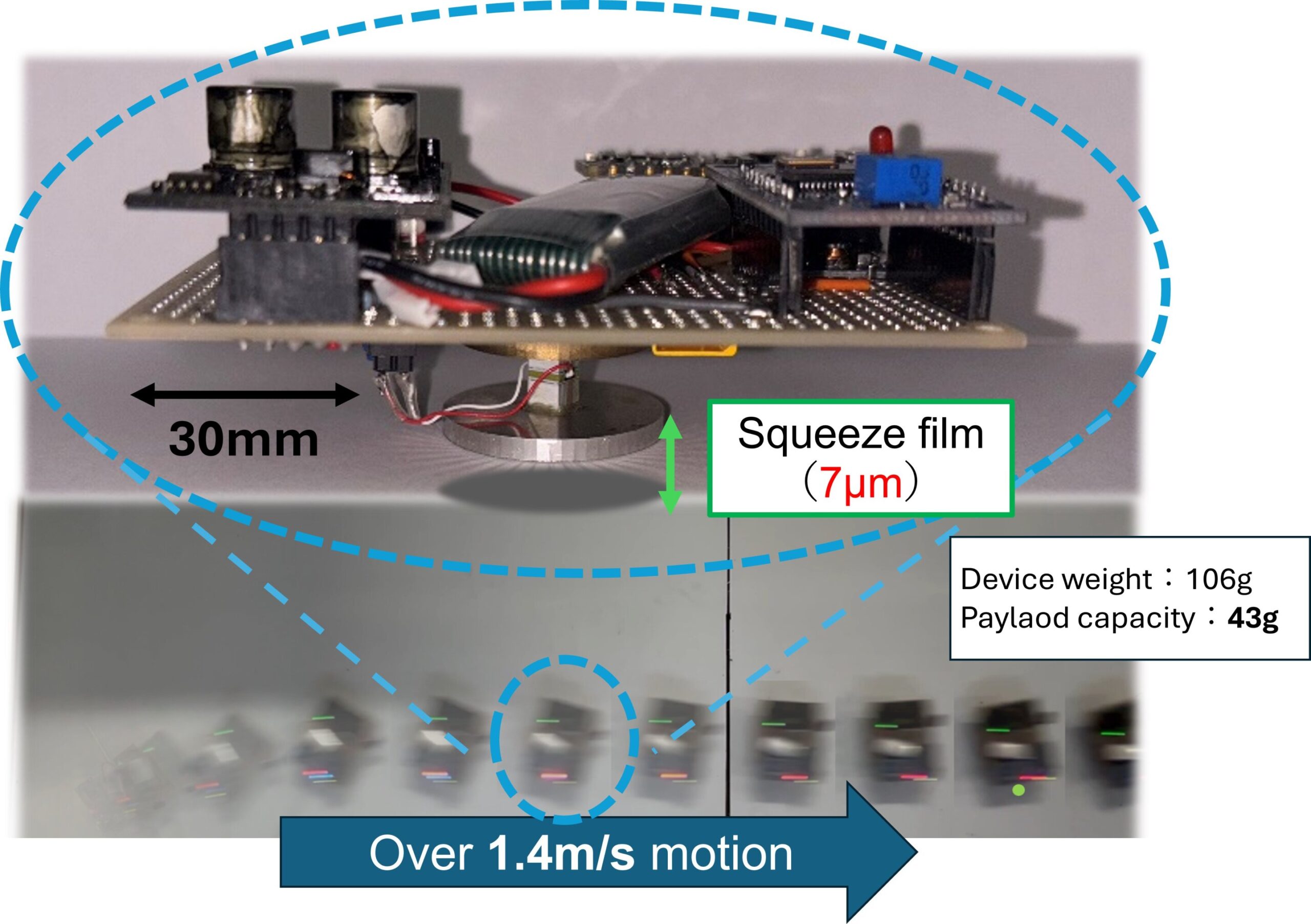
To mitigate this issue, the team developed a wireless drive circuit, allowing for stable levitation height and fast, flexible transport without cables. Ohmi Fuchiwaki, the study’s author and an associate professor at Yokohama National University, emphasized the innovation, stating, “While acoustic levitation removes floor friction, conventional systems rely on cables that disturb positioning. We solved this by developing an untethered levitation device.”
Additionally, the researchers incorporated a piezoelectric actuator to generate a squeeze film, which facilitates the device’s omnidirectional movement. This engineering breakthrough paves the way for frictionless transport free from tethers or traditional constraints.
Looking forward, the team aims to improve the device’s levitation efficiency and stability, particularly under varying loads and on irregular surfaces. Ambitious future goals include developing a robotic system using multiple levitation devices along with robust propulsion mechanisms. Such advancements could revolutionize the contactless transport of machine components, biomedical cells, and other small items critical in various industries.
In conclusion, this untethered levitation device represents a significant leap in transport technology, offering a frictionless solution that holds promise for numerous practical applications. Researchers continue to explore enhancements to maximize the device’s potential impact on future technological advancements.
The content above is a summary. For more details, see the source article.