


Key Takeaways
- An innovative framework called BIOT-EMW integrates blockchain and IoT for efficient electro-medical waste management in healthcare.
- The system achieves low latency and high scalability, allowing real-time tracking of waste from generation to disposal.
- It uses a private blockchain for logging data, optimizing cost and regulatory compliance in healthcare environments.
Overview of BIOT-EMW Framework
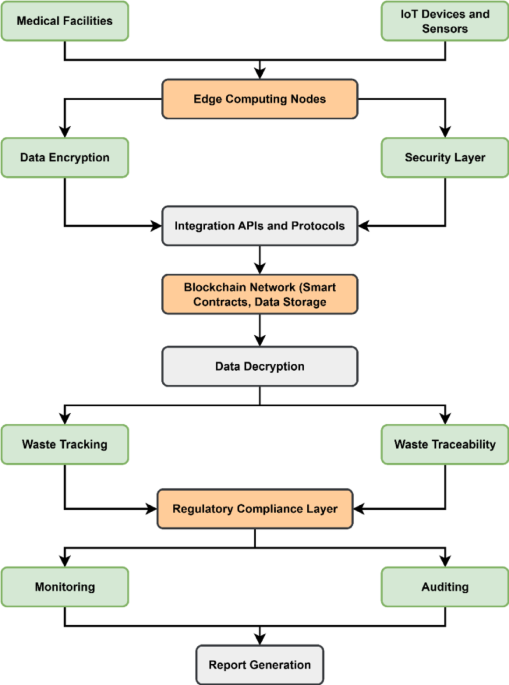
The BIOT-EMW framework leverages blockchain technology and IoT to enhance electro-medical waste (EMW) management efficiency within healthcare environments. This smart management system improves scalability and energy utilization, making it possible to monitor various types of waste in real-time.
The framework was tested using a controlled setting that simulates actual EMW management scenarios. It combines IoT sensors, edge computing, and blockchain logging, employing low-power devices as smart bins to capture environmental parameters like fill levels and temperatures. This approach minimizes communication overhead and ensures timely responses in hospital settings.
Measurements of latency, bandwidth, and power consumption were taken during these experiments, which indicated that the BIOT-EMW system performs well under realistic conditions. Latency was measured from event detection to edge-side processing, while bandwidth was calculated based on data transmitted per waste event.
In practical terms, this system facilitates the classification and tracking of hazardous materials. When an item is discarded, sensors categorize the waste type and log all relevant data on a blockchain ledger. This process triggers notifications for pickup requests, ensuring compliance with management protocols.
Performance Evaluation
The effectiveness of the BIOT-EMW framework was assessed through various performance metrics, including latency, resource utilization, and scalability. Generally, the system demonstrated low latency (ranging from 3.45 to 9.33 ms), indicating its ability for real-time operations across different waste types, including scrap, infectious, pharmaceutical, and chemical waste.
Comparative analysis against existing frameworks shows that BIOT-EMW outperforms others in latency and bandwidth, making it a suitable option for energy-constrained environments. This assessment is critical for ensuring operational safety and compliance with healthcare regulations, as misclassification risks are handled conservatively.
Deployment and Cost Efficiency
The framework supports a modular and progressive deployment, which is essential for healthcare organizations facing budget constraints. It utilizes a private blockchain network to minimize transaction costs and improve governance while maintaining compliance and auditability.
Overall, the BIOT-EMW system balances performance, cost, and regulatory requirements effectively. By employing hybrid storage solutions—recording only essential data on-chain—resource consumption, and operating expenses are optimized, which is crucial for sustainable waste management practices in the healthcare sector.
The content above is a summary. For more details, see the source article.









