


Key Takeaways
- The integration of drone technology with whale optimization and deep reinforcement learning enhances object detection while ensuring privacy in smart cities.
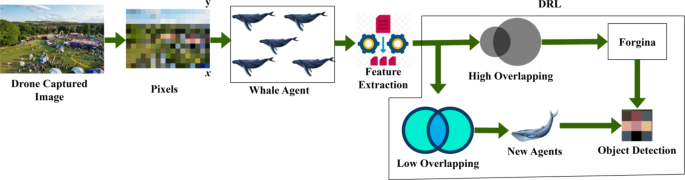
- High-resolution drone images are processed through advanced algorithms for efficient extraction and classification of pixel-based features, improving real-time decision-making.
- Performance assessments indicate that optimized models reduce false positives and improve detection accuracy, vital for applications in urban surveillance.
The article discusses advancements in privacy preservation and object detection in smart cities via drone technology. By utilizing computer vision techniques, drones capture high-resolution images that are processed to detect abnormal behavior and track objects. Two main processes are emphasized: whale optimization and deep reinforcement learning (DRL).
Whale optimization enhances accuracy in identifying features in the high-resolution images captured. It employs pixel-based feature extraction, analyzing overlapping pixels to improve the detection of objects. The algorithm ensures that both high and low overlapping pixels are considered, leading to effective privacy preservation. The technique examines pixel distributions from the drone’s imagery, optimizing the drone’s movements to identify features efficiently.
The integration of deep reinforcement learning further strengthens the detection process by allowing the system to learn from its interactions. This adaptability comes from training on various image datasets, where it adjusts hyperparameters like learning rates and decision-making processes to refine its object identification capabilities. As a result, the overall object detection process becomes more dynamic and responsive, improving efficiency and accuracy.
Performance evaluations demonstrate significant improvements, notably in average precision rates and the reduction of false positives, which is critical in real-time scenarios such as urban surveillance. By carefully calibrating the system using deep learning techniques and continual updates based on feedback from the environment, the technology can maintain operational effectiveness even in challenging conditions, such as varying light and motion blur.
Additionally, practical deployment considerations are discussed, emphasizing the importance of lightweight algorithms suited for edge devices to ensure low-latency processing. This reduces the processing load on drones while enhancing their operational capabilities in real-world settings. The insights presented indicate a promising future for drone-assisted technologies in smart cities, focusing on both object detection and privacy preservation through improved computational efficiency and analytical precision.
The findings provide a solid foundation for further research and application of drones in maintaining security and privacy in urban environments, showcasing the synergy between advanced algorithms and real-time data processing capabilities.
The content above is a summary. For more details, see the source article.









