Key Takeaways
- The European Space Agency has launched a new facility for testing CubeSats, simulating space conditions.
- The facility uses an air bearing system to create microgravity, allowing for accurate testing of satellite systems.
- CubeSat projects will soon utilize this facility to validate their attitude control systems prior to flight.
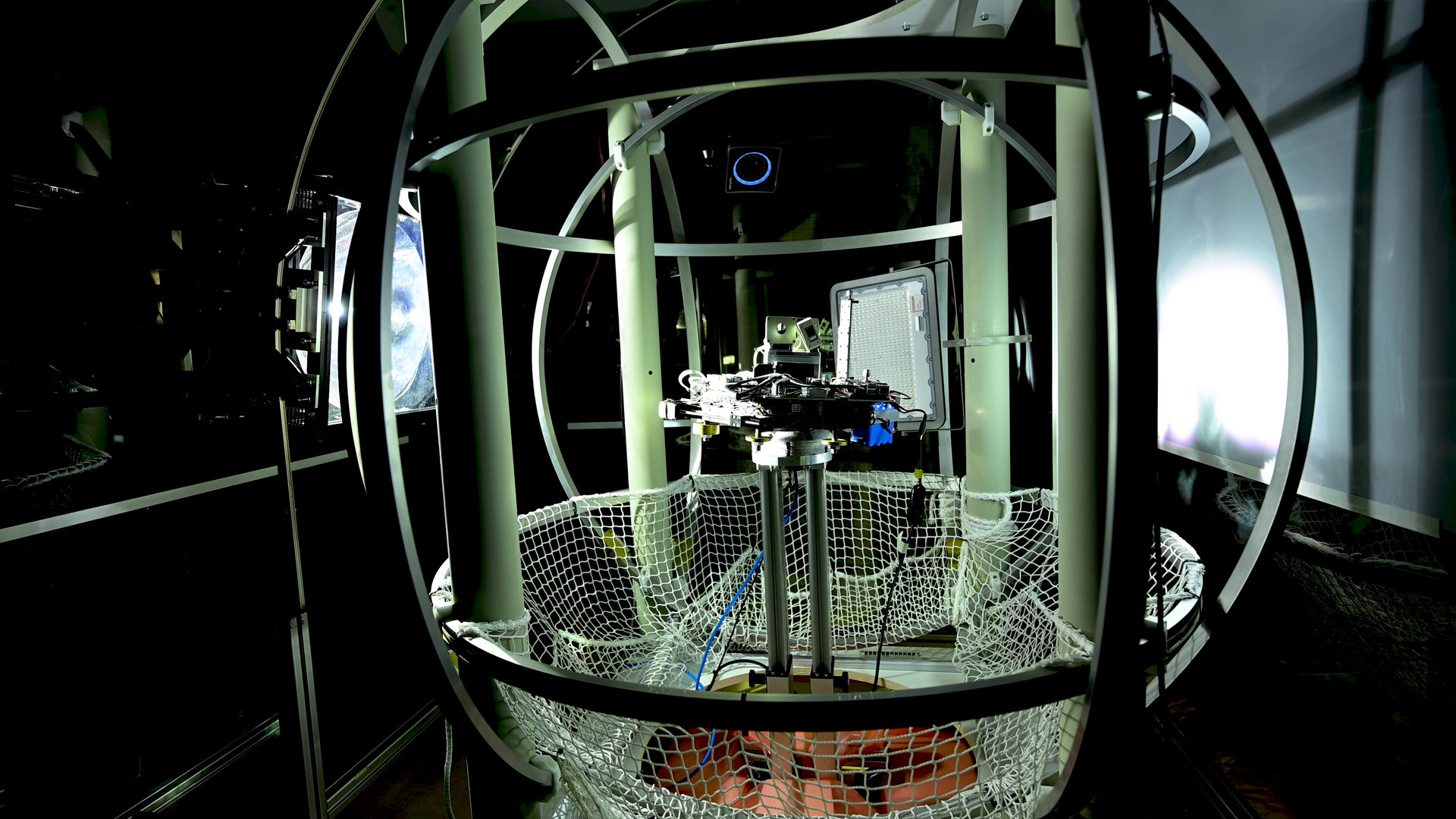
Inside a unique spherical structure, a platform gently spins as if floating in space, illuminated by a bright lamp that simulates the Sun. This is part of the European Space Agency’s (ESA) new facility designed for testing CubeSats—small satellites typically no larger than a shoebox and weighing only a few kilograms. Constructed by the University of Bologna in partnership with Nautilus – Navigation in Space, this facility is situated within the Attitude and Control System (AOCS) & Pointing Systems laboratory at ESTEC, ESA’s technical center.
Before any piece of machinery is sent to space, it must undergo extensive testing on Earth to ensure it can withstand the conditions it will encounter. Andrew Hyslop, an AOCS engineer at ESA, detailed how the facility can test attitude control systems both separately and integrated within a complete CubeSat. These systems are vital as they dictate the satellite’s orientation while in space, comprising sensors, software, and actuators.
The facility employs an air bearing system that blows a continuous stream of air upwards, creating an air gap that allows the platform to float. The CubeSat or its attitude control system is then mounted on this levitating platform.
To determine its orientation, the system utilizes Sun sensors, a magnetometer, and a gyroscope. To mimic sunlight conditions, a lamp simulating the Sun is included in the setup. Hyslop explains that Sun sensors can misinterpret reflected sunlight from Earth as direct sunlight, which is why the facility also incorporates an albedo lamp to counteract this effect.
Metal coils lining the interior of the cage simulate Earth’s magnetic field, which changes as the spacecraft orbits the planet. Hyslop notes that this replication is crucial for testing since the actual magnetic environment fluctuates in space.
To commence a test, the CubeSat system is placed on the air-bearing platform, which can be given a gentle push to initiate movement. The attitude control system is then activated to correct any deviations from the correct orientation.
Much like other attitude control systems used in satellites stationed in low Earth orbit, reaction wheels are employed here. When these wheels spin, the spacecraft rotates in the opposite direction due to the principle of conservation of angular momentum. This mechanism is essential for maintaining the desired orientation in space.
Additionally, the platform has small reflective markers tracked by two overhead cameras, ensuring precise measurement of the platform’s true orientation. This information is crucial as it allows the team to compare actual orientation data with the platform’s internal measurements, thereby validating their accuracy.
The lab team has recently completed the setup, getting it ready for its inaugural clients. ESA CubeSat projects will soon benefit from this facility, gaining essential confidence in their attitude control systems before embarking on their flights.
The content above is a summary. For more details, see the source article.