


Key Takeaways
- Skild AI’s S1 robot leverages NVIDIA infrastructure to perform tasks through video demonstrations, bypassing traditional retraining.
- The S1 model significantly enhances operational efficiency, allowing robots to learn unprogrammed skills in real-time.
- Skild AI achieved a $100 million annual revenue run rate shortly after its launch, with partnerships across various industries.
Innovative Learning in Robotics
Skild AI has unveiled the S1 robot foundation model, which utilizes NVIDIA infrastructure to train robotics systems via single video demonstrations. This model allows robots to perform long-horizon tasks they have never encountered before, employing in-context learning techniques that negate the need for parameter weight updates or task-specific post-training.
Deepak Pathak, Skild AI’s cofounder and CEO, emphasized the transformative nature of this technology, stating, “Learning by experience, and not preprogramming, is the step change that has happened in robotics.” The integration of NVIDIA technologies, such as Isaac Lab and NVIDIA Cosmos, enables Skild AI to create diverse learning experiences, facilitating the robot’s adaptability across various contexts and tasks.
The S1 model offers a significant advancement over traditional industrial methods, which often require new datasets, retraining, and validation as product specifications or factory layouts evolve. Instead, the S1 system can interpret an operator’s video feed, understanding intent, object identification, and task execution order. This approach allows for seamless translation from video prompts to tangible robot actions, eliminating the need for extensive retraining.
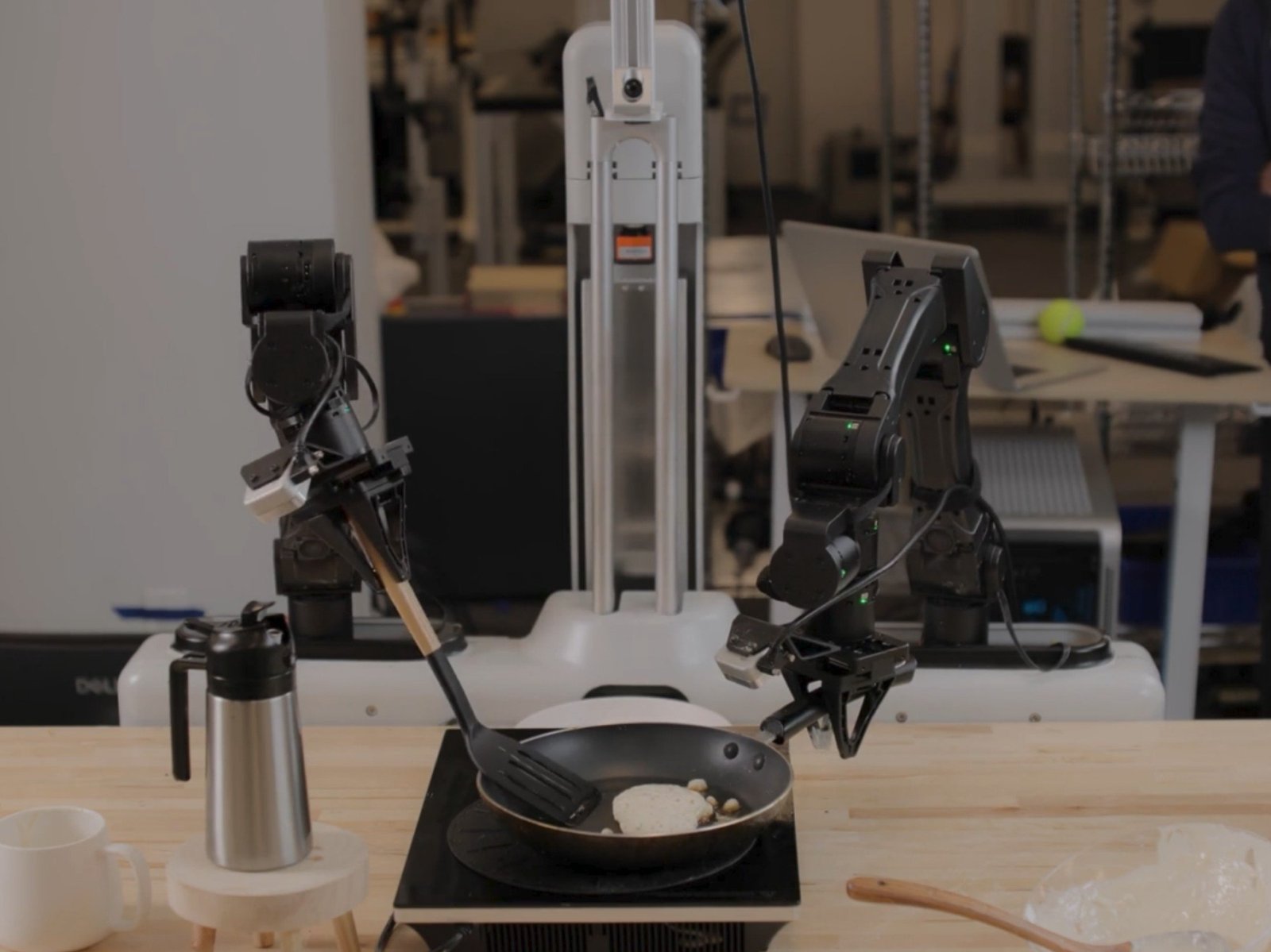
The S1 robot is capable of handling unfamiliar tasks lasting up to 10 minutes—activities like brewing pour-over coffee, making pancakes, assembling kits, and potting plants—each involving multiple intricate manipulation steps. In a recent trial for plant potting, the robot successfully transferred an operator’s video recording into action in just 11 minutes. On multistep tasks, the S1 achieved an impressive average success rate of approximately 66 percent, in stark contrast to the nine percent success rate observed with baseline systems. This efficiency means a single video demonstration can replace roughly 380 manual training examples, reducing human effort from 50-100 hours per task.
Skild AI is partnering with industry leaders, including Foxconn and NVIDIA, to implement the Skild Brain on dual-arm robots for assembly operations on NVIDIA’s Blackwell production lines. This collaboration involves a complex assembly sequence where the robot installs components like busbars and limit blocks, managing multiple screws and adapting to any physical disturbances found in the work environment.
NVIDIA’s accelerated computing capabilities enhance the S1’s training using a combination of teleoperation, human video feeds, physical simulations, and deployed data. Additionally, Skild utilizes NVIDIA Cosmos to convert video inputs into structured training data, while Cosmos Curator assists in data annotation and filtering. Synthetic data from NVIDIA’s Omniverse and Isaac Sim is employed to ensure comprehensive testing and scenario modeling.
Reinforcement learning from Isaac Lab, supported by the Newton physics engine, optimizes the robot’s physical interactions, ensuring accuracy in calculations concerning contact, forces, and collision detection. Ongoing developments include GPU-accelerated simulation solvers to further refine physical contact handling, gripping approaches, and solid-object manipulation, with plans for public release aimed at empowering external developers.
For insights into physical AI advancements, attendees can join the Physical AI Expo in Amsterdam, London, and North America. Additionally, the IoT Tech Expo is set to take place, featuring industry leaders discussing the future of IoT and its integration with other technology sectors.
The content above is a summary. For more details, see the source article.









