


Key Takeaways
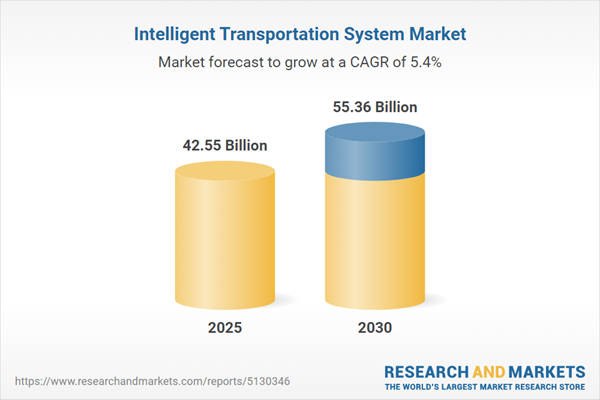
- The Intelligent Transportation System (ITS) market is projected to grow from USD 42.55 billion in 2025 to USD 55.36 billion by 2030, at a CAGR of 5.4%.
- Key growth drivers include urban traffic congestion, rising vehicle ownership, and government initiatives for smart cities.
- North America is expected to see significant growth, driven by investments in smart mobility and advanced transportation technologies.
Market Growth Overview
The global Intelligent Transportation System (ITS) market is poised for significant expansion, with a projected value increase from USD 42.55 billion in 2025 to USD 55.36 billion by 2030, reflecting a compound annual growth rate (CAGR) of 5.4%. The growth is largely fueled by urban traffic congestion, a rise in vehicle ownership, and an increasing demand for smart mobility solutions.
Government initiatives aimed at developing smart cities and enhancing public transport infrastructure are also accelerating the deployment of ITS technologies. These systems contribute to improved road safety, reduced travel time, optimized traffic flows, and minimized environmental impact. Various applications, including advanced traffic management systems and smart parking solutions, are being increasingly adopted across roadways and public transit networks.
Key Market Segments
The ITS market is primarily driven by established global players, including Siemens, Hitachi, and Cubic Corporation. The railway segment is anticipated to hold the second-largest market share, propelled by infrastructure modernization, investments in high-speed rail projects, and a demand for improved safety and operational efficiency. Advanced ITS technologies such as automated signaling and real-time monitoring are becoming critical for enhancing railway operations.
In terms of application, the ticketing segment is expected to experience rapid growth, driven by the rising demand for contactless and digital payment systems. Automated fare collection (AFC) systems are becoming essential for efficient fare processing and improving commuter convenience while reducing operational costs.
Regional Insights
North America is projected to register the second-highest CAGR during the forecast period, supported by advanced transportation infrastructure and growing investments in smart mobility. The presence of a well-established transport network allows for the effective integration of advanced ITS solutions. Additionally, government initiatives promoting eco-friendly transport, such as congestion pricing and electric vehicle integration, are further driving ITS adoption in the region. These factors position North America as a key player in the global ITS market.
The content above is a summary. For more details, see the source article.









