


Key Takeaways
- Despite significant U.S. military success against Iranian forces, the Strait of Hormuz remains effectively closed due to Iran’s drone and missile capabilities.
- Iran’s strategy involves air denial, leveraging low-cost systems to contest air control and disrupt shipping traffic while imposing economic costs on the U.S.
- The U.S. military faces challenges in countering this tactic, necessitating a shift towards building more affordable, mobile defense systems to secure vital waterways.
Iran’s Strategic Impact on the Hormuz Strait
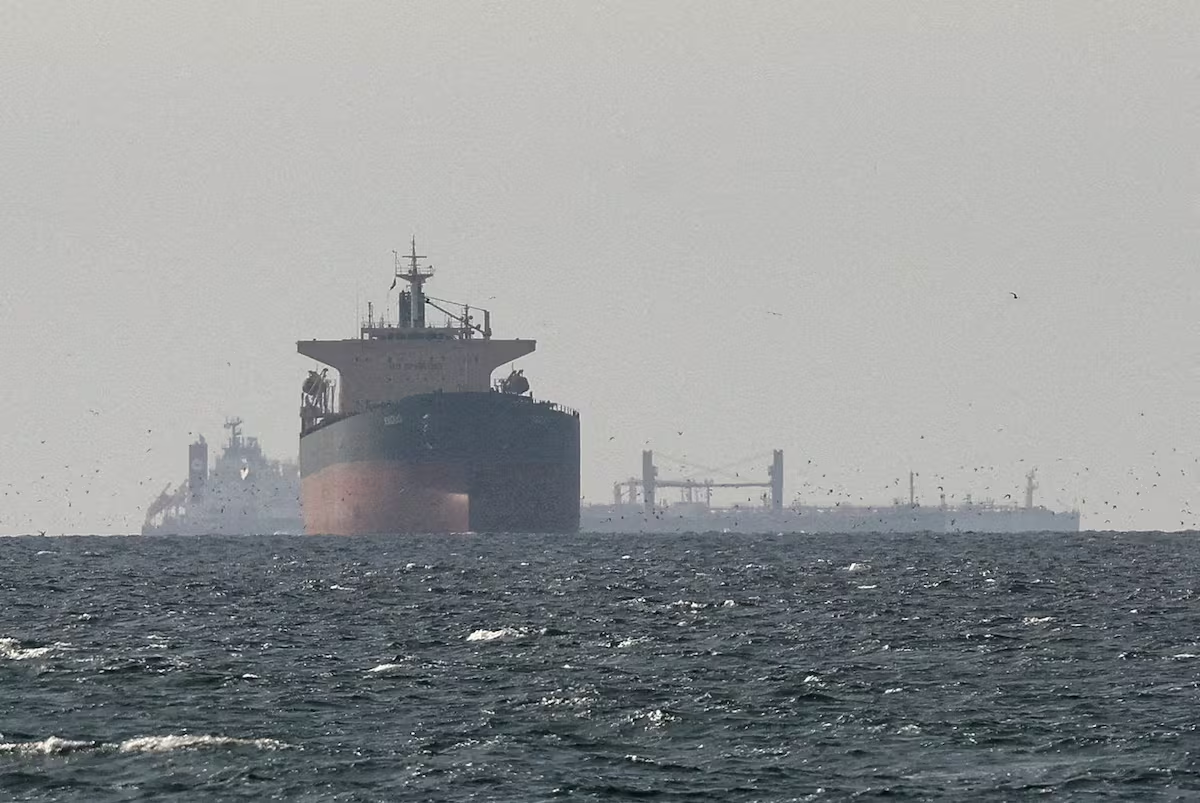
Iran’s Foreign Minister Abbas Aragchi recently emphasized the significance of the Hormuz Strait, particularly in the context of the ongoing conflict. Although the United States has targeted over 10,000 Iranian sites and diminished Iran’s air defenses and naval capabilities, the Strait of Hormuz remains effectively closed. Iran has successfully maintained its hold over this critical maritime chokepoint through its use of drones and missiles.
Tehran’s approach seeks to impose continuous economic and political strains on the U.S., attempting to sway Washington’s resolve in the conflict. The crux of Iran’s strategy lies in exploiting a gap in U.S. military doctrine concerning air superiority and air denial. While the U.S. has achieved air superiority over parts of Iran, it struggles to extend this control where it’s most critical—over the Strait of Hormuz.
Air superiority allows forces to operate freely, but Iran’s drone and missile tactics create an environment where American operations are hindered. The U.S. may control the skies at higher altitudes, but the threat of Iranian drones and missiles at lower altitudes prevents safe navigation through the strait. This has necessitated a strategic shift in U.S. military operations, with aircraft now operating from farther away, rather than pressing threats from closer bases.
Iran’s strategy revolves around air denial, which allows it to contest airspace effectively without achieving full air superiority. This tactic capitalizes on the deployment of low-cost, mobile systems to create a dangerous operational environment for U.S. forces. Iran’s recent actions in the Strait of Hormuz, including attacks on commercial vessels that have resulted in fatalities, highlight the effectiveness of this denial approach. Iranian forces have targeted over 20 vessels in the area since the conflict escalated, stymying regular shipping traffic except for vessels willing to pay for safe passage.
The implications of these actions extend beyond immediate military outcomes; rising gas prices and stock market fluctuations indicate broader economic impacts that could pressure Washington to reconsider its stance in the conflict. This approach is reminiscent of Iran’s recent tactics employed by Houthi proxies in the Red Sea, which similarly exploited drones and missiles to impose costs on U.S. forces despite extensive airstrikes.
The current U.S. military strategy lacks a robust counter to Iran’s air denial tactics. Successfully achieving air superiority above the Strait of Hormuz necessitates a reevaluation of defense capabilities. This includes developing many low-cost systems to continuously challenge Iranian aerial threats while enhancing mobile air defenses that can be deployed near critical waterways. However, decades of military procurement choices have focused on fewer, high-cost platforms, leaving a vulnerability in the necessary layered defense capabilities.
In order to address these deficiencies effectively, the U.S. must shift its focus towards creating affordable and flexible systems. This transformation cannot be relegated to an afterthought but must be integrated as a central mission, potentially at the expense of current legacy systems. The urgency for adaptation increases as the implications of Iran’s strategy become ever more evident, reflected in both geopolitical tensions and rising economic costs.
The content above is a summary. For more details, see the source article.









