


Key Takeaways
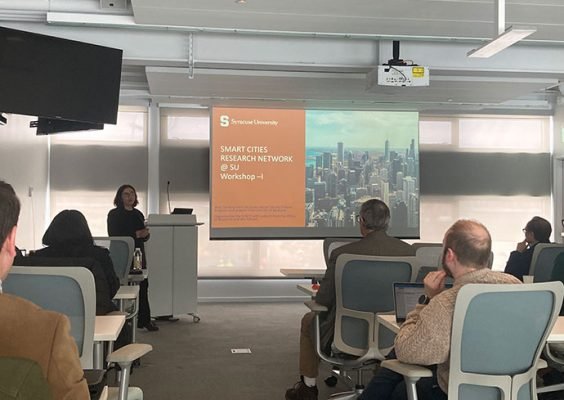
- The Syracuse Center of Excellence hosted the first Smart Cities Research @ SU workshop on February 14, led by Professor Sevgi Erdogan, a 2024 Faculty Fellow recipient.
- The workshop aimed to unite faculty, government agencies, and community partners to create a framework for smart cities research, emphasizing the role of technology in sustainable community development.
- Future workshops will include broader community engagement to enhance collaborative efforts in smart city innovation.
Workshop Overview
On February 14, the Syracuse Center of Excellence in Environmental and Energy Systems (SyracuseCoE) hosted its inaugural Smart Cities Research @ SU workshop, led by Sevgi Erdogan, an associate professor at the School of Information Studies (iSchool) and a recipient of the 2024 Faculty Fellow award. This initiative is part of SyracuseCoE’s broader commitment, having allocated nearly $200,000 in Faculty Fellow funding for 11 research projects over the past year.
Erdogan directs the Smart Cities and Civic Technologies (SC&CT) Research Center, which is dedicated to exploring the interactions between human, physical, and natural systems using information science and digital technologies. The aim is to influence public policy and promote sustainability and resilience across various urban dimensions.
Erdogan’s project, “Smart Cities Research Network Development for Sustainable and Resilient Communities,” is designed to unite academic faculty, government agencies, and local partners to create a structured approach for smart city research. Smart cities utilize technologies such as sensor networks, IoT, and big data analytics to enhance city services and improve residents’ quality of life, addressing issues like mobility, energy efficiency, and waste management.
The February workshop was the first of two organized under the Faculty Fellow award, engaging a multidisciplinary group of faculty from various schools within Syracuse University, including engineering, architecture, and public policy. Representatives from the City of Syracuse’s government also participated, providing insights into local research needs.
Following the opening remarks by Erdogan, iSchool Associate Dean Carsten Østerlund, and SyracuseCoE Executive Director Jianshun “Jensen” Zhang, municipal representatives shared ongoing initiatives. Faculty members presented brief talks to showcase their current research, and a working session was held to identify collaborative themes.
Erdogan highlighted the workshop’s importance in laying a collaborative foundation for smart city research at Syracuse University. She emphasized the initiative’s core goal: leveraging technology for social good and sustainable community development.
Looking forward, the next workshop aims to involve community organizations and industry partners. This collaborative effort is intended to establish a research network that understands and meets community needs.
SyracuseCoE is committed to supporting these workshops and ongoing collaborations, including a multi-scale monitoring system for air quality and energy flows across Syracuse, which will facilitate research opportunities in smart city technology. Faculty interested in participating in the second workshop can contact Professor Sevgi Erdogan via email.
The content above is a summary. For more details, see the source article.









